
Graphisurus
Kirby, 1837
Species Guides
3- Graphisurus despectus(Salt-and-pepper Long-horned Beetle)
- Graphisurus fasciatus(Banded Graphisurus)
- Graphisurus triangulifer
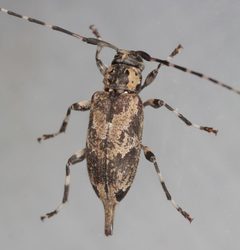
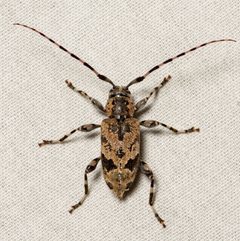
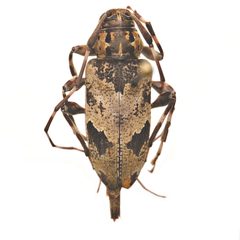
Graphisurus is a of longhorned beetles (Cerambycidae) containing five North American . Members are medium-sized beetles with distinctive elytral patterning. The genus exhibits notable plant fidelity, with individual species specializing on particular tree genera: G. triangulifer primarily on Celtis (hackberry), G. despectus on Carya (hickory), and G. fasciatus on Quercus (oak). are typically and attracted to lights.
Pronunciation
How to pronounce Graphisurus: /ɡræˈfɪsʊrəs/
These audio files are automatically generated. While they are not always 100% accurate, they are a good starting point.
Identification
Graphisurus are recognized by their moderately robust bodies (12–17 mm length), long typical of Cerambycidae, and distinctive elytral markings. G. triangulifer is distinguished by dark triangular markings on the . G. fasciatus has transverse bands. G. despectus shows different patterning. Antennae are and extend beyond the body.
Images
Habitat
Deciduous forests and woodlands. frequently encountered at blacklight stations. Larval consists of dead or dying wood of trees, with G. triangulifer preferring larger diameter branches and trunk sections of Celtis, G. despectus in Carya, and G. fasciatus in Quercus.
Distribution
Eastern and central North America. G. triangulifer ranges from Long Island to central Georgia, west to Texas, and northward in the interior to Ohio, Indiana, Kansas, and Missouri. G. fasciatus is widespread and common across eastern North America. G. despectus occurs in eastern deciduous forests.
Seasonality
active primarily during summer months. G. triangulifer observed in Missouri during early July. Light-trapping records suggest peak adult activity coincides with warm summer nights.
Diet
Larvae bore into and consume wood of dead or dying trees. Specific host associations documented: Celtis laevigata and C. occidentalis for G. triangulifer, Carya spp. for G. despectus, Quercus spp. for G. fasciatus. feeding habits not documented.
Host Associations
- Celtis laevigata - larval primary for G. triangulifer
- Celtis occidentalis - larval confirmed for G. triangulifer
- Acer negundo - potential larval suspected but not confirmed for G. triangulifer
- Carya spp. - larval primary for G. despectus
- Quercus spp. - larval primary for G. fasciatus
Life Cycle
Complete with wood-boring larvae. Larvae tunnel in sapwood and heartwood of branches and trunks. Development likely spans one or more years depending on conditions. emerge through exit holes. Specific timing of larval stages and not documented.
Behavior
are and strongly attracted to ultraviolet light. Females likely oviposit in bark crevices of trees. Larvae bore into wood, creating galleries. One G. triangulifer adult observed dropping to ground from cut hackberry log, suggesting adults may remain near host material.
Ecological Role
Primary decomposers of dead wood in deciduous forests. Larval tunneling contributes to wood breakdown and nutrient cycling. Serve as for including Podoschistus vittifrons (Ichneumonidae) and aulacid wasps.
Similar Taxa
- TypocerusSimilar body form and elytral patterning in some ; distinguished by different antennal structure and pattern details
- NeoclytusSimilar size and banded ; distinguished by different pattern arrangement and associations
- Other Lamiinae generaMany share general longhorned beetle ; Graphisurus distinguished by specific pattern elements and fidelity patterns