
Neoclytus
J. Thomson, 1860
Species Guides
20- Neoclytus acuminatus(Red-headed Ash Borer)
- Neoclytus approximatus
- Neoclytus augusti
- Neoclytus balteatus
- Neoclytus caprea(Banded Ash Borer)
- Neoclytus conjunctus(Western Ash Borer)
- Neoclytus horridus
- Neoclytus interruptus
- Neoclytus irroratus
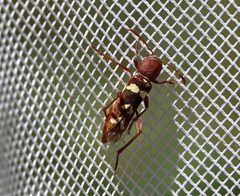
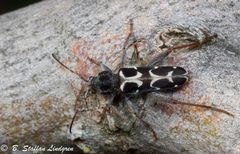
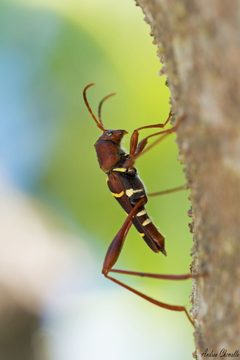
Neoclytus is a of longhorn beetles (Cerambycidae) comprising approximately 93 native to the New World. are small to medium-sized beetles (4-20 mm) with striking black-and-yellow or black-and-white banded patterns that provide -mimicry protection. The genus is notable for male-produced that attract both sexes. Larvae are wood-borers primarily of dead, dying, or stressed hardwood trees, with several species frequently encountered emerging from stored firewood.
Pronunciation
How to pronounce Neoclytus: /niːˈɒklɪtəs/
These audio files are automatically generated. While they are not always 100% accurate, they are a good starting point.
Identification
Distinguished from other Clytini by combination of: small size (4-20 mm), bold black-and-yellow or black-and-white banded color patterns, and rapid scurrying . Separated from similar -mimicking cerambycids (e.g., Clytus, Xylotrechus) by specific elytral pattern details and antennal proportions. -level identification requires examination of genitalia and detailed pattern analysis; several species pairs (e.g., N. scutellatus/N. mucronatus) are difficult to distinguish without close examination.
Images
Habitat
Primarily associated with deciduous woodlands, forests, and prairie-woodland edges. found on bark of dead, dying, or stressed hardwood trees; also attracted to recently cut logs and stumps. Larval is subcortical tissues and sapwood of trees. Some occur in xeric sand prairies, dolomite glades, and igneous prairie habitats where suitable host trees are present.
Distribution
New World distribution with approximately 93 . Center of diversity in North America, particularly in eastern and central United States. Several species have expanded ranges due to anthropogenic movement of wood products; N. acuminatus now established in Europe including Romania and other western Palearctic regions.
Seasonality
activity varies by and latitude. N. acuminatus: February-November in southeastern U.S., May-August in northeastern U.S.; up to three annually in south, one in north. N. caprea: March-June, earlier in southern latitudes. Firewood-stored may emerge indoors during winter months when heated.
Diet
feed on leaves, flowers, pollen, fruit, and nectar. Larvae are , tunneling beneath bark and into sapwood of trees.
Host Associations
- Fraxinus spp. - larval ash, primary for N. caprea
- Carya spp. - larval hickory
- Ulmus spp. - larval elm
- Quercus spp. - larval oak
- Robinia pseudoacacia - larval black locust, significant pest of planted trees for N. acuminatus
- Celtis spp. - larval hackberry
- Prosopis spp. - larval mesquite
- Juglans spp. - larval walnut
- Vitis spp. - larval grape
Life Cycle
deposited in bark crevices of trees. Larvae hatch and tunnel beneath bark before boring into sapwood, feeding through spring, summer, and fall. Larvae pupate in chambers beneath bark, typically in pupal stage. Most complete one annually; some southern may have multiple generations. Development may extend to several years in dry milled lumber.
Behavior
Males of several (N. acuminatus, N. mucronatus) produce during distinctive "pushup stance" calling —fully extending forelegs to elevate and above substrate, positioning for optimal release. Both sexes attracted to male-produced pheromones. are rapid runners and reluctant fliers, enhancing -mimicry defense. Males guard females post-copulation to ensure paternity. Adults frequently found on freshly cut or fallen trees, running actively over bark surfaces.
Ecological Role
Primary decomposers of dead and dying hardwood , facilitating nutrient recycling in forest . Native fill of exploiting stressed trees; some species (notably N. acuminatus) have become pests of planted trees and windbreaks. Serve as prey for woodpeckers and other . systems exploited by as .
Human Relevance
Several are significant pests of ornamental and planted trees, particularly N. acuminatus on black locust windbreaks and farm woodlots. Multiple species frequently emerge from stored firewood brought indoors, causing nuisance and concern due to -like appearance. N. acuminatus introduced to Europe via wood products and now established as species. Some species (N. approximatus) are exceptionally rare and of interest to collectors.
Similar Taxa
- ClytusSimilar -mimicry coloration and patterning; distinguished by antennal proportions and specific elytral markings
- XylotrechusOverlapping size range and color patterns; separated by body shape and antennal segment proportions
- PlagionotusShared tribe Clytini and -mimicry; distinguished by pattern details and geographic distribution
Misconceptions
Frequently mistaken for or yellowjackets by general public due to rapid movement and bold yellow-and-black coloration. cannot sting; females may be perceived as stinging due to visible ovipositor. Beetles emerging from firewood do not re-infest structural timber or furniture; they complete development from larvae already present in wood.
More Details
Pheromone Biology
Male-produced have been chemically characterized for N. acuminatus and N. mucronatus. N. mucronatus produces (R)-3-hydroxyhexan-2-one; enantiomerically enriched (94% ee) form more attractive than racemic blend. Pheromone system represents rare case where same compound functions as both pheromone (for conspecifics) and (for ).
Firewood Ecology
Multiple (N. caprea, N. acuminatus, N. mucronatus) commonly complete development in firewood logs. Indoor triggered by artificial warmth and light; extended 'daylight' from indoor lighting may advance emergence timing. Dry milled lumber may trap larvae, extending from one year to several years.
Conservation Status
Most are common and widespread. N. approximatus is one of North America's rarest cerambycids; larval unknown, possibly herbaceous plants rather than woody hosts. Specimens collected from prairie vegetation and Monarda flowers suggest non-woody host association.
Sources and further reading
- BugGuide
- Wikipedia
- GBIF taxonomy match
- iNaturalist taxon
- NCBI Taxonomy
- Catalogue of Life
- Recycling ash: Banded Ash Borer, Neoclytus caprea — Bug of the Week
- One of North America’s rarer longhorned beetles | Beetles In The Bush
- Bug Eric: Wasp Wednesday: Not Wasp VII
- Bug Eric: Wasp Wednesday: Not Wasp IX
- Insects roasting on an open fire: Bess beetles, Passalidae, carpenter ants, Formicidae, darkling beetles, Tenebrionidae, and longhorn beetles, Cerambycidae — Bug of the Week
- Mydidae | Beetles In The Bush
- Calling Behavior of the Cerambycid Beetle Neoclytus acuminatus acuminatus (F.)
- Male‐produced aggregation pheromone of the cerambycid beetle Neoclytus mucronatus mucronatus
- New records of the alien longhorn beetle Neoclytus acuminatus (Coleoptera: Cerambycidae) in Romania
- Red-headed ash borer Neoclytus acuminatus acuminatus (Fabricius) (Coleoptera: Cerambycidae): the global distribution, current spreading and the seasonal activity depending on its different habitats