
Clytini
Genus Guides
17- Calloides
- Chlorophorus(wasp beetles)
- Clytoleptus
- Clytus(clytine longhorn beetles)
- Euryscelis
- Glycobius(sugar maple borer)
- Megacheuma
- Megacyllene
- Neoclytus
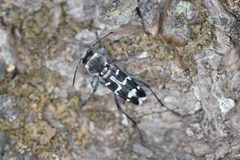
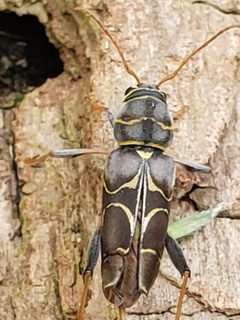
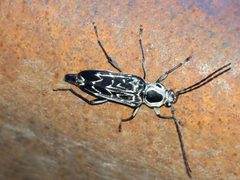
Clytini is a tribe of longhorn beetles (Cerambycidae) within the Cerambycinae. Members are typically medium-sized (8–16 mm), often with bright coloration and banded . Many exhibit -mimicry, with rapid, jerky movements and contrasting yellow-black or red-black patterns. The tribe includes -mimicking such as Cyrtinus, which are among the smallest cerambycids (2–3 mm). Larvae are primarily , developing in dead wood of trees and shrubs. are frequently floricolous or attracted to exudates and fermented fruits. The tribe is distributed across North America, Europe, and Asia, with some species showing expanding or declining trends.
Pronunciation
How to pronounce Clytini: //klaɪˈtaɪnaɪ//
These audio files are automatically generated. While they are not always 100% accurate, they are a good starting point.
Identification
Distinguished from other Cerambycinae tribes by combination of: -mimicking appearance with rapid, erratic movements; banded with yellow/black or red/black patterns in many ; antennal insertion between or dividing ; medium body size (with exception of minute -mimics). Separation from similar tribes (e.g., Anaglyptini, Tillomorphini) requires examination of antennal structure, pronotal shape, and male genitalia. Within Clytini, genera distinguished by: elytral band pattern and completeness; pronotal margin coloration; leg coloration; body size; seasonal activity period.
Images
Habitat
Larvae develop primarily in dead wood of trees and shrubs, including branches and trunks. Some utilize wood at the collar of plants. found on flowers, at exudates, on fermented fruits, or on wood. -mimicking species occur on dead twigs and branches in association with small ants.
Distribution
Widespread across temperate and tropical regions. North America: diverse fauna including Megacyllene, Neoclytus, Cyrtinus, Glycobius. Europe: 25 in France, with 22 in Rhône-Alpes region; includes both Mediterranean and mountain species. Asia: well-represented in Vietnam, India, and Malaysia. Some introduced species established outside native ranges (e.g., Xylotrechus pantherinus, X. stebbingi, Neoclytus acuminatus in Europe).
Seasonality
activity varies by and region. Many temperate species active in spring (e.g., Megacyllene caryae) or fall (e.g., M. robiniae). Some species attracted to flowers during specific blooming periods. timing tied to accumulated , with between 316–648 DD (base 10°C) reported for some species.
Diet
Larvae strictly , feeding on dead wood of trees and shrubs. floricolous, feeding on pollen and nectar, or attracted to sap exudates and fermented fruits.
Host Associations
- dead wood of trees and shrubs - larval developmentprimary substrate for larval feeding and development
- branches and trunks of trees and shrubs - larval developmentincludes various hardwoods and some conifers
- legumes (e.g., Robinia, Carya) - larval developmentspecific to certain such as Chlorophorus trifasciatus
- conifers - larval developmentassociated with expanding in some regions
- flowers (e.g., Solidago, Monarda) - feeding pollen and nectar sources
Life Cycle
laid on or near wood, often on lower bole (<20 cm) with preference for southern and eastern aspects. Larval 7–10 days after oviposition. Larvae feed in phloem-xylem interface, creating galleries; development includes early, mid, and late instars with variable mortality at each stage. occurs in wood. tied to thermal accumulation. Adult lifespan sexually dimorphic, with males typically emerging earlier and living longer than females. Female averages approximately 41 eggs.
Behavior
of many exhibit rapid, jerky, -like movements suggesting mimicry. Some species (e.g., Cyrtinus pygmaeus) are slow and clumsy, mimicking movement and . Adults frequently encountered on flowers, at sap flows, or on wood. Some species show mating assemblies on tree trunks. Adults are highly mobile and may explore non-host plants without utilizing them for .
Ecological Role
Larvae contribute to wood decomposition and nutrient cycling in forest . Serve as prey for woodpeckers and other ; hairy woodpeckers (Dryobates villosus) are significant of some . (e.g., Dolichomitus irritator) occasionally attack larvae. Sensitive to modifications and forestry practices; some species serve as indicators of plant and forest health. trends vary, with some species expanding due to conifer afforestation while others decline from habitat loss.
Human Relevance
Some emerge from firewood stored indoors, causing concern to homeowners. A few introduced species have established in new regions, potentially impacting native . Generally not considered significant economic pests, though larvae may degrade quality of dead wood products. Subject of interest to coleopterists due to mimicry systems and conservation status of rare species.
Similar Taxa
- AnaglyptiniAlso contains -mimicking with small body size and humped ; distinguished by antennal structure and male genitalia
- TillomorphiniIncludes -mimicking and flower-visiting ; separation requires detailed examination of morphological characters
- CallichrominiSome share bright metallic or contrasting coloration; distinguished by body form and antennal insertion
More Details
Taxonomic diversity
The tribe includes numerous with varied ecological specializations, from large -mimics to minute -mimics. Generic composition varies by biogeographic region.
Conservation status
Some are exceptionally rare with poorly known (e.g., Neoclytus approximatus), while others are expanding their ranges due to anthropogenic changes.
Mimicry systems
Multiple mimicry types occur within the tribe: -mimicry in larger (Megacyllene, Neoclytus), -mimicry in smaller genera (Cyrtinus, Euderces), with corresponding behavioral adaptations.
Sources and further reading
- BugGuide
- Wikipedia
- iNaturalist taxon
- NCBI Taxonomy
- Catalogue of Life
- One of North America’s rarer longhorned beetles | Beetles In The Bush
- The Pan-Pacific Entomologist 88(2)—Penrose Memorial issue | Beetles In The Bush
- North America’s itsiest bitsiest longhorned beetle | Beetles In The Bush
- When is a locust borer not a locust borer? | Beetles In The Bush
- Les Clytini, un groupe de coléoptères longicornes à suivre (Coleoptera Cerambycidae)
- Additions to the genus Rhaphuma Pascoe, 1858 (Coleoptera: Cerambycidae: Cerambycinae: Clytini) from Vietnam
- Life history and bionomics ofGlycobius speciosus(Coleoptera: Cerambycidae: Cerambycinae: Clytini)
- New Distribution and Host Record of <i>Demonax balyi</i> (Pascoe, 1859) (Cerambycidae : Clytini) from Garhwal Region of Uttarakhand, India