
Glycobius
LeConte, 1873
sugar maple borer
Species Guides
1- Glycobius speciosus(Sugar Maple Borer)
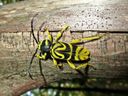
Glycobius is a of longhorned beetles ( Cerambycidae) containing the single Glycobius speciosus, commonly known as the sugar maple borer. The species is native to eastern North America and is a wood-borer whose larvae feed on sugar maple (Acer saccharum). are active in spring and early summer.


Pronunciation
How to pronounce Glycobius: //ɡlaɪˈkoʊbiəs//
These audio files are automatically generated. While they are not always 100% accurate, they are a good starting point.
Images
Habitat
Associated with forests containing sugar maple (Acer saccharum); larvae develop within living or recently dead maple trees, particularly in the phloem-xylem interface of the lower bole (<20 cm diameter). have been observed in mesic lowland deciduous forest and dry-mesic upland deciduous forest .
Distribution
Eastern North America; recorded from New York, Vermont, and Missouri. Distribution records indicate presence in the northeastern United States and Ozark region of Missouri.
Seasonality
emerge between 316 and 648 accumulated (base 10°C), typically in spring and early summer. Males emerge prior to or simultaneously with females.
Diet
Larvae feed on the phloem and xylem tissues of sugar maple (Acer saccharum). diet is not documented.
Host Associations
- Acer saccharum - larval Primary and obligate ; larvae feed on living or recently dead trees, preferring southern and eastern aspects and lower bole positions (<20 cm diameter)
Life Cycle
Complete . Larval occurs 7–10 days after oviposition. Larval development progresses through distinct size classes characterized by capsule measurements and gallery lengths. Nearly 20% of individuals survive to adulthood under natural conditions. Mortality is concentrated in late larval development (43%), with by hairy woodpeckers (Dryobates villosus) accounting for 43% of total mortality and 74% of late instar mortality. One , Dolichomitus irritator (Ichneumonidae), has been documented. Female averages 41.3 ± 6 . Non-functional ovipositors observed in 16% of females represent appreciable reproductive loss.
Behavior
are attracted to ethanol/red wine-baited traps, though less commonly than some sympatric cerambycids. Oviposition occurs preferentially on southern and eastern aspects of trees. In 77% of infested trees, only one oviposition site is established; in 70% of these sites, only 1–2 larvae successfully eclose and penetrate bark to begin feeding. Males possess longer and wider than females, pronotal pits containing gland pores, and a straight to concave margin of the terminal sternite.
Ecological Role
Primary consumer and wood-borer in sugar maple . Larval galleries impact tree growth, with attacked trees showing significantly reduced cross-sectional area growth (1.9% vs. 3.7% in control trees) in the year preceding attack. Serves as prey for woodpeckers and for .
Human Relevance
Economic pest of sugar maple in forest and sugarbush operations. reduce tree growth rates and can impact maple syrup production. Damage is often cryptic, leading to conservative estimates of impact. Management implications exist for sugar maple silviculture and syrup production.
Similar Taxa
- Plinthocoelium suaveolensBoth are cerambycids in tribe Clytini attracted to ethanol-based traps in similar forest ; distinguished by association (Plinthocoelium on Sideroxylon lanuginosum vs. Glycobius on Acer saccharum) and
- Eburia quadrigeminataSympatric cerambycid frequently captured in same trap types; distinguished by different associations and
More Details
Sexual dimorphism
Males have longer and wider than females, possess pronotal pits containing gland pores, and show a straight to concave margin of the terminal sternite compared to the more rounded margin in females. Males also emerge earlier and live longer than females.
Population dynamics
Partial indicate 30% of larval mortality occurs during early development, 27% during mid-larval development, and 43% during late larval development. The cryptic nature of much borer damage suggests previous impact estimates are conservative.
Sources and further reading
- BugGuide
- Wikipedia
- GBIF taxonomy match
- iNaturalist taxon
- NCBI Taxonomy
- Catalogue of Life
- North America’s itsiest bitsiest longhorned beetle | Beetles In The Bush
- Ascalaphidae | Beetles In The Bush
- August | 2022 | Beetles In The Bush
- Arthropoda | Beetles In The Bush | Page 5
- Life history and bionomics ofGlycobius speciosus(Coleoptera: Cerambycidae: Cerambycinae: Clytini)
- Characteristics of trees damaged by sugar maple borer, Glycobiusspeciosus (Say)