
Plinthocoelium suaveolens
(Linnaeus, 1768)
Bumelia Borer
Species Guides
2- Plinthocoelium suaveolens plicatum(Bumelia Borer)
- Plinthocoelium suaveolens suaveolens(bumelia borer)
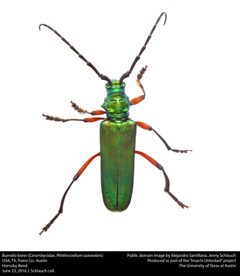
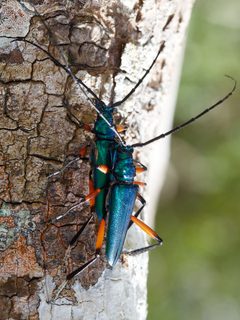
Plinthocoelium suaveolens, commonly known as the bumelia borer, is a large, strikingly colorful longhorn beetle in the Cerambycidae. display brilliant iridescent green , coppery-bronze and pronotum, and exceptionally long orange-and-black banded legs and . The is tightly associated with its plant, gum bumelia (Sideroxylon lanuginosum), with larvae boring in the roots of living trees and adults often found perching on lower trunks or flying to flowers. Two are recognized: the nominate P. s. suaveolens in the southeastern U.S. and P. s. plicatum in the southwestern U.S. and northern Mexico.
Pronunciation
How to pronounce Plinthocoelium suaveolens: //plɪn.θəˈsiː.li.əm swɑːˈviː.oʊ.lɛnz//
These audio files are automatically generated. While they are not always 100% accurate, they are a good starting point.
Identification
Distinguished from other North American cerambycids by the combination of large size, brilliant iridescent green , coppery pronotum, and exceptionally long orange-and-black banded legs. The only similar in range is Plinthocoelium schwarzi, which has black rather than orange . plicatum differs from the nominate subspecies by having more pronounced transverse rugae on the pronotum and lacking the bronze or cupreous tints. No other cerambycid species shares the specific association with Sideroxylon lanuginosum combined with this color pattern.
Images
Appearance
Large-bodied cerambycid with brilliant metallic coloration. are iridescent green to blue-green. and pronotum are coppery-bronze with weak transverse rugae in the nominate . Legs and are extraordinarily elongated relative to body size; legs are black with contrasting bright orange , creating a bold banded pattern. Antennae are black and, in males, may exceed body length significantly. Overall length approximately 25–35 mm.
Habitat
Associated with xeric limestone and dolomite glades, dry woodlands, and rocky hilltop prairies where the plant Sideroxylon lanuginosum (gum bumelia) occurs. The host plant is one of few woody naturally adapted to these thin-soiled, drought-prone conditions. are found on living host trees, particularly on lower trunks and in foliage during flowering.
Distribution
North America: southeastern and south-central United States from Florida and Georgia west to New Mexico and Arizona, extending into northern Mexico. Northern distributional limit in Missouri, where it occurs in the White River Hills region and as far north as the dolomite glades south of St. Louis. The two intermingle in northeastern Texas.
Seasonality
are active primarily during July and August in Missouri, with records extending into September. Activity peaks during the hottest part of the day (2–4 PM). Adult and activity are correlated with flowering of the plant.
Host Associations
- Sideroxylon lanuginosum - larval Larvae bore in roots of living trees; feed on nectar/pollen of flowers and possibly sap
Life Cycle
Larvae tunnel through the roots of living Sideroxylon lanuginosum, ejecting through holes near the base of the trunk. Larval galleries are large and clean, extending considerable distances from the trunk. Developmental period from larva to has been observed to span at least one season; exact duration unknown. Adults emerge in mid-summer, with activity tied to plant flowering.
Behavior
are extremely wary and alert, among the most difficult cerambycids to approach. They detect observers from several feet away through visual and antennal sensitivity, often fleeing before close approach. When alarmed, they twitch , change posture, and may fly rapidly away with legs and antennae outstretched. Adults have been observed perching on lower trunks of trees and flying to flowers on high branches. They are attracted to fermenting baits, which has been used successfully for trapping.
Ecological Role
Larvae act as root borers in living trees, contributing to nutrient cycling and wood decomposition. The serves as prey for birds and other . may function as of the host plant during flower visitation.
Human Relevance
Valued by entomologists and photographers for its exceptional beauty. Occasionally encountered by the public in its native range. Not a pest of houses or living trees outside of its specific association; dead wood piles may harbor larvae but do not pose risks to structures or ornamental plantings. Subject of specialized collecting techniques including fermenting traps.
Similar Taxa
- Plinthocoelium schwarziSimilar size and iridescent coloration, but distinguished by black rather than orange
- Callona rimosaCompetes for title of most beautiful North American cerambycid but occurs in different geographic range (not Missouri)
- Crioprosopus magnificusSimilarly spectacular coloration but different geographic distribution
More Details
Subspecies distinction
Missouri belong to the nominate P. s. suaveolens, characterized by bronze or cupreous tints and weak transverse rugae on the pronotum. Subspecies P. s. plicatum occurs in Texas, New Mexico, Arizona, and northern Mexico, with more pronounced pronotal rugae and lacking bronze tints.
Conservation context
The 's glade has been significantly reduced by overgrazing and fire suppression, leading to woody encroachment by Juniperus virginiana. Active management including mechanical removal, controlled burns, and managed grazing is being employed to restore glade and preserve this and other glade-associated .
Sources and further reading
- BugGuide
- Wikipedia
- GBIF taxonomy match
- iNaturalist taxon
- NCBI Taxonomy
- Catalogue of Life
- How to mount Plinthocoelium suaveolens | Beetles In The Bush
- Bumelia borer on white | Beetles In The Bush
- Another look at North America’s most beautiful longhorned beetle | Beetles In The Bush
- North America’s most beautiful longhorned beetle | Beetles In The Bush
- Botanizing at Salt Lick Point Land & Water Reserve | Beetles In The Bush
- North America’s most beautiful longhorned beetle | Beetles In The Bush