
Callichromatini
Genus Guides
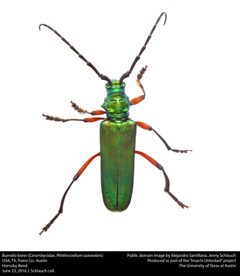
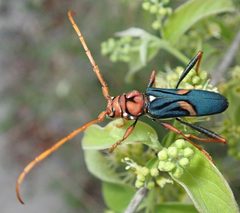
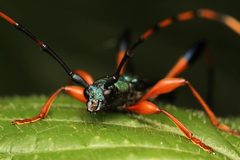
1Callichromatini is a tribe of longhorn beetles (Cerambycidae) within the Cerambycinae. The tribe contains approximately 148 and is characterized by often spectacularly colored, metallic . Members are primarily tropical and subtropical in distribution, with some species reaching into temperate North America. The tribe includes notable genera such as Plinthocoelium, Chloridolum, Aphrodisium, and Schwarzerium. Many species exhibit brilliant iridescent coloration in greens, blues, and tones.
Pronunciation
How to pronounce Callichromatini: //ˌkælɪˌkroʊməˈtaɪnaɪ//
These audio files are automatically generated. While they are not always 100% accurate, they are a good starting point.
Identification
Callichromatini can be distinguished from related cerambycine tribes by a combination of morphological features, though precise diagnostic characters require examination. Members typically exhibit elongated body forms with extremely long (often exceeding body length), a characteristic of the Cerambycidae. Many display striking metallic coloration. The tribe is placed in Cerambycinae based on tarsal formula and other structural features. Species-level identification relies on examination of pronotal , elytral patterns, and genitalic structures.
Images
Distribution
The tribe has a predominantly tropical and subtropical distribution worldwide. In the New World, it ranges from the southern United States (Florida, Georgia, Texas, New Mexico, Arizona) through Mexico and Central America to South America. In the Old World, it occurs across Africa, Asia (including China, Southeast Asia, and India), and Australia. The Plinthocoelium occurs in the southern United States and northern Mexico. The genus Chloridolum is distributed from Southeast Asia to Australia. Chinese representatives include Schwarzerium yunnanum from Yunnan Province.
Human Relevance
Some Callichromatini are among the most visually striking beetles in the world and are highly prized by collectors. The larval habits of certain species, such as Plinthocoelium suaveolens, have been studied in detail; larvae bore in roots of living trees (Sideroxylon lanuginosum). The tribe has been subject to taxonomic revision, with new species and described regularly from previously unexplored regions.
Similar Taxa
- LamiinaeThe other major of Cerambycidae, distinguished by having a tarsal formula of 5-5-5 (vs. 4-4-4 in Cerambycinae) and typically broader, flatter body forms; Callichromatini belongs to Cerambycinae.
- other Cerambycinae tribesDistinguished by combinations of antennal segment proportions, pronotal and elytral , and male genitalic structures; precise differentiation requires detailed morphological examination.
More Details
Taxonomic history
The tribe has undergone significant revision, with Linsley (1964) providing foundational work on North American representatives. Recent studies have greatly expanded the known diversity, particularly from Asia.
Notable genera
Plinthocoelium (including the spectacular P. suaveolens, the Bumelia Borer), Chloridolum, Aphrodisium, and Schwarzerium are among the better-known . The genus Schwarzerium includes the subgenus Rugosochroma, erected for S. yunnanum.