
Megacyllene
Casey, 1912
Species Guides
8- Megacyllene angulifera
- Megacyllene antennata(Mesquite Borer)
- Megacyllene caryae(painted hickory borer)
- Megacyllene decora(Amorpha borer)
- Megacyllene powersi
- Megacyllene robiniae(Locust Borer)
- Megacyllene robusta
- Megacyllene snowi
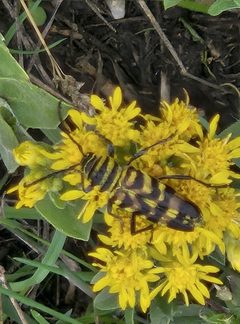
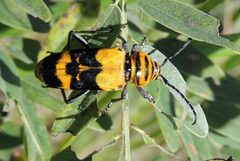
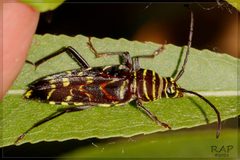
Megacyllene is a of longhorn beetles (Cerambycidae) comprising approximately 50 distributed primarily in the Americas. The genus includes both Nearctic and Neotropical species with diverse ecological associations. Several species have been studied for their chemistry, revealing species-specific attraction to compounds such as anti-2,3-hexanediol and (S)-α-terpineol. Larval vary considerably among species, with most Nearctic species associated with Fabaceae (e.g., Robinia, Prosopis, Dalea), though notable exceptions include M. caryae on Carya and M. comanchei possibly on Asteraceae.
Pronunciation
How to pronounce Megacyllene: /ˌmɛɡəˈsɪlɪni/
These audio files are automatically generated. While they are not always 100% accurate, they are a good starting point.
Images
Distribution
Distributed across the Americas, with occurring in North America (United States, Canada), Central America, and South America (Peru, Brazil, Argentina). Specific distribution varies by species: M. comanchei occurs in the Great Plains from Texas to South Dakota; M. angulifera in northern Great Plains states and provinces; M. andesiana in Peru; M. angulata in the Amazon region.
Host Associations
- Fabaceae - larval Primary larval for most Nearctic including Robinia (M. robiniae, M. snowi), Prosopis (M. antennata), Amorpha (M. decora), Dalea candida (M. angulifera)
- Asteraceae - possible larval Heterotheca suggested as possible for M. comanchei based on association with dead root crowns; not confirmed
- Malvaceae - possible Luehea cymulosa observed as copulation site for M. angulata; larval development unconfirmed
- Dilleniaceae - possible Doliocarpus dentatus observed as copulation site for M. angulata; larval development unconfirmed
- Juglandaceae - larval Carya primary for M. caryae, which is unique in the for not using Fabaceae
- Oleaceae - larval Fraxinus americana documented as larval for M. angulifera
Behavior
of many are associated with flowers, particularly Solidago (goldenrod) for M. angulifera. M. comanchei adults exhibit atypical for the , being found crawling on the ground in shortgrass prairie rather than on flowers, possibly seeking oviposition sites at plant root crowns. Mating behavior has been described for M. angulata, with copulation occurring on host plants. Males of congeneric species may use multiple tactics when aggressively competing for mates.
Sources and further reading
- BugGuide
- Wikipedia
- GBIF taxonomy match
- iNaturalist taxon
- NCBI Taxonomy
- Catalogue of Life
- Megacyllene comanchei revisited | Beetles In The Bush
- SCIENTIFIC NOTE: First Larval Host Record for Megacyllene angulifera (Casey) (Cerambycidae)
- Responses of Megacyllene andesiana and Oreodera bituberculata (Coleoptera: Cerambycidae) to anti-2,3-hexanediol, fuscumol, and fuscumol acetate in Peru
- Notes on mating behaviour and a possible new host plant for Megacyllene angulata (Fabricius, 1775) (Cerambycidae, Coleoptera)
- The Common Natural Products (S)-α-Terpineol and (E)-2-Hexenol are Important Pheromone Components of Megacyllene antennata (Coleoptera: Cerambycidae)