
Megacyllene caryae
(Gahan, 1908)
painted hickory borer, hickory borer
Megacyllene caryae, known as the painted hickory borer or hickory borer, is a longhorned beetle in the Cerambycidae. It occurs in the eastern United States and has been introduced to the Marquesas Islands in French Polynesia. are active exclusively in spring, emerging from dead hickory wood as temperatures warm. The species is frequently misidentified as the closely related locust borer (M. robiniae) due to their nearly identical appearance, though they differ in seasonality, plants, and subtle morphological characters.
Pronunciation
How to pronounce Megacyllene caryae: //ˌmɛɡəˈsɪləni kəˈraɪ.i//
These audio files are automatically generated. While they are not always 100% accurate, they are a good starting point.
Identification
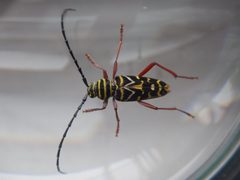
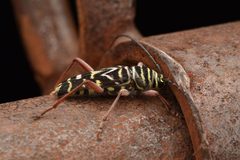
Megacyllene caryae is distinguished from the similar (locust borer) by several characters: legs are often distinctly reddish (versus black in M. robiniae); elytral bands are slightly narrower, often broken and incomplete, and show an alternating pattern of yellow and white (versus wider, continuous yellow bands in M. robiniae); the pronotum has a black margin (versus narrowly margined with yellow in M. robiniae). Season is the most reliable distinguishing character: M. caryae is active only in spring (March–June), while M. robiniae occurs in fall (August–November).
Images
Habitat
Found in deciduous woodlands where hickory trees (Carya spp.) occur. are encountered on trunks of recently fallen or dead hickory trees, particularly wind-thrown specimens in sunny exposures. Larvae develop in dead wood of hickories and occasionally other deciduous trees.
Distribution
Eastern United States, from the Atlantic coast west to the eastern edge of the Great Plains; also recorded from Hiva Oa in the Marquesas Islands, French Polynesia (introduced).
Seasonality
are active in early spring, emerging as temperatures warm from March through June, with peak activity in April. This spring contrasts sharply with the fall activity period of related in the .
Diet
Larvae feed on dead wood of hickories (Carya spp.), including mockernut hickory (Carya alba). Occasionally recorded from other including honey locust (Gleditsia triacanthos) and eastern redbud (Cercis canadensis). do not feed.
Host Associations
- Carya alba - larval mockernut hickory
- Carya spp. - larval hickories in general
- Gleditsia triacanthos - occasional larval honey locust
- Cercis canadensis - occasional larval eastern redbud
Life Cycle
Females lay in bark crevices of dead trees. Larvae tunnel beneath the bark before boring into the sapwood, where they feed through summer. occurs in autumn, with in pupal and emerging the following spring. Development typically spans one year, though may extend if wood dries out or nutritional conditions are poor.
Behavior
are and highly mobile. They are attracted to recently dead or fallen hickory trees, where mating occurs on exposed trunk surfaces. Adults are known to emerge indoors from firewood stored inside homes during winter, causing alarm due to their -like appearance. They are not aggressive and do not sting.
Ecological Role
Decomposer; larvae break down dead hickory wood, contributing to nutrient cycling in forest . may serve as when visiting flowers, though this has not been specifically documented for this .
Human Relevance
Frequently encountered by homeowners when emerge from firewood brought indoors during winter. Often misidentified as or as the locust borer, causing unnecessary concern. Does not damage structural wood, furniture, or living trees; poses no health or property threat. The demonstrates effective wasp mimicry in coloration and rapid movement, which may deter .
Similar Taxa
- Megacyllene robiniaeNearly identical black-and-yellow banded pattern, but active in fall rather than spring; feeds on living black locust (Robinia pseudoacacia) rather than dead hickory; legs black rather than reddish; elytral bands wider and continuous; pronotum with yellow margin.
- Megacyllene decoraLarger size and more boldly marked with wide black and yellow bands; occurs in fall; associated with false indigo (Amorpha fruticosa) rather than hickory.
Misconceptions
Commonly misidentified as the locust borer () by novice entomologists and homeowners. The -like appearance leads to mistaken identity as a stinging insect, causing alarm when found indoors. Despite emerging from firewood, it does not infest structural wood or cause damage to homes.
More Details
Wasp Mimicry
The black-and-yellow banded coloration and rapid running represent effective mimicry of yellowjacket (Vespula spp.), likely conferring protection from despite the being harmless.
Firewood Emergence
are well-known for emerging from hickory firewood stored indoors during winter months, a phenomenon that generates numerous identification requests from concerned homeowners.
Taxonomic History
Described by Charles Joseph Gahan in 1908. The specific epithet caryae refers to the Carya (hickories), its primary .
Sources and further reading
- BugGuide
- Wikipedia
- GBIF taxonomy match
- iNaturalist taxon
- NCBI Taxonomy
- Catalogue of Life
- When is a locust borer not a locust borer? | Beetles In The Bush
- June | 2010 | Beetles In The Bush | Page 2
- A classic fall ‘bycid | Beetles In The Bush
- Bug Eric: February 2009
- Megacyllene comanchei revisited | Beetles In The Bush
- Bug Eric: Wasp Wednesday: Not Wasp VII