
Prionoxystus robiniae
Peck, 1818
Carpenterworm Moth, Locust Borer
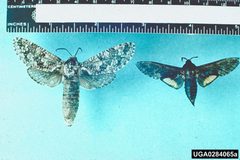
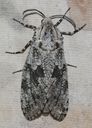
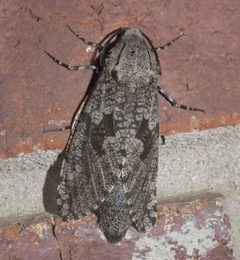
Prionoxystus robiniae is a in the Cossidae, found across much of North America from southern Canada through most of the United States. are active from May to July, with wingspans ranging from 43–85 mm. The larvae are wood-borers that tunnel into hardwood trees, causing economic damage to timber. Females release to attract males, which fly upwind to locate them; mating occurs at dusk and early night, with copulation lasting 1–2 hours.
Pronunciation
How to pronounce Prionoxystus robiniae: /ˌpraɪ.oʊˈnɒksɪ.stəs ˈroʊ.bɪni.aɪ/
These audio files are automatically generated. While they are not always 100% accurate, they are a good starting point.
Identification
have a wingspan of 43–85 mm. The can be distinguished from other Cossidae by its association with hardwood and its specific adult period. Larvae create extensive tunnels in wood, which may be detected by at holes.
Images
Habitat
Associated with hardwood forests and urban areas where trees grow. Larvae develop within the wood of living or recently dead hardwood trees.
Distribution
Southern Canada (Alberta, Manitoba, Saskatchewan) and most of the United States, including Vermont.
Seasonality
are on wing from May to July, with timing varying by location.
Diet
Larvae feed on the wood of locust (Robinia), oak, chestnut, poplar, willow, maple, and ash. do not feed.
Host Associations
- Robinia - larval primary ; implied by epithet
- Quercus - larval oak
- Castanea - larval chestnut
- Populus - larval poplar
- Salix - larval willow
- Acer - larval maple
- Fraxinus - larval ash
Life Cycle
Larvae tunnel into hardwood, creating galleries that reduce timber value. Development occurs within wood; emerge to mate. Specific details of -laying, larval instars, and are not documented in available sources.
Behavior
Females adopt a calling posture with elevated and wings folded to expose between the 7th and 8th abdominal segments. Males detect with their and fly upwind to locate females. Males produce ultrasonic clicks during courtship, possibly for mate recognition or to inhibit rival males. Males may fight for access to calling females. Females typically mate only once, while males may mate multiple times.
Ecological Role
Larvae act as wood-borers in hardwood trees, contributing to nutrient cycling in dead or dying wood but also causing economic damage to living timber.
Human Relevance
Considered a pest because larval tunnels decrease the value of hardwood lumber.
Similar Taxa
- Prionoxystus macmurtreicongeneric in same , may share wood-boring habits and require association for distinction
- Megacyllene robiniaeshares 'locust borer' but is a cerambycid beetle, not a ; active in fall rather than summer, and found on goldenrod flowers
Misconceptions
The 'locust borer' is also applied to the Megacyllene robiniae, a cerambycid that is unrelated and active in a different season.
Sources and further reading
- BugGuide
- Wikipedia
- GBIF taxonomy match
- iNaturalist taxon
- NCBI Taxonomy
- Catalogue of Life
- Amorpha borer on goldenrod | Beetles In The Bush
- When is a locust borer not a locust borer? | Beetles In The Bush
- Saltatorial sidetracks | Beetles In The Bush
- An Inordinate Fondness #9 | Beetles In The Bush
- Megacyllene comanchei revisited | Beetles In The Bush
- Mating Behavior in the Carpenterworm Moth, Prionoxystus robiniae (Lepidoptera: Cossidae)1