
Prionoxystus macmurtrei
Guérin-Méneville, 1829
Little Carpenterworm Moth
Prionoxystus macmurtrei, commonly known as the little carpenterworm moth, is a of carpenter in the Cossidae. are active from spring through mid-summer across eastern and central North America. The larvae are wood-borers that tunnel through hardwood trees, causing damage that reduces lumber value.
Pronunciation
How to pronounce Prionoxystus macmurtrei: //ˌpraɪəˈnɒksɪstəs mækˈmɜːrtriː//
These audio files are automatically generated. While they are not always 100% accurate, they are a good starting point.
Identification
The combination of moderate size (45–75 mm wingspan), mottled gray-brown coloration, and spring-to-summer period distinguishes this from many other Cossidae. It is smaller than the related carpenterworm (Prionoxystus robiniae), which has a wingspan of 50–90 mm. The similar species Prionoxystus piger is also larger (wingspan to 90 mm) and has been reported to have more contrasting wing patterns. Examination of genitalia or larval association may be necessary for definitive identification in areas of overlap.
Images
Appearance
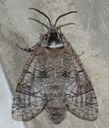
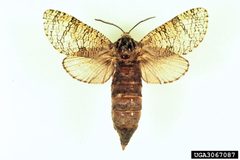
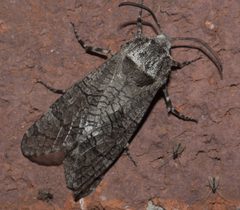
have a wingspan of 45–75 mm. The body and wings are mottled gray-brown with irregular darker markings, providing cryptic coloration against bark. Forewings typically show a mix of light and dark gray with wavy transverse lines. Hindwings are lighter, often pale gray. The body is robust and somewhat hairy, typical of Cossidae. are bipectinate in males, simpler in females.
Habitat
Associated with deciduous forests and woodlands containing ash, maple, and oak. Larvae occur within living or recently dead hardwood trees. are often found near larval trees and are attracted to lights.
Distribution
Eastern and central North America: Ontario and Quebec south to Florida, west to Texas, north to Minnesota. Records also include Vermont.
Seasonality
are on wing from April to July. The period spans spring through early summer, with peak activity varying by latitude.
Diet
Larvae feed on ash (Fraxinus), maple (Acer), and oak (Quercus). The specific tissues consumed are wood (xylem), with larvae tunneling through heartwood and sapwood.
Host Associations
- Fraxinus - larval food plantash
- Acer - larval food plantmaple
- Quercus - larval food plantoak
Life Cycle
Complete with larval development occurring within trees. Larvae create extensive tunnels in wood, likely requiring multiple years to mature given the size of and wood-boring habit typical of Cossidae. occurs within the tunnel, with adults emerging through an exit hole.
Behavior
Larvae bore into living hardwoods, creating tunnels that weaken structural integrity and degrade lumber quality. are and attracted to light. They do not feed as adults.
Ecological Role
As a wood-boring insect, larvae contribute to nutrient cycling by breaking down hardwood tissue. They may also create for other organisms in the form of abandoned tunnels. In natural forests, they likely target stressed, dying, or dead trees; in managed settings, they are considered a pest of living timber.
Human Relevance
Considered a pest of hardwood timber. Larval tunneling reduces lumber grade and value, particularly in ash, maple, and oak. The is not known to attack finished wood products or structures. Management in forestry contexts may involve removing infested trees.
Similar Taxa
- Prionoxystus robiniaeLarger size (wingspan 50–90 mm vs. 45–75 mm), also a carpenterworm moth with overlapping range and . Previously confused or synonymized; now recognized as distinct.
- Prionoxystus pigerLarger size (wingspan to 90 mm), more contrasting wing pattern. Occurs in overlapping range.
More Details
Taxonomic history
Originally described as Cossus macmurtrei by Guérin-Méneville in 1829. The has been historically confused with P. robiniae, and literature prior to modern revisions may not reliably distinguish between them.
Economic impact
Damage is primarily to standing timber quality rather than tree mortality. Tunneling degrades lumber appearance and structural properties, affecting veneer and furniture-grade wood particularly.