
Prionoxystus
Grote, 1882
carpenterworm moth
Species Guides
2- Prionoxystus macmurtrei(Little Carpenterworm Moth)
- Prionoxystus robiniae(Carpenterworm Moth)
Prionoxystus is a of carpenterworm moths in the Cossidae. The genus includes three described : P. robiniae, P. macmurtrei, and P. piger. are and exhibit complex mating involving , acoustic signals, and visual displays. Larvae are wood-borers, with at least P. robiniae associated with Robinia (black locust).
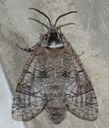
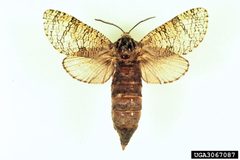
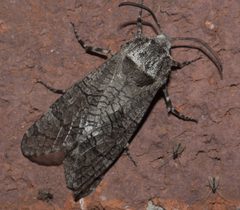
Pronunciation
How to pronounce Prionoxystus: //ˌpraɪ.oʊˈnɒk.sɪtəs//
These audio files are automatically generated. While they are not always 100% accurate, they are a good starting point.
Identification
Members of Prionoxystus can be recognized as cossid by their robust bodies, relatively broad wings, and often subdued coloration typical of carpenter moths. -level identification requires examination of genitalia or detailed wing pattern analysis; P. robiniae is distinguished by its association with black locust and specific geographic range in eastern North America.
Images
Habitat
Associated with wooded areas containing trees; larvae bore into living or dead hardwoods.
Distribution
North America; records include the United States (specifically Vermont and broader eastern regions based on P. robiniae occurrence).
Seasonality
and activity occur during scotophase (dark period); emergence rhythms have been documented but specific seasonal timing varies by and latitude.
Diet
Larvae bore into wood; P. robiniae has been observed in Robinia (black locust). feeding habits are not documented in available sources.
Host Associations
- Robinia - larval Association inferred from epithet 'robiniae' and ; specific confirmation from primary literature not provided in available sources
Life Cycle
Holometabolous with wood-boring larval stage. emerge from trees; specific developmental timing and instar details not documented in available sources.
Behavior
exhibit activity patterns. Females release from an eversible gland between the 8th and 9th abdominal segments during scotophase, peaking 1-2 hours after darkness onset and continuing up to 6 hours. Calling females extrude the gland, elevate the , and fan their wings. Males locate females by flying upwind (anemotaxis), then circling and landing. Males possess hairpencils (scent brushes) on the hindwings that are everted during courtship and may disseminate aphrodisiac . Males produce ultrasonic chirping sounds by rubbing the forewing against the hindwing. Copulation lasts 1-3 hours. Both sexes are polygamous.
Ecological Role
Larvae function as primary decomposers or herbivores in woody substrates; specific impacts not quantified in available sources.
Human Relevance
Larvae of P. robiniae bore into black locust and potentially other hardwoods, potentially affecting timber and ornamental trees; known as carpenterworm moths due to larval wood-boring habit.
Similar Taxa
- CossusAnother of carpenter moths in Cossidae; distinguished by genitalia and associations
- ZeuzeraLeopard moth in Cossidae; typically have spotted wing patterns and different larval preferences
More Details
Acoustic communication
Male P. robiniae produce ultrasonic chirping via stridulation (forewing rubbing against hindwing), a relatively uncommon communication mode in that may function in courtship.
Pheromone gland morphology
The female gland in P. robiniae is eversible and located between the 8th and 9th abdominal segments, a specific anatomical feature enabling controlled release during calling .
Sources and further reading
- BugGuide
- Wikipedia
- GBIF taxonomy match
- iNaturalist taxon
- NCBI Taxonomy
- Catalogue of Life
- Fecundity and Oviposition Behavior in the Carpenterworm, Prionoxystus robiniae1
- Emergence Behavior and Rhythms in the Carpenterworm Moth, Prionoxystus robiniae1
- Mating Behavior in the Carpenterworm Moth, Prionoxystus robiniae (Lepidoptera: Cossidae)1