
Megacyllene robiniae
(Forster, 1771)
Locust Borer
, the locust borer, is a longhorn beetle to eastern North America and a significant pest of black locust trees (Robinia pseudoacacia). are active from late August through October, feeding on goldenrod pollen. The exhibits striking black and yellow banding that mimics . Larval tunneling in living black locust wood creates entry points for fungal , contributing to tree decline and wind damage susceptibility.
Pronunciation
How to pronounce Megacyllene robiniae: /ˌmɛɡəˈsɪləni ˈroʊbɪniˌi/
These audio files are automatically generated. While they are not always 100% accurate, they are a good starting point.
Identification
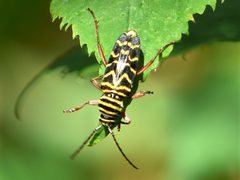
Distinguished from the closely related hickory borer (Megacyllene caryae) by season of activity (fall vs. spring), complete yellow elytral bands that extend fully across the (vs. often broken and incomplete in caryae), and the yellow pronotal margin (vs. black in caryae). The W-shaped third elytral band is diagnostic. Distinguished from Megacyllene decora by narrower, less bold banding and smaller size.
Images
Appearance
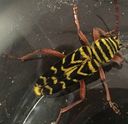
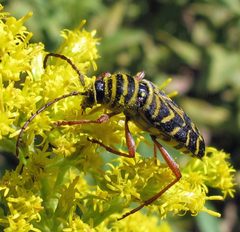
measure 11–28 mm in length with a narrow, elongated body. The display alternating black and yellow transverse bands in a zigzag pattern; the third band forms a distinctive W-shape. The pronotum has a narrow yellow margin along its edge. are dark brown to black, reaching two-thirds body length in males and one-half in females. Legs are reddish-brown. Full-grown larvae are legless, white, robust, and approximately 25 mm long.
Habitat
Found wherever unprotected black locust trees (Robinia pseudoacacia) grow, particularly in uncultivated fields and meadows where goldenrod is present. are strongly associated with flowering goldenrod for feeding. The has expanded its range following the ornamental planting of black locust but remains confined to North America.
Distribution
to eastern North America. Native range coincides with black locust distribution; expanded westward to Idaho and Colorado through ornamental tree plantings. Present in Canada (New Brunswick, Nova Scotia, Ontario, Prince Edward Island) and throughout the eastern and central United States. Not established outside North America despite black locust introductions elsewhere.
Seasonality
emerge in late August and are active through September and October. Peak activity occurs from late day to dusk. Females seek black locust trunks in fall to locate wounds for -laying. Larvae overwinter within bark, resume feeding in spring, and pupate in late July to early August.
Diet
feed on pollen of goldenrods (Solidago spp.). Larvae feed within the wood of living black locust trees (Robinia pseudoacacia), tunneling through heartwood and creating galleries approximately 10 cm long by 7 mm wide.
Host Associations
- Robinia pseudoacacia - larval Living trees; larvae tunnel in trunks and branches
- Solidago - food sourcePollen feeding; strongly associated with goldenrod flowers
Life Cycle
Females lay in crevices and near wounds on black locust trunks in fall. Eggs hatch and larvae overwinter beneath bark. In spring, larvae burrow into wood and create extensive tunnels. Larvae overwinter a second time within the tree, then pupate in late July–early August. emerge late August–September. Development spans approximately one year with overlapping possible.
Behavior
are with peak activity from late afternoon to dusk. They are strong fliers and readily visit goldenrod flowers for pollen feeding. Females actively search tree trunks for wounds suitable for oviposition. Adults are not particularly wary and can be approached for observation. The is a classic "fall borer" with adult activity timed to coincide with late-season goldenrod bloom.
Ecological Role
As a herbivore, larvae significantly impact black locust by weakening trees through tunneling. Larval galleries serve as primary sites for wind-borne spores of Fulvifomes robiniae, a fungus causing rot in Robinia . This -fungus interaction substantially reduces black locust timber value and increases tree susceptibility to wind damage. contribute to pollination of goldenrod through pollen feeding.
Human Relevance
Major pest of black locust timber and ornamental trees. Historically caused severe economic damage; by 1900, black locust timber value was reported as "practically destroyed" across much of the United States outside mountain forests. Currently managed with carbaryl applied during peak activity (August/September). Adults occasionally cause concern when mistaken for structural pests, though they do not infest buildings. Frequently encountered by entomologists and naturalists as a conspicuous fall insect on goldenrod.
Similar Taxa
- Megacyllene caryaeNearly identical black and yellow banding; distinguished by spring activity, broken/incomplete elytral bands, black pronotal margin, and often reddish legs. Breeds in dead hickory wood rather than living black locust.
- Megacyllene decoraLarger, chunkier body with wider, bolder black and yellow bands. Less common, associated with false indigo (Amorpha fruticosa) rather than black locust. occur on goldenrod and snakeroot in fall.
More Details
Etymology
The specific epithet robiniae derives from Robinia, the generic name of black locust (Robinia pseudoacacia), honoring French royal gardeners Jean Robin and Vespasien Robin.
Mimicry and Coloration
The -like black and yellow pattern is considered both (of stinging Hymenoptera) and potentially cryptic coloration that breaks up the 's outline against flowers and bark. The beetle is part of a larger mimicry complex including goldenrod soldier beetles (Chauliognathus pensylvanicus) and various wasps on fall goldenrod.
Historical Pest Impact
In 1900, the 's damage was so extensive that black locust was considered commercially worthless across most of its range. The prevents black locust from realizing its potential as a valuable timber tree due to combined beetle and fungal damage.
Sources and further reading
- BugGuide
- Wikipedia
- GBIF taxonomy match
- iNaturalist taxon
- NCBI Taxonomy
- Catalogue of Life
- A classic fall ‘bycid | Beetles In The Bush
- An Inordinate Fondness #9 | Beetles In The Bush
- When is a locust borer not a locust borer? | Beetles In The Bush
- Amorpha borer on goldenrod | Beetles In The Bush
- June | 2010 | Beetles In The Bush | Page 2
- Missouri | Beetles In The Bush | Page 9