
Amorpha
L., 1753
false indigo, false indigos, leadplant, desert false indigo, indigo bush
Species Guides
1- Amorpha juglandis(walnut sphinx)
Amorpha is a of flowering plants in the pea (Fabaceae) native to North America, ranging from southern Canada through most of the United States to northern Mexico. The genus is distinguished by its unique floral : unlike typical pea-family flowers with the standard wing and keel petal structure, Amorpha flowers possess only a single petal, giving the genus its Greek name meaning "deformed" or "without form." The approximately 15 include shrubs and subshrubs occupying diverse from prairies to riparian corridors, with some species serving as important larval plants for specialized insects and others showing tendencies outside their native ranges.
Pronunciation
How to pronounce Amorpha: /əˈmɔːrfə/
These audio files are automatically generated. While they are not always 100% accurate, they are a good starting point.
Identification
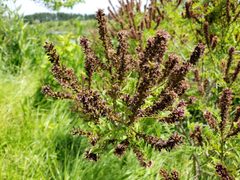
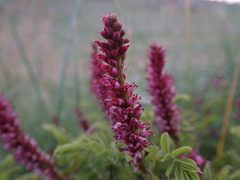
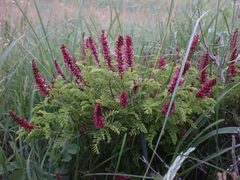
Amorpha is immediately recognizable among Fabaceae by its single-petaled flowers, which lack the bilateral symmetry and complex petal arrangement (banner, wings, keel) characteristic of most legumes. The flowers are typically arranged in dense, elongated spikes. Leaves are pinnately compound with numerous small leaflets. within the are distinguished by growth habit (ranging from low subshrubs to 5-meter shrubs), leaflet size and , flower color (blue-purple to white), and association. Amorpha fruticosa is the largest species, forming substantial shrubs in wet habitats, while A. nana is a diminutive prairie species rarely exceeding 30 cm in height.
Images
Habitat
varies substantially among . Amorpha fruticosa occupies riparian corridors, wet ditches, and floodplains, often forming dense stands in association with willows and other hydrophilic vegetation. Amorpha canescens is characteristic of mesic to dry prairies, frequently codominant with little bluestem (Schizachyrium scoparium) in tallgrass prairie remnants. Amorpha californica occurs in canyon side-streams with poison oak and willow on boulder-strewn substrates. Several species occupy intermediate habitats including open woodlands, glades, and sandy regions. The shows adaptability to disturbance, with A. fruticosa expanding aggressively in some northeastern and northwestern U.S. regions where introduced.
Distribution
Native to North America with a continuous range spanning southern Canada (Manitoba, Ontario), the contiguous United States, and northern Mexico. Individual show narrower distributions: A. fruticosa is transcontinental; A. canescens is centered in the prairie provinces and Midwest; A. californica is to California; A. georgiana is restricted to the southeastern coastal plain; A. ouachitensis is endemic to the Ouachita Mountains. Disjunct occur in some species. Amorpha fruticosa has been introduced to Europe and shows spread in parts of Canada and the U.S. outside its native range.
Seasonality
Flowering occurs primarily in late spring through mid-summer, with timing varying by and latitude. Amorpha fruticosa typically blooms June-July in the northern part of its range, earlier in the south. Amorpha canescens flowers June-August in prairie . Foliage is deciduous, with leaf-out in spring and in autumn. Seed occurs late summer to fall. Associated insects, such as the amorpha borer (Megacyllene decora), show activity in late summer and fall (August-October), coinciding with goldenrod bloom.
Host Associations
- Megacyllene decora - larval Amorpha fruticosa is the sole known larval for this longhorn beetle; larvae develop in living stems
- Schinia lucens - larval Noctuid whose larvae feed exclusively on Amorpha
- Zerene eurydice - larval California dogface butterfly, to California, uses A. californica as obligate plant
- Schizachyrium scoparium - associateLittle bluestem grass frequently codominant with A. canescens in prairie
Life Cycle
woody or semi-woody plants. is primarily sexual via insect-pollinated flowers producing small, single-seeded legume fruits. Vegetative reproduction occurs through root sprouting in some , contributing to clonal patch formation. Seed dormancy and hard seed coats are common; scarification enhances germination. Fire response varies: A. canescens resprouts from root crown following prairie fires; A. californica does not stump-sprout and appears fire-sensitive, with eliminated by stand-replacing fire.
Ecological Role
Nitrogen fixation via root nodules contributes soil nitrogen to associated plant . Amorpha canescens is considered a key prairie legume, supporting prairie productivity. Dense stands of A. fruticosa stabilize riparian soils and provide cover for wildlife. Flowers produce nectar and pollen supporting diverse including bees, , and beetles. herbivore relationships include obligate associations with several insect . Seeds are consumed by birds and small mammals.
Human Relevance
Ornamental for native plant landscaping and prairie restoration. Amorpha canescens used historically by Native Americans for pipe smoking and tea preparation from dried leaves. A. fruticosa has been planted for erosion control and wildlife , but is considered in some jurisdictions including parts of the northeastern U.S., northwestern U.S., and southeastern Canada, where it displaces native vegetation. Phytochemical research has identified antioxidant compounds including hydroxycinnamic acids in A. fruticosa fruits. The name has been applied to an (Amorpha-4,11-diene synthase) in terpenoid biosynthesis research, though this is nomenclatural coincidence rather than biological relationship.
Similar Taxa
- BaptisiaAlso called "false indigo" and shares confusion; distinguished by typical papilionaceous (pea-shaped) flowers with full petal complement and more robust, less woody habit
- IndigoferaTrue indigos in Fabaceae with trifoliate leaves and typical pea-flowers; some historically used for indigo dye production unlike Amorpha
- RobiniaBlack locust and relatives share pinnate leaves and Fabaceae affiliation but have showy, typical pea-flowers and often bear thorns unlike Amorpha
Misconceptions
The "false indigo" is applied to multiple unrelated (Amorpha, Baptisia, Indigofera) causing persistent confusion; Amorpha does not produce indigo dye compounds. The name "leadplant" for A. canescens derives from a folk belief that the plant indicated lead ore deposits, which is unfounded; the name more likely describes the silvery-gray (lead-colored) foliage . Despite status in some regions, A. fruticosa is simultaneously listed as rare or endangered in parts of its native range (West Virginia, Manitoba, Ontario), reflecting loss rather than biological rarity.
More Details
Floral morphology
The single-petal flower of Amorpha represents a derived condition within Faboideae, with loss of the wing and keel petals that characterize the . The remaining petal is typically interpreted as the banner (standard). This modification does not prevent insect pollination; flowers are visited by diverse bees and .
Conservation status variation
Amorpha crenulata is federally listed as endangered in the United States. Amorpha fruticosa shows opposite conservation designations: rare in some native-range jurisdictions, in others. This pattern reflects human-mediated alteration and introduction dynamics rather than intrinsic biological vulnerability.
Sources and further reading
- BugGuide
- Wikipedia
- iNaturalist taxon
- NCBI Taxonomy
- Catalogue of Life
- California Dogface Butterfly: What the Fire Did | Bug Squad
- Bohart Open House: Celebrating the California Dogface Butterfly | Bug Squad
- Amorpha borer on goldenrod | Beetles In The Bush
- A classic fall ‘bycid | Beetles In The Bush
- Missouri | Beetles In The Bush | Page 9
- Megalopygidae | Beetles In The Bush
- Amorpha fruticosa (false indigo-bush).
- Cloning and expression of Amorpha-4, 11-Diene synthase gene in Artemisia annua
- QUANTITATIVE DETERMINATION OF HYDROXYCINMONARY ACIDS AND ASSESSMENT OF THE ANTIOXIDANT PROPERTIES OF AMORPHA FRUTICOSA L.
- The effects of habitat fragmentation on Amorpha canescens, a prairie forb, and its associated herbivores
- Desert Physio-Ecological Adaptation of Amorpha fruticosa to Dynamic Shading Under Photovoltaic Panels in a Sandy Region.