
Zerene eurydice
(Boisduval, 1855)
California dogface butterfly, flying pansy, dog head butterfly
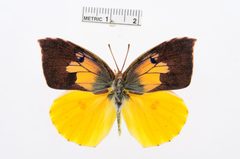
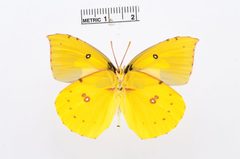
Zerene eurydice, commonly known as the California dogface , is a pierid butterfly to California and designated as the state's official insect since 1972. The exhibits pronounced : males display distinctive black and yellow-orange wing patterns resembling a dog's silhouette, while females are predominantly yellow with black forewing markings. The butterfly is closely associated with its larval plants, false indigo species (Amorpha californica and A. fruticosa), and is most abundant at the Shutamul Bear River Preserve near Auburn. Despite its cultural prominence, the species remains rarely encountered in the wild due to its fast, high-flying and specific requirements.

Pronunciation
How to pronounce Zerene eurydice: /zeˈreː.ne eʊ̯ˈrɪ.dɪˌkeː/
These audio files are automatically generated. While they are not always 100% accurate, they are a good starting point.
Identification
Distinguished from similar pierids by the male's unique forewing pattern: black border enclosing yellow-orange patch with two black dots forming dog- silhouette. Females resemble other yellow pierids but show paired black forewing dots rather than extensive dark margins. Differs from Zerene cesonia (southern dogface) by geographic range and subtle wing pattern differences. UV forewing patterns visible only in males and only on surface, unlike some Colias with more extensive UV markings. Fast, sustained at 15–20 feet above ground often precludes close observation.
Images
Appearance
Medium-sized with wingspan 5.1–6.3 cm. Wings covered in ; body bears setae hairs. Males: forewings with black outer margins enclosing yellow-orange patch containing two black dots, creating dog- silhouette; iridescent UV-reflective structures on dorsal forewings. Females: predominantly yellow wings with two black dots or dashes on each forewing, minimal dark markings. Both sexes: UV patterns restricted to dorsal forewings only. Larvae and pupae greenish-yellow, matching plant foliage.
Habitat
Foothill and montane environments including chaparral, oak woodlands, and coniferous forests. Specifically associated with riparian zones and streambanks where plants grow among poison oak, willow, and rocky substrates. Temperate terrestrial climate. Optimal exemplified by Shutamul Bear River Preserve: 40-acre conservation site with extensive false indigo stands on Bear River banks.
Distribution
Strictly to California, USA. Documented in 37 of 58 California counties including Alameda, Butte, Contra , El Dorado, Fresno, Glenn, Kern, Kings, Lake, Los Angeles, Marin, Mariposa, Mendocino, Monterey, Napa, Nevada, Orange, Placer, Plumas, Riverside, Sacramento, San Diego, San Francisco, San Luis Obispo, San Mateo, Santa Barbara, Santa Cruz, Shasta, Sierra, Solano, Sonoma, Sutter, Tulare, Tuolumne, Ventura, Yolo, and Yuba. Core at Shutamul Bear River Preserve, Placer County. Historic breeding site in Gates Canyon, Solano County, apparently extirpated by 2020 wildfire.
Seasonality
Two annually: first brood April–July ( lifespan 3–4 months), second brood August–October (adult lifespan 6–8 months). Adults of second brood enter reproductive and overwinter, re-emerging early spring to mate. Daily activity: begins approximately 7 a.m., continues intermittently through afternoon with roosting in bushes between activity periods. Females typically initiate flight 1–2 hours after males.
Diet
Larvae: herbivore, feeding exclusively on Amorpha californica and Amorpha fruticosa (Fabaceae). : nectar from diverse flowers including blue gilia (Gilia), sunflowers (Helianthus), thistles (Cirsium), California buckeye (Aesculus californica), and tall blue verbena (Verbena). Attracted to moist soil areas, presumably for mineral uptake.
Host Associations
- Amorpha californica - larval false indigo; primary at core sites
- Amorpha fruticosa - larval secondary ; also Fabaceae
Life Cycle
Complete with four stages. laid on plant foliage. Larvae feed on Amorpha leaves, using greenish-yellow coloration for camouflage. occurs on or near host plant; chrysalis greenish-yellow. Two per year with second- entering extended dormancy. mechanism historically unclear; recent research investigating whether as adult or chrysalis. Average approximately 100 eggs per female per season.
Behavior
Fast, powerful, sustained typically 15–20 feet above ground level, making observation and photography difficult. Males patrol flight paths, often flying up and down canyons in repetitive beats. briefly descend to nectar at flowers but seldom linger. Both sexes roost in vegetation during inactive periods. Cryptic of stages: larvae and pupae rely on color matching with plant foliage to avoid detection.
Ecological Role
Human Relevance
Official state insect of California since July 28, 1972, following advocacy by Fresno fourth-graders and Assemblyman Kenneth L. Maddy. First state insect designated by any U.S. state. Cultural icon: depicted on California driver licenses, U.S. first-class postage stamp (2019), California State Fair monorail, and wine labels. Subject of 2013 children's book "The Story of the Dogface " by Fran Keller. Conservation focus: Shutamul Bear River Preserve managed partly for this ; volunteer docent-led tours available. Research subject for studies on UV signaling, , and butterfly conservation.
Similar Taxa
- Zerene cesoniaSouthern dogface; overlapping yellow-black coloration but distinct geographic range (southeastern U.S. and Mexico vs. California ), subtle wing pattern differences, and distribution prevent confusion in field
- Colias speciesRelated sharing yellow-orange and black wing patterns and UV male markings; distinguished by wing shape, pattern details, and lack of male dog- silhouette
- Other yellow pierids (e.g., Phoebis, Nathalis)Similar female coloration; distinguished by wing venation, pattern details, and male secondary sexual characteristics
More Details
Conservation status
Global status G4 (apparently secure) per NatureServe 2019 assessment. Uncommon and local with 81–300 element occurrences. Long-term decline <30% due to 20th-century conversion in California Coast and Transverse Ranges. Primary threats: fire suppression leading to habitat closure and eventual catastrophic fire; localized livestock grazing; habitat conversion. 2020 wildfire in Gates Canyon apparently extirpated historic ; Amorpha californica lacks fire resistance and does not stump-sprout.
Sexual selection research
Male iridescent UV forewing patterns, produced by microstructures, have been associated with mating success, suggesting role in female choice or male-male competition.
Taxonomic history
Has been placed in Colias as Colias eurydice; mitochondrial studies confirm close relationship but support separate generic status. Sister genus relationship to Colias well established.
Sources and further reading
- BugGuide
- Wikipedia
- GBIF taxonomy match
- iNaturalist taxon
- NCBI Taxonomy
- Catalogue of Life
- The Land of Z (Zerene) and The Land of B (Bohart) | Bug Squad
- Bohart Open House: Celebrating the California Dogface Butterfly | Bug Squad
- Take a Virtual Tour of the California Dogface Butterfly Habitat | Bug Squad
- California Dogface Butterfly: What the Fire Did | Bug Squad
- Can You Name California's State Insect? | Bug Squad
- In Pursuit of the California Dogface Butterfly | Bug Squad