
Neandra brunnea
(Fabricius, 1798)
pole borer, longhorned beetle
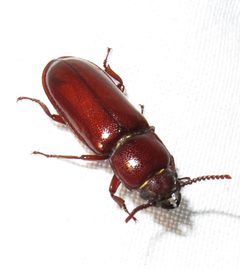
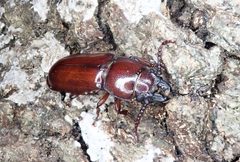
Neandra brunnea, commonly known as the pole borer, is a of longhorn beetle in the Parandrinae. It is unusual among cerambycids for its relatively short, bead-like rather than the elongated antennae typical of the . range from 8–20 mm in length and are yellowish-brown to reddish-brown in coloration. The species is distributed across eastern North America, with adults active from March through November. Larvae bore into decaying wood, including wooden poles and posts in contact with moist soil.
Pronunciation
How to pronounce Neandra brunnea: //niˈændɹə ˈbɹʌniə//
These audio files are automatically generated. While they are not always 100% accurate, they are a good starting point.
Identification
Distinguished from other North American parandrines by the (notched) inner margin of the ; Parandra polita has entire eyes and contiguous at the base. The short, serrate and reddish-brown coloration with large mandibles give it a superficial resemblance to small stag beetles (Lucanidae) or ground beetles (Carabidae), but the are distinctly pentamerous with slender, padless segments typical of Parandrinae. The only other eastern North American parandrine, P. polita, has a narrower, more flattened body and triangular mandibles that are contiguous at the base.
Images
Habitat
Deciduous woodlands and bottomland forests; larvae develop in decaying wood of hardwoods. have been collected at blacklights in wet bottomland forest . The is associated with moist environments where decaying wood is in contact with soil.
Distribution
Eastern North America, from Canada (New Brunswick, Ontario, Québec) southward through the eastern United States. Records include the Mississippi River valley and surrounding regions.
Seasonality
active March through November; most commonly encountered at blacklights during summer months.
Diet
Larvae bore into and feed on decaying hardwood; specifically recorded from poles and posts in contact with moist soil. diet unknown but likely minimal or non-feeding given short adult lifespan typical of cerambycids.
Host Associations
- decaying hardwood - larval food sourceIncludes wooden poles and posts in contact with moist soil
Life Cycle
Complete with wood-boring larval stage. Larvae tunnel in decaying wood, creating galleries. occurs within the wood. emerge and are attracted to lights at night. Specific details of -laying and larval development duration are not well documented.
Behavior
are and attracted to ultraviolet light. They are capable of but are not strong fliers. When disturbed, adults may remain motionless or crawl with urgency but make no attempt to fly. Larvae are cryptic wood-borers.
Ecological Role
Decomposer; larvae break down decaying hardwood, contributing to nutrient cycling in forest . The association with moist, decaying wood suggests a role in processing dead wood in bottomland and riparian forests.
Human Relevance
Occasional pest of wooden poles and posts in contact with moist soil; the "pole borer" reflects this association. Not considered a significant economic pest of living trees or structural timber. Attracted to blacklights, making it a subject of interest for collectors and researchers.
Similar Taxa
- Parandra politaAlso a parandrine cerambycid with short and large , but has entire (not ) , mandibles contiguous at the base, and a narrower, more flattened body
- Lucanus capreolusSuperficially similar reddish-brown coloration and large , but is a (Lucanidae) with and different body proportions
- Carabidae (ground beetles)Superficially similar body shape and running , but have , different tarsal structure, and are active
Misconceptions
Despite the "longhorned ," this lacks the characteristically long of most Cerambycidae. The short, bead-like antennae and robust body with large frequently lead to misidentification as a or ground beetle.
More Details
Antennal morphology
The short, (bead-like) and serrate of N. brunnea represent the plesiomorphic condition in Cerambycidae, retained in the archaic Parandrinae but lost in most other subfamilies where antennae are typically and greatly elongated.
Tarsal structure
Parandrinae, including N. brunnea, have distinctly pentamerous with slender, padless segments—another plesiomorphic trait shared with the small Spondylidinae.
Rarity of observation
Despite being considered the most commonly encountered of the four North American parandrine , live are rarely observed; most records come from passive collection methods such as blacklights or Japanese beetle traps.