
Neandra
Lameere, 1912
pole borer
Species Guides
2- Neandra brunnea(pole borer)
- Neandra marginicollis
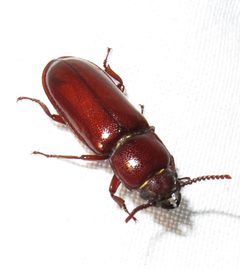
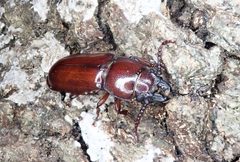
Neandra is a of longhorned beetles in the Cerambycidae, Parandrinae. The genus contains at least two described : Neandra brunnea and Neandra marginicollis. These beetles are atypical for cerambycids, possessing short, bead-like rather than the elongated antennae characteristic of most longhorned beetles. They are known to bore in decaying wood and are attracted to lights at night.
Pronunciation
How to pronounce Neandra: //niˈæn.drə//
These audio files are automatically generated. While they are not always 100% accurate, they are a good starting point.
Identification
Neandra can be distinguished from other cerambycids by their short, equal-segmented (not elongated as in typical longhorned beetles), pentamerous with slender, padless segments, and (notched) inner margins. They resemble small stag beetles in general appearance due to reddish-brown coloration and prominent forward-projecting . Neandra brunnea has sickle-shaped mandibles that are well separated at the base and distinctly emarginate eyes, while the related Parandra polita has triangular mandibles contiguous at the base and entire eyes.
Images
Habitat
Decaying wood, including standing dead trees and wooden poles or posts in contact with moist soil. Wet bottomland forests along river systems.
Distribution
North America. Neandra brunnea has been recorded from North America, South Africa, and Germany (the latter records possibly representing introductions). Neandra marginicollis is known from the United States.
Seasonality
have been observed in June and July.
Life Cycle
Larval stage bores in decaying wood, including poles and posts in contact with moist soil.
Behavior
are and attracted to blacklights. They have been observed "sleeping" or resting during daylight hours.
Ecological Role
Decomposer; larvae contribute to wood decay and nutrient cycling in forest .
Human Relevance
Known as "pole borers" due to larval habit of boring in wooden poles and posts in contact with moist soil, potentially causing structural damage.
Similar Taxa
- Parandra politaAlso in Parandrinae with short and -like appearance, but has triangular contiguous at the base and entire (not ) , plus a narrower, more flattened body.
- Orthosoma brunneumAlso a large, brown prionid with somewhat similar body form, but has longer and lacks the short, bead-like antennae of Neandra.