
Orthosoma brunneum
(Forster, 1771)
Brown Prionid
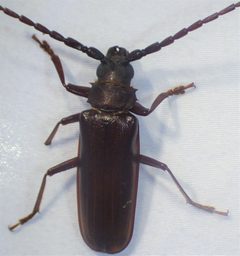
Orthosoma brunneum is a large, brown longhorned beetle in the Prioninae, commonly known as the brown prionid. It is the sole in its and is widely distributed across eastern North America. are and frequently attracted to ultraviolet lights. Larvae develop in decaying logs and have been shown to tolerate and behaviorally respond to high carbon dioxide concentrations typical of their wood-boring .


Pronunciation
How to pronounce Orthosoma brunneum: /ɔrˈθoʊˌsoʊmə ˈbrʌn.i.əm/
These audio files are automatically generated. While they are not always 100% accurate, they are a good starting point.
Identification
Orthosoma brunneum can be distinguished from similar large brown cerambycids by its placement in the Prioninae (prionid root borers), indicated by the broad, tuberculate pronotum and overall robust build. It differs from Prionus by its shorter, non- and uniform brown coloration (Prionus species often show more contrasting patterns). It can be separated from other brown prionines such as Tragosoma depsarium by its more elongated body form and lack of distinct elytral maculations. The related Derobrachus (giant palm borers) is much larger and has distinctly spined pronota.
Images
Habitat
Deciduous and mixed forests, particularly areas with abundant dead or decaying hardwood logs. are often found near rotting stumps and fallen timber. The shows a preference for moist, decaying wood where larval development occurs.
Distribution
Eastern North America, ranging from southern Canada (Ontario, Quebec, New Brunswick, Nova Scotia) south through the eastern United States. Records extend westward to the Great Plains region. The is broadly distributed across the deciduous forest biome of eastern North America.
Seasonality
are active primarily during summer months, with peak activity from June through August. activity is common, with adults frequently attracted to lights after dark. Larvae are present year-round within logs.
Life Cycle
Larvae develop in the heartwood and sapwood of decaying hardwood logs, creating extensive galleries as they feed. The larval stage is prolonged, likely spanning multiple years. Larvae have been demonstrated to tolerate low-oxygen, high-carbon dioxide conditions typical of decaying wood, and actively select microhabitats with elevated CO₂ concentrations while feeding. occurs within the log, and emerge through exit holes. Mated females show a strong preference for ovipositing in substrates with high CO₂ concentrations, which serves as a cue for suitable larval .
Behavior
are primarily and are strongly attracted to ultraviolet lights. They are not attracted to prionic acid lures that are highly effective for Prionus . Larvae exhibit specific behavioral responses to carbon dioxide: feeding larvae actively aggregate in areas with 30-50% CO₂ when given a choice, while non-feeding larvae lose this preference. Adult females, particularly mated individuals, select oviposition sites based on elevated CO₂ concentrations, which indicates decaying wood suitable for larval development. Males do not show behavioral responses to CO₂.
Ecological Role
As a wood-boring , O. brunneum contributes to the decomposition of dead hardwood timber, facilitating nutrient cycling in forest . The is part of the saproxylic (dead-wood dependent) and provides (through its galleries) for other organisms. It is not considered a significant economic pest, as it primarily colonizes already-decayed wood rather than healthy trees or seasoned lumber.
Human Relevance
Occasionally attracted to porch and security lights, where it may be noticed by homeowners. Not a structural pest. Sometimes collected by entomologists using ultraviolet light traps or encountered during fieldwork. Has been used in physiological and behavioral research on insect responses to atmospheric gases.
Similar Taxa
- Prionus imbricornisSimilar large brown prionine with overlapping range and , but distinguished by male's hypersegmented, and attraction to prionic acid lures (O. brunneum lacks both traits).
- Derobrachus spp.Similar large brown prionines, but much larger (often 50+ mm), with prominently spined pronota and southwestern distribution (D. geminatus occasionally ranges into eastern states).
- Tragosoma depsariumAnother large brown prionine with similar , but has distinct dark markings on the and more rounded body profile.
Misconceptions
Often mistaken for Prionus due to similar size, coloration, and placement, but lacks the diagnostic antennal modifications and responses of that . The 'brown prionid' reflects this subfamily affinity but can cause confusion with true Prionus species.
More Details
Physiological Research
Orthosoma brunneum has been the subject of classic studies on insect respiratory physiology and , particularly regarding of and behavioral responses to high CO₂ and low O₂ conditions in decaying wood . These studies demonstrated that larvae actively select high-CO₂ microenvironments while feeding, likely because such conditions indicate ongoing microbial decay and suitable nutritional substrate.
Taxonomic Note
The name Orthosoma was also used historically for a microsporidian genus, but this usage has been replaced by Orthosomella to avoid homonymy with the genus.
Sources and further reading
- BugGuide
- GBIF taxonomy match
- iNaturalist taxon
- NCBI Taxonomy
- Catalogue of Life
- Summer Insect Collecting iRecap | Beetles In The Bush
- Cerambycidae | Beetles In The Bush | Page 5
- July | 2011 | Beetles In The Bush
- Disteniidae | Beetles In The Bush
- THE CARBON DIOXIDE RELATED BEHAVIOR OF THE ADULTS OF ORTHOSOMA BRUNNEUM (FORSTER) (COLEOPTERA, CERAMBYCIDAE)
- THE BEHAVIOR OF THE LARVAE OF ORTHOSOMA BRUNNEUM (FORSTER) (COLEOPTERA, CERAMBYCIDAE) IN RELATION TO GASES FOUND IN THE LOGS INHABITED BY THE LARVAE