
Derobrachus
Audinet-Serville, 1832
Species Guides
5- Derobrachus brevicollis(Bahiagrass Borer)
- Derobrachus geminatus(palo verde beetle)
- Derobrachus hovorei(Palo Verde Root Borer)
- Derobrachus leechi
- Derobrachus thomasi(Thomas's Oak Borer)
Derobrachus is a of prionine longhorned beetles in the Cerambycidae. The genus contains approximately 21 described distributed across the Americas, from the southwestern United States through Mexico and Central America to northern South America. Several species, including D. hovorei, are commonly known as 'palo verde root borers' due to their association with that plant. The genus was established by Audinet-Serville in 1832. A recently described species, D. cusucoensis from Honduras, was discovered in cloud forest and represents the ninth species recorded for that country.
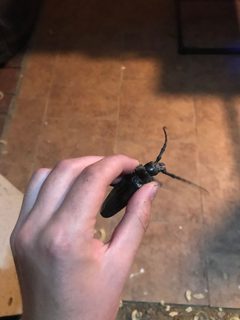
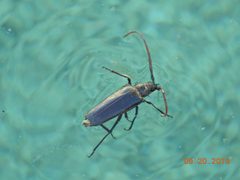
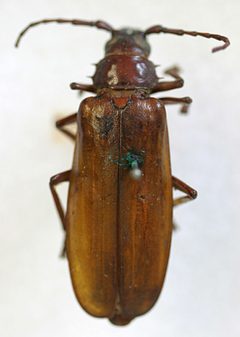
Pronunciation
How to pronounce Derobrachus: /ˌdɛrəˈbrækəs/
These audio files are automatically generated. While they are not always 100% accurate, they are a good starting point.
Identification
Derobrachus are large, robust prionine beetles with elongated bodies and very long . They can be distinguished from other New World prionine by their overall body form and antennal structure. Species-level identification requires examination of specific morphological characters including pronotal shape, elytral , and antennal segment proportions. D. hovorei, a common species in the southwestern United States, is recognized by its size and the 'palo verde root borer.'
Images
Habitat
vary by and include desert scrub, mesquite-acacia woodland, oak-juniper woodland, and montane cloud forest. D. cusucoensis occurs in Honduran cloud forest at montane elevations. In the southwestern United States, species such as D. hovorei are found in creosote-mesquite scrub and associated desert habitats. Several species show association with specific plants including Parkinsonia/Cercidium (palo verde) and various Prosopis species.
Distribution
The ranges from the southwestern United States (Arizona, New Mexico, Texas) south through Mexico and Central America to northern South America. Honduras has nine recorded including the recently described D. cusucoensis from Cusuco National Park. D. hovorei occurs in the Sonoran Desert region of Arizona and adjacent areas.
Seasonality
of at least some are active during summer months. D. hovorei has been observed at lights in late July. Activity patterns likely vary by species and region.
Host Associations
- Parkinsonia/Cercidium (palo verde) - larval D. hovorei commonly known as 'palo verde root borer'
- Prosopis glandulosa (mesquite) - associated found in mesquite areas
Behavior
of at least some are attracted to mercury-vapor and ultraviolet lights at night. D. hovorei adults have been observed crawling on sand near light stations. Larvae are wood-borers, developing in roots and trunks of trees.
Ecological Role
As larvae, Derobrachus function as wood-boring insects in living or dead trees, contributing to nutrient cycling and potentially affecting tree health. Their association with woody legumes such as palo verde and mesquite suggests a specialized role in these .
Human Relevance
Some , particularly D. hovorei, are familiar to entomologists and naturalists in the southwestern United States due to their large size and attraction to lights. The 'palo verde root borer' reflects their association with this iconic desert tree. No significant economic or medical importance is documented.
Similar Taxa
- PrionusBoth are large prionine beetles with long attracted to lights; Prionus typically have more strongly serrated or pectinate antennae in males and different pronotal shapes
- NothopleuraAnother large prionine in the same tribe; Nothopleura such as N. madericus have different body proportions and antennal structure
More Details
Species diversity
The contains approximately 21 described , with several new species described in the 21st century including D. chemsaki, D. drumonti, D. hovorei, D. lingafelteri, D. thomasi, and D. wappesi (all Santos-Silva, 2007) and D. cusucoensis (Santos-Silva et al., 2018). Many species are named after coleopterists including D. hovorei (Frank Hovore), D. wappesi (Jim Wappes), and D. lingafelteri (Steve Lingafelter).
Taxonomic history
The was established by Audinet-Serville in 1832 with D. brevicollis as the type . The genus has been subject to modern taxonomic revision, with an identification key to all species published and updated to include newly described .