
Orthosoma
Audinet-Serville, 1832
brown prionid
Species Guides
1- Orthosoma brunneum(Brown Prionid)
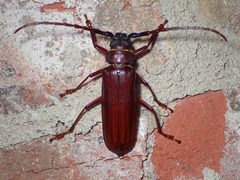
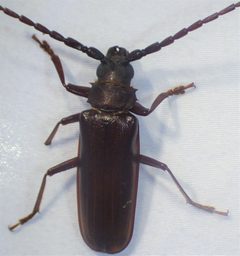
Orthosoma is a of longhorned beetles ( Cerambycidae) containing the single Orthosoma brunneum, commonly known as the brown prionid. The genus is classified in the Prioninae and tribe Prionini. are attracted to lights and have been documented in fermenting traps. The genus name Orthosoma was previously used for a microsporidian genus, which has since been renamed Orthosomella due to this preoccupation.

Pronunciation
How to pronounce Orthosoma: //ɔːrˈθoʊsə.mə//
These audio files are automatically generated. While they are not always 100% accurate, they are a good starting point.
Identification
The single Orthosoma brunneum can be distinguished from related prionine beetles by the presence of several spikes on the pronotum, a characteristic feature of the . Males lack the hypersegmented, modifications seen in males of the genus Prionus. The species is not attracted to prionic acid lures, unlike Prionus species.
Images
Habitat
have been observed at ultraviolet lights in pine-oak-hickory forests. Larvae inhabit decaying logs, where they exhibit behavioral responses to carbon dioxide concentrations.
Distribution
Eastern and central North America.
Seasonality
are active during July and August, with peak activity in summer months.
Diet
Larvae feed in decaying wood of logs.
Life Cycle
Larval development occurs within decaying logs. Larvae congregate in areas with elevated carbon dioxide concentrations (30–50% CO2) during feeding stages; when feeding ceases, they no longer show this selective . emerge in summer.
Behavior
are and attracted to ultraviolet lights. Unmated females are found more frequently in areas with decaying wood or elevated CO2 concentrations. Mated females oviposit preferentially in locations with the highest available CO2 concentrations, suggesting carbon dioxide plays a role in oviposition site selection. Males do not exhibit behavioral responses to CO2.
Ecological Role
Larvae contribute to wood decomposition in forest .
Human Relevance
occasionally come to lights at residences. The has been documented in fermenting trap surveys for Cerambycidae.
Similar Taxa
- PrionusBoth are in Prioninae, but Prionus males have hypersegmented, adapted for detecting , and Prionus are attracted to prionic acid lures, whereas Orthosoma brunneum is not.
Sources and further reading
- BugGuide
- Wikipedia
- iNaturalist taxon
- NCBI Taxonomy
- Catalogue of Life
- July | 2011 | Beetles In The Bush
- Disteniidae | Beetles In The Bush
- Summer Insect Collecting iRecap | Beetles In The Bush
- THE CARBON DIOXIDE RELATED BEHAVIOR OF THE ADULTS OF ORTHOSOMA BRUNNEUM (FORSTER) (COLEOPTERA, CERAMBYCIDAE)
- THE BEHAVIOR OF THE LARVAE OF ORTHOSOMA BRUNNEUM (FORSTER) (COLEOPTERA, CERAMBYCIDAE) IN RELATION TO GASES FOUND IN THE LOGS INHABITED BY THE LARVAE