
Tragosoma
Audinet-Serville, 1832
Species Guides
4- Tragosoma harrisii(Hairy Pine Borer)
- Tragosoma pilosicorne
- Tragosoma soror
- Tragosoma spiculum
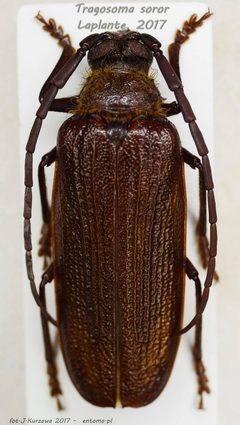
Tragosoma is a of large saproxylic longhorn beetles in the Prioninae, distributed across the Holarctic region. The genus includes approximately six described , with Tragosoma depsarium being the most widely studied and the type species. These beetles are obligate deadwood whose larvae develop in the sapwood of conifers, particularly pines. are notable for their robust, somewhat flattened bodies and relatively short compared to other cerambycids. Several species are of conservation concern due to their dependence on specific deadwood microhabitats threatened by modern forestry practices.
Pronunciation
How to pronounce Tragosoma: /træɡoʊˈsoʊmə/
These audio files are automatically generated. While they are not always 100% accurate, they are a good starting point.
Identification
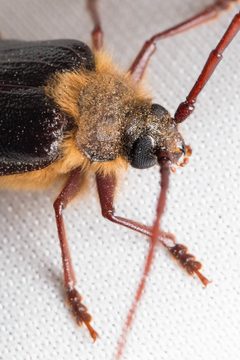
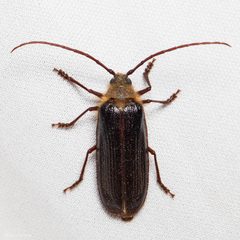
Tragosoma are distinguished from other North American prionines by their combination of large size (20–35 mm), robust and somewhat flattened body form, and relatively short that do not greatly exceed body length. The pronotum bears distinct lateral spines or . are often sculptured with coarse punctation or . T. depsarium specifically can be recognized by its dark coloration with variable reddish or brownish markings, and the distinctive large oval exit holes (up to 12 mm wide with rough edges) created by emerging . The is distinguished from similar large cerambycids such as Ergates and Trichocnemis by body proportions and antennal length.
Images
Habitat
Coniferous forests in and alpine regions. Larval development occurs in deadwood, specifically large-diameter (≥8 cm), bark-free, sun-exposed logs of Scots pine (Pinus sylvestris) and occasionally Norway spruce (Picea abies). Prefers downed logs in open conditions with higher humidity and more stable daily temperatures, though standing deadwood is also utilized. Dry to semi-dry environments are favored.
Distribution
Holarctic distribution spanning Eurasia and North America. In Eurasia: fragmented from northern Europe (Sweden) to southern Europe (Greece, Spain), and eastward through Russia to Siberia and the Russian Far East; southern and central European restricted to mountain regions, while eastern European and Fennoscandian populations occur in forests. In North America: western regions including southwestern United States. Individual have more restricted ranges within this broad pattern.
Diet
Saproxylic; larvae feed on the sapwood of dead conifers, primarily Pinus . do not feed on wood; specific adult diet unknown.
Host Associations
- Pinus sylvestris - larval development substrateScots pine; primary , bark-free sun-exposed logs
- Picea abies - larval development substrateNorway spruce; rarely used
Life Cycle
Larval development requires 4 or more years in the sapwood of dead conifers. occurs in the wood, with emerging through distinctive large oval exit holes. Development can occur in recently dead trees as well as in logs dead for more than 100 years. Adults are relatively long-lived and may be encountered outside the typical season.
Behavior
create large oval exit holes (up to 12 mm wide) with rough edges, typically on south-facing sides of wood. Shows strong fidelity to wood with existing galleries and exit holes—89% of new exit holes occur in deadwood items bearing old T. depsarium exit holes. Occupancy and abundance correlate with specific microclimatic conditions: colder and more stable winter temperatures, higher spring temperatures, and reduced daily temperature fluctuations.
Ecological Role
Saproxylic contributing to deadwood decomposition in coniferous forest . As a dependent on large-diameter deadwood with specific microclimatic characteristics, serves as an for old-growth forest conditions and deadwood continuity. The is part of the of wood-boring insects that initiate and accelerate wood decomposition processes.
Human Relevance
Tragosoma depsarium is listed as Near Threatened on the IUCN European Red List and Vulnerable on the Swedish national Red List. Primary threats include industrial forestry reducing deadwood availability, fire suppression eliminating standing deadwood, and removal of coarse woody debris. The has been the subject of conservation-oriented research on deadwood management and microclimate requirements. Other species in the are occasionally encountered by entomologists using fermentation traps baited with sweet red wine.
Similar Taxa
- Ergates faberBoth are large prionine cerambycids developing in coniferous deadwood; Ergates has more elongate body form and males possess extremely long exceeding body length by much more than in Tragosoma
- Trichocnemis spiculatusSimilar large size and coniferous ; Trichocnemis has more cylindrical body and different pronotal armature
- Rhagium inquisitorBoth are Holarctic saproxylic cerambycids with and conifer associations; Rhagium is in Lepturinae, much smaller (12–20 mm), with distinctly ribbed and pupates directly under bark rather than in sapwood
Sources and further reading
- BugGuide
- Wikipedia
- GBIF taxonomy match
- iNaturalist taxon
- NCBI Taxonomy
- Catalogue of Life
- A winter longhorned beetle | Beetles In The Bush
- Oecanthidae | Beetles In The Bush
- The geographic range of Tragosoma depsarium (Linnaeus, 1767) (Coleoptera, Cerambycidae) in the Palaearctic
- Microclimatic Conditions Mediate The Effect of Deadwood and Forest Characteristics On a Threatened Beetle Species, Tragosoma Depsarium
- Microclimatic conditions mediate the effect of deadwood and forest characteristics on a threatened beetle species, Tragosoma depsarium