
Tragosoma harrisii
LeConte, 1851
Hairy Pine Borer
Tragosoma harrisii is a large longhorned beetle in the Cerambycidae, Prioninae. It is one of the few North American cerambycids with a Holarctic distribution, also occurring in Europe and Asia. The is associated with coniferous forests and has been documented in and montane regions across its range. are active during summer months and have been collected using sweet red wine-baited traps.
Pronunciation
How to pronounce Tragosoma harrisii: /træɡoʊˈsoʊmə ˈhærɪsaɪ/
These audio files are automatically generated. While they are not always 100% accurate, they are a good starting point.
Identification
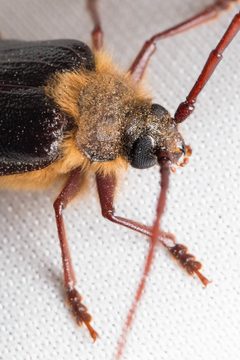
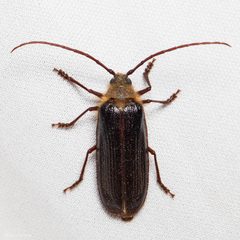
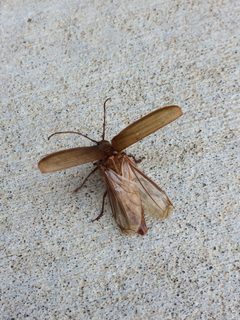
Distinguished from other North American Tragosoma by its Holarctic distribution and association with coniferous . The hairy body surface separates it from smoother . Males can be recognized by their longer relative to females. The is larger and more robust than most Lepturinae and many other cerambycids. In the western United States, it may occur sympatrically with other large prionines but differs in its setose appearance.
Images
Habitat
Coniferous forests, particularly those dominated by pine . Associated with and montane forest . In western North America, found in Ponderosa pine and pinyon-juniper woodlands at moderate to high elevations. The species breeds in dead or dying conifer wood.
Distribution
Holarctic distribution: North America (western Canada and United States including Alberta, British Columbia, Manitoba, and southward; also New Brunswick, Newfoundland in eastern Canada), Europe, and Asia. In the western United States, documented from Utah, Arizona, Nevada, and surrounding states. The shows a transcontinental range in North America unlike many cerambycids with more restricted distributions.
Seasonality
active during summer months. In the southwestern United States, has been collected in June and September. Peak activity likely varies by latitude and elevation, with higher elevation active later in the season.
Host Associations
- Pinus ponderosa - breedingPonderosa pine, documented from trap sites in Ponderosa pine woodlands
- Pinus monophylla - breedingSingle-leaf pinyon pine, associated with pinyon-juniper woodlands
- Juniperus osteosperma - breedingUtah juniper, found in mixed conifer woodlands
Life Cycle
Larval development occurs in dead or dying conifer wood, likely requiring substantial wood mass given the large size. presumably occurs within the wood, though specific details of pupation site (under bark versus in sapwood) have not been documented for this . Adults emerge in summer. The complete duration is unknown but likely spans multiple years given the species' size and wood-boring habit.
Behavior
are attracted to sweet fermenting baits, particularly sweet red wine (SRW), and have been collected in jug traps baited with this substance. activity on tree trunks has not been documented for this , unlike some other large cerambycids. Adults do not feed on flowers or foliage; their mouthparts are likely adapted for minimal feeding or mate location rather than substantial nutrition.
Ecological Role
Primary decomposer in coniferous forest , facilitating nutrient cycling through wood decomposition. Larval tunneling in dead wood creates for other organisms and contributes to forest structural diversity. The is part of the guild of large wood-boring beetles that initiate decomposition of coarse woody debris in conifer forests.
Human Relevance
Of minor economic concern; may occasionally be found in dead timber or firewood but is not a primary pest of living trees or commercial timber. Occasionally collected by entomologists using baited traps. The is of biogeographic interest due to its Holarctic distribution pattern shared with only a handful of other North American cerambycids.
Similar Taxa
- Tragosoma depsariumAlso Holarctic in distribution and associated with conifers; T. harrisii distinguished by hairy body surface and more western North American distribution
- Tragosoma nigripenneAnother North American Tragosoma ; T. harrisii differs in distribution and body
- Derobrachus spp.Large prionine beetles with robust bodies; distinguished by extremely long in males and different associations (often lower elevations, different trees)
- Enaphalodes spp.Large cerambycids frequently captured in same traps; distinguished by different body shape, smoother , and different antennal structure
More Details
Holarctic Distribution
One of approximately nine North American cerambycid with confirmed Holarctic distributions, including Rhagium inquisitor, Asemum striatum, Arhopalus rusticus, Acmaeops pratensis, Pachyta lamed, Judolia sexmaculata, and Saperda populnea. Most of these species are associated with conifers, suggesting a shared ecological basis for their transcontinental distributions.
Taxonomic History
First described by LeConte in 1851. The Tragosoma contains relatively few globally, with T. harrisii representing the primary North American representative of the genus in the western part of the continent.
Collection Methods
Most effectively collected using sweet red wine-baited jug traps placed in coniferous . Bottle traps appear less effective for this . have been captured in traps left in the field for extended periods (up to three months), suggesting prolonged adult activity or attraction to aging .