
Arhopalus rusticus
(Linnaeus, 1758)
rust pine borer
Species Guides
3Arhopalus rusticus is a longhorned beetle (Cerambycidae: Spondylinae) native to coniferous forests of the Northern Hemisphere. are and attracted to light, hiding under bark during daylight. The has been introduced to Australia, New Zealand, and South America through global trade and is considered a significant forestry pest. It is a suspected of the pine wood Bursaphelenchus xylophilus, though research indicates its oviposition does not facilitate nematode transmission. Males produce an -, (S)-fuscumol, which has potential applications for detection and monitoring.
Pronunciation
How to pronounce Arhopalus rusticus: /ɑːrˈhɒpələs ˈrʌstɪkəs/
These audio files are automatically generated. While they are not always 100% accurate, they are a good starting point.
Identification
Distinguished from similar spondylidine beetles by the combination of dark brown to brownish-red coloration, dull finish, and 2–3 parallel elytral ridges. Antennal length relative to body differs between sexes. Larval galleries under bark are 6–7 mm wide and similar to those of A. striatum, requiring close examination for separation. may be separated from A. striatum by subtle differences in antennal proportions and elytral sculpturing.
Images
Appearance
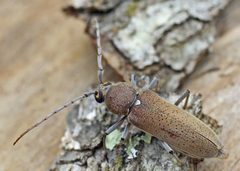
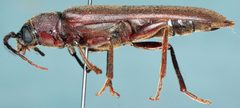
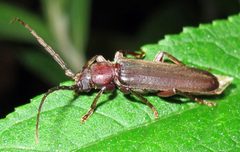
measure 10–30 mm in length. Body elongated, flattened, and slightly hairy. Coloration dark brown to brownish-red with dull finish. bear 2–3 parallel longitudinal ridges. sexually dimorphic: females with antennae not exceeding half body length, males with antennae approximately two-thirds body length. Larva white, flattened, 28–39 mm long when mature. Pupa up to 25 mm long. white, elongated, approximately 0.5 × 1.9 mm.
Habitat
Coniferous forests, particularly those dominated by Pinus (pines), Picea (spruce), Cunninghamia (fir), and Cupressus (cypress). Infests basal portions of trees up to 1.5 m in height. Associated with weakened, dying, or dead conifers, including post-fire dry wood. Larvae show strong spatial in woodland centers, while display random spatial distribution within stands.
Distribution
Native to northern and central Europe, Siberia, Korea, Mongolia, northern Pakistan, Japan, and northern China. Naturalized and established across the United States. Introduced to Australia, New Zealand, and South America (Argentina). Climate modeling predicts potential range expansion under future warming scenarios, with increasing suitability in southern hemisphere regions.
Seasonality
active from mid-June through late August. activity pattern with peak attraction to light after nightfall. Two-year time with larvae once or twice under bark or in wood before pupating in spring or summer of the third year.
Diet
Larvae feed initially under bark, then enter wood through oval holes and excavate tunnels 6–7 mm wide in sapwood. do not feed significantly; gnawing on pine needles has been observed but is not required for reproductive maturation.
Host Associations
- Pinus - primary Scots pine and other Pinus preferred
- Picea - Norway spruce utilized, particularly in Europe
- Cunninghamia - Fir attacked
- Cupressus - Cypress utilized
- Pinus thunbergii - Japanese black pine in -affected stands
- Pinus tabulaeformis - Chinese pine in studied woodlands
Life Cycle
Complete with two-year . Mating occurs at sunset. Females deposit in clusters (up to 800 per female) into bark crevices. Eggs hatch in 2–3 weeks. Larvae feed under bark for 4–6 weeks before entering wood. Larvae overwinter once or twice, then construct pupal chambers and chew exit holes in spring or summer of third year. Pupal stage lasts 14–21 days. emerge through exit holes.
Behavior
; hides under bark during daylight hours. Strongly attracted to artificial light at night. Mating activity concentrated at sunset. Larvae exhibit spatial patterns with centers in woodland interiors, decreasing toward edges. show random spatial distribution. Both larvae and adults concentrate at specific heights on trees. Males produce aggregation- (S)-fuscumol that attracts both sexes.
Ecological Role
Secondary pest of weakened, dying, or fire-killed conifers. Second strongest known carrier of Bursaphelenchus mucronatus (pine wood ) after Monochamus alternatus; suspected but unconfirmed of Bursaphelenchus xylophilus. Contributes to decomposition of dead conifer . Shows high temporal segregation from Monochamus alternatus in co-infested trees, reducing direct competition.
Human Relevance
Significant forestry pest with potential for economic damage to conifer stands. in Australia, New Zealand, and South America requiring attention. Male-produced (S)-fuscumol identified for use in cost-effective detection and monitoring at ports of entry and in established . Climate change predicted to expand suitable , particularly in southern hemisphere. Not a confirmed of despite earlier suspicions—research shows ovipositor structure and surface -laying preclude transmission.
Similar Taxa
- Arhopalus striatumLarval galleries nearly identical in appearance; separable by antennal proportions and subtle elytral differences
- Spondylis buprestoidesAttracted to same male-produced (S)-fuscumol in field trials; distinguished by different
- Monochamus alternatusCo-occurs on declining Pinus trees; distinguished by different temporal activity patterns and confirmed status for pine wood
Misconceptions
Previously suspected as a of Bursaphelenchus xylophilus ( ), but dissection and behavioral studies confirm the ovipositor is less ossified than in Monochamus alternatus and are deposited only on bark surfaces, preventing nematode transmission during oviposition.
Sources and further reading
- BugGuide
- Wikipedia
- GBIF taxonomy match
- iNaturalist taxon
- NCBI Taxonomy
- Catalogue of Life
- Bembicid Holdings | Entomology Research Museum
- A winter longhorned beetle | Beetles In The Bush
- Research Showcases Best and Brightest Fathers of the Insect World
- 🪲 Entomologizing w/ the WGNSS Entomology Group at Hughes Mountain Natural Area — 11 Oct 2025 | Beetles In The Bush
- Very wary tigers! | Beetles In The Bush
- Geostatistical analysis of the spatial distribution of Arhopalus rusticus larvae and adults
- Prediction of the Global Distribution of Arhopalus rusticus under Future Climate Change Scenarios of the CMIP6
- Interspecific Relationship Between Monochamus alternatus Hope and Arhopalus rusticus (L.) in Pinus thunbergii Affected by Pine Wilt Disease
- Can forest pattern affect the distribution and abundance of Arhopalus rusticus (Coleoptera: Cerambycidae)? A landscape perspective in central Argentina
- Morphological Anatomy, Developmental Characteristics of the Reproductive System in Arhopalus rusticus (Coleoptera: Cerambycidae) and Their Impacts on the Transmission Potential of Bursaphelenchus xylophilus (Aphelenchida: Parasitaphelenchidae)
- A male-produced aggregation-sex pheromone of the beetle Arhopalus rusticus (Coleoptera: Cerambycidae, Spondylinae) may be useful in managing this invasive species
- Chromosome-level genome assembly of the longhorn beetle Arhopalus rusticus (Coleoptera: Cerambycidae).