
Arhopalus rusticus obsoletus
(Randall, 1838)
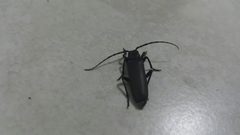
Arhopalus rusticus obsoletus is a of longhorned beetle in the Cerambycidae. It belongs to a with Holarctic distribution, occurring in both North America and Eurasia. The subspecies is associated with coniferous wood, where larvae develop under bark. are active during warmer months and can be found on or near dead conifers.
Pronunciation
How to pronounce Arhopalus rusticus obsoletus: /ɑrˈhɒpələs ˈrʌstɪkəs ɒbˈsoʊlɛtəs/
These audio files are automatically generated. While they are not always 100% accurate, they are a good starting point.
Images
Habitat
Associated with coniferous forests. Larvae develop under the bark of dead or dying conifers, particularly pines (Pinus spp.). are found on or near trees.
Distribution
North America; Caribbean; Middle America; Europe and Northern Asia (excluding China). The has a broad Holarctic distribution.
Seasonality
are active during spring and summer months. The overwinters as larvae under bark.
Diet
Larvae feed on dead conifer wood, particularly pine. Specific dietary details for this are not documented separately from the .
Host Associations
- Pinus - larval Primary for larvae
Life Cycle
laid under bark of dead conifers. Larvae feed and develop under bark, creating galleries in the cambium and outer sapwood. occurs under bark in lined with and wood shavings. emerge through exit holes. Overwinters as larva.
Ecological Role
Primary decomposer of dead conifer wood. Contributes to nutrient cycling in coniferous forest .
Human Relevance
Occasionally encountered in cut timber and processed pine products. Not considered a significant economic pest as it primarily colonizes dead or dying trees rather than living timber.
Similar Taxa
- Arhopalus rusticus rusticusEuropean nominate ; distinguished by subtle differences in elytral and coloration, though boundaries between subspecies are not always clear-cut
- Arhopalus ferusSimilar conifer-associated Arhopalus ; distinguished by differences in antennal length and pronotal shape
- Asemum striatumAnother Holarctic conifer-boring cerambycid with similar and distribution; distinguished by more cylindrical body form and different antennal proportions
More Details
Taxonomic Note
The subspecific status of A. rusticus obsoletus has been debated. Some treatments consider North American as specifically distinct (A. obsoletus), while others maintain them as a of the Holarctic A. rusticus. The GBIF treats it as a valid subspecies.
Holarctic Distribution Pattern
A. rusticus is one of several North American cerambycids with Holarctic distribution, including Tragosoma depsarium, Asemum striatum, Acmaeops pratensis, Pachyta lamed, Judolia sexmaculata, and Saperda populnea. Most of these are associated with conifers, suggesting historical biogeographic connections between Palearctic and Nearctic coniferous forests.
Sources and further reading
- BugGuide
- GBIF taxonomy match
- Bembicid Holdings | Entomology Research Museum
- A winter longhorned beetle | Beetles In The Bush
- Research Showcases Best and Brightest Fathers of the Insect World
- 🪲 Entomologizing w/ the WGNSS Entomology Group at Hughes Mountain Natural Area — 11 Oct 2025 | Beetles In The Bush
- “62nd” Annual “Season-Opener-Birthday-Bug-Collecting-Trip” | Beetles In The Bush