
Spondylidinae
Audinet-Serville, 1832
Tribe Guides
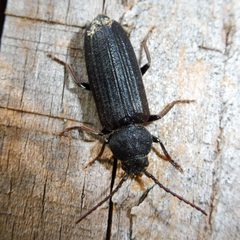
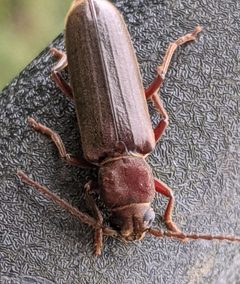
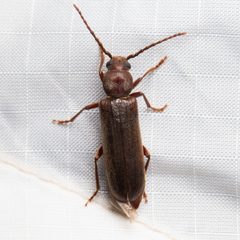
4Spondylidinae is a of longhorned beetles (Cerambycidae) comprising slightly over 100 , primarily distributed in coniferous forests of the hemisphere. Members are characterized by cerambycine aspect with flattened, dark bodies, oblique , and scarcely elongated . is minimal. The subfamily has a complicated systematic history, having been variously treated as Spondylidini, Aseminae, or Spondylidinae, with current consensus recognizing seven tribes: Anisarthrini, Asemini, Atimiini, Nothorhinini, Saphanini, Spondylidini, and Tetropiini. Many species are economically significant forest pests and prolific invaders globally.
Pronunciation
How to pronounce Spondylidinae: //ˌspɒndɪlɪˈdaɪniː//
These audio files are automatically generated. While they are not always 100% accurate, they are a good starting point.
Identification
Spondylidinae are distinguished from Cerambycinae by their divided stridulitrum. have a cerambycine aspect with generally flattened, dark bodies, oblique , and scarcely elongated . is scarcely evident. Larvae differ markedly from Cerambycinae and resemble Lepturinae larvae in having rounded heads and large , plus two closely spaced small spines on the last abdominal segment. The Tetropium is distinguished by finely faceted and activity, contrasting with the or habits of most other genera.
Images
Habitat
Primarily coniferous forests of the hemisphere; also occurs in coniferous forests of tropical and subtropical areas including Mexico and Cuba. Very few (e.g., Zamium, Masatopus) occur in Austral Africa and Madagascar. live on plants, taking under bark or in trunks during inactive periods.
Distribution
Native to Northern Hemisphere coniferous forests with highest diversity in Palearctic, North America, and Asia. established in New Zealand, Australia, South Africa, and South America. Specific regional records include: Lithuania and Kaliningrad Region (seven from four tribes); Eastern Anatolia, Turkey (one species); Connecticut and nearby U.S. states; and northeastern New Mexico/northwestern Oklahoma.
Diet
Phytophagous. Larvae of most attack conifers; exceptions include some Saphanini (Saphanus, Drymochares) and Anisarthrini. Larvae develop in stumps, large branches, and can infest stressed or fire-damaged trees. feed on plant tissues.
Life Cycle
Behavior
Nearly all are or ; only Tetropium (with finely faceted ) exhibits activity. Males of Tetropium fuscum display a -specific calling posture: vertical leg extension raising the body approximately 10° above the substrate, correlated with release of the fuscumol. Presence of males stimulates calling . Adults attracted to volatiles including ethanol and α-pinene.
Ecological Role
Larvae act as wood-borers in conifer , contributing to decomposition and nutrient cycling. Some are significant forest pests; Arhopalus rusticus carries the pine wood (Bursaphelenchus xylophilus), which causes . such as Arhopalus ferus and Tetropium fuscum impact plantation forestry and require monitoring.
Human Relevance
Economically important as forest pests and . Arhopalus ferus (burnt pine longhorn beetle) is monitored at New Zealand ports, airports, and sawmills to meet pine log export standards. Tetropium fuscum (brown spruce longhorn beetle) is an wood-borer in North America. -based monitoring using fuscumol and geranylacetone is employed for detection and management.
Similar Taxa
- CerambycinaeSimilar appearance (cerambycine aspect) but distinguished by undivided stridulitrum and different larval
- LepturinaeLarvae resemble Spondylidinae in having rounded and large , but differ in and Spondylidinae have divided stridulitrum
- ParandrinaeShares short, equal-segmented and pentamerous , but parandrines have margined pronotum and different structure
- AseminaeHistorically treated as separate but now synonymized; spondylidines and asemines share larval and are recognized as the same lineage
Sources and further reading
- BugGuide
- Wikipedia
- iNaturalist taxon
- NCBI Taxonomy
- Catalogue of Life
- When is a stag beetle not a stag beetle? | Beetles In The Bush
- Cerambycidae | Beetles In The Bush | Page 6
- Calling behavior of Tetropium fuscum (Coleoptera: Cerambycidae: Spondylidinae)
- Exploring the Nature of Arhopalus ferus (Coleoptera: Cerambycidae: Spondylidinae) Pheromone Attraction
- Larval Hosts of Cerambycidae (Coleoptera: Parandrinae, Prioninae, Lepturinae, Spondylidinae, Cerambycinae) in Connecticut and Nearby States
- First Report of the Larch Longhorn (Tetropium gabrieli Weise, Coleoptera: Cerambycidae: Spondylidinae) on Larix spp. in Lithuania
- A faunistic review of Spondylidinae Audinet-Serville, 1832 (Coleoptera: Cerambycidae) of the south-eastern Baltic region (Lithuania and the Kaliningrad Region)
- Doğu Anadolu Bölgesi Cerambycidae (Coleoptera) Tür Çeşitliliği: Kısım 1 (Lepturinae, Spondylidinae ve Cerambycinae) EASTERN ANATOLIA REGION CERAMBYCIDAE (COLEOPTERA) SPECIES DIVERSITY: PART 1 (LEPTURINAE, SPONDYLINIDAE AND CERAMBYCINAE)
- Catalogue of the Cerambycidae (Coleoptera) of the Neotropical Region. Part III. Subfamilies Parandrinae, Prioninae, Anoplodermatinae, Aseminae, Spondylidinae, Lepturinae, Oxypeltinae, and addenda to the Cerambycinae and Lamiinae