
Tetropium
Kirby, 1837
spruce longhorn beetles
Species Guides
8- Tetropium abietis(Round-headed Fir Borer)
- Tetropium cinnamopterum(Eastern Larch Borer)
- Tetropium fuscum(Brown Spruce Longhorn Beetle)
- Tetropium parallelum
- Tetropium parvulum(Northern Spruce Borer)
- Tetropium schwarzianum
- Tetropium undescribed
- Tetropium velutinum(Western Larch Borer)
Tetropium is a of long-horned beetles (Cerambycidae) containing at least 20 described , sometimes classified in its own tribe Tetropiini. Several species are significant forest pests, particularly of spruce (Picea) trees. The genus includes economically important species such as T. fuscum (brown spruce longhorn ), an pest in Atlantic Canada, and T. castaneum. are attracted to synthetic and tree volatiles, making them amenable to detection and monitoring using baited traps.
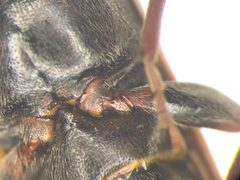
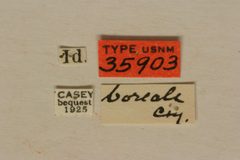
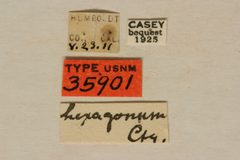
Pronunciation
How to pronounce Tetropium: //tɛˈtroʊpiːəm//
These audio files are automatically generated. While they are not always 100% accurate, they are a good starting point.
Images
Habitat
Forested regions with spruce or mixed coniferous stands; have been documented in freshly clear-cut areas, stressed or spruce stands, and natural forest including old-growth forests such as Białowieża Forest in Poland.
Distribution
Native to the Palearctic region including Europe and Asia; T. fuscum is established as an in Atlantic Canada (Nova Scotia) since at least 1980-1990; T. castaneum has been studied in field trials in Romania (Eastern Carpathians) and Poland but is not established in North America; distribution records from GBIF include Denmark, Norway, Sweden, and Vermont (USA).
Seasonality
emerge in early summer; larval development occurs through summer and autumn, with larvae in galleries and pupating in spring.
Host Associations
- Picea - primary Larvae are phloeophagous, feeding on phloem and cambium of living spruce trees; associated with spruce volatiles including monoterpenes and ethanol
- Picea rubens - Red spruce infested by T. fuscum in Atlantic Canada
- Picea abies - Norway spruce colonized by Tetropium in Poland
Life Cycle
Tetropium parvulum has a documented 1-year : emerge in early summer, larvae mature by September, overwinter in L-shaped galleries penetrating wood to 25–35 mm depth, and pupate in spring. T. fuscum larvae have six instars with sexually dimorphic -capsule widths in instars five and six.
Behavior
males produce and release the fuscumol ((2S,5E)-6,10-dimethyl-5,9-undecadienol) during a characteristic calling posture with body raised approximately 10° off the substrate, end elevated; presence of males stimulates calling . Both sexes are attracted to fuscumol when combined with volatiles; fuscumol alone primarily attracts females while addition of host volatiles increases male attraction. Cross-attraction occurs among sympatric Tetropium to (S)-fuscumol plus host volatiles. Adults show increased landing rates on larger diameter trees (>10 cm DBH), though this may reflect passive interception rather than active visual selection.
Ecological Role
Significant forest pest ; T. fuscum causes tree mortality in Atlantic Canada; larvae act as phloeophagous borers in spruce; of ophiostomatoid fungi including Ophiostoma tetropii (introduced to North America with T. fuscum), O. piceae, and Pesotum fragrans; serves as phoretic for mites (Trichouropoda shcherbakae), with T. fuscum carrying 82% of deutonymphs in one study.
Human Relevance
Economically important as forest pests; T. fuscum is in North America requiring detection and monitoring programs; T. parvulum is economically important borer of white and Engelmann spruce logs in Alberta; subject to extensive research on -based trapping using fuscumol, monoterpenes, and ethanol lures for monitoring and detection; Crosstrap and Barrier trap designs recommended for effective capture.
Similar Taxa
- Ips typographusBoth are coniferous forest pests attracted to volatiles; combination of (-)-alpha-pinene, ethanol, and I. typographus has been shown to match attractiveness of fuscumol lures for Tetropium
- MonochamusBoth are cerambycid with that are forest pests of conifers; share similar ecological roles as wood-boring beetles
More Details
Pheromone chemistry
Fuscumol is male-produced and acts as a long-range ; (S)-fuscumol and racemic fuscumol are active while (R)-fuscumol is inactive; attraction is synergized by monoterpenes and ethanol
Mite phoresy
In Białowieża Forest, Poland, 9.4% of Tetropium beetles carried phoretic mites (Trichouropoda shcherbakae), with most mites attached to legs; mite intensity varied temporally and by location on body
Fungal associations
Tetropium are associated with ophiostomatoid fungi; Ophiostoma tetropii was introduced from Europe to Atlantic Canada with T. fuscum; these fungi may contribute to tree mortality beyond direct larval damage
Sources and further reading
- BugGuide
- Wikipedia
- GBIF taxonomy match
- iNaturalist taxon
- NCBI Taxonomy
- Catalogue of Life
- Eumastacidae | Beetles In The Bush
- Effect of Chirality, Release Rate, and Host Volatiles on Response of Tetropium fuscum (F.), Tetropium cinnamopterum Kirby, and Tetropium castaneum (L.) to the Aggregation Pheromone, Fuscumol
- Field assessment of synthetic attractants and traps for the cerambycid beetles Tetropium castaneum L. and Tetropium fuscum (F.) in the Eastern Carpathians, Romania
- Host Volatile Attractants and Traps for Detection ofTetropium fuscum(F.),Tetropium castaneumL., and Other Longhorned Beetles (Coleoptera: Cerambycidae)
- Influence of Host Tree Condition on the Performance of an Exotic Longhorn Beetle, Tetropium fuscum (Coleoptera: Cerambycidae)
- NOTES ON THE BIOLOGY OF TETROPIUM PARVULUM (COLEOPTERA: CERAMBYCIDAE) IN ALBERTA
- Calling behavior of Tetropium fuscum (Coleoptera: Cerambycidae: Spondylidinae)
- Diversity and pathogenicity of ophiostomatoid fungi associated with Tetropium species colonizing Picea abies in Poland
- Number of instars and sexual dimorphism of Tetropium fuscum (Coleoptera: Cerambycidae) larvae determined by maximum likelihood
- Behavioral and Electrophysiological Responses of Tetropium fuscum (Coleoptera: Cerambycidae) to Pheromone and Spruce Volatiles
- Influence of Host Tree Condition on the Performance ofTetropium fuscum(Coleoptera: Cerambycidae)
- STUDIES IN THE BIOLOGY OF XYLONOMUS BRACHTYABRIS KR., AND X. IRRIGATOR F., PARASITES OF THE LARCH LONGHORN BEETLE, TETROPIUM GABRIELI WEISE
- Phoresy of Trichouropoda shcherbakae Hirschmann, 1972 (Acari: Mesostigmata) on beetles of the genus Tetropium Kirby, 1837 (Coleoptera: Cerambycidae) in Białowieża Forest, Poland
- Do visual cues associated with larger diameter trees influence host selection by Tetropium fuscum (Coleoptera: Cerambycidae)?
- A preliminary study on the pathogenicity of three blue-stain fungi associated with Tetropium spp. to Norway spruce in Poland
- Identity and phylogenetic relationships of ophiostomatoid fungi associated with invasive and native Tetropium species (Coleoptera: Cerambycidae) in Atlantic Canada
- Shape as a Key to Taxonomy: Morphometric Analysis of Tetropium Species (Coleoptera: Cerambycidae).