
Tetropium fuscum
(Fabricius, 1787)
Brown Spruce Longhorn Beetle
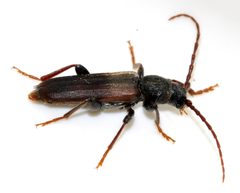
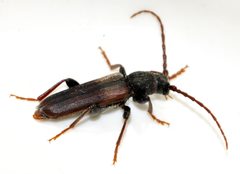
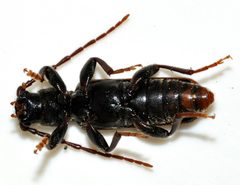
Tetropium fuscum is a wood-boring cerambycid beetle native to Europe and Northern Asia, established as an in Atlantic Canada since at least 1990. The is a documented pest of spruce trees (Picea spp.), with larvae developing in the phloem of trees. males produce an called fuscumol that attracts both sexes, particularly when combined with host tree volatiles. In its introduced Canadian range, it has been observed infesting stressed and red spruce, with larval galleries sometimes girdling stems and causing tree mortality.
Pronunciation
How to pronounce Tetropium fuscum: /tɛˈtroʊ.pi.əm ˈfʌs.kʌm/
These audio files are automatically generated. While they are not always 100% accurate, they are a good starting point.
Identification
can be distinguished from the native Tetropium cinnamopterum by morphological examination; historical misidentifications occurred in Nova Scotia where T. fuscum specimens were previously labeled as T. cinnamopterum. The male calling posture—body raised on extended legs with elevated—is a reliable indicator of release and can be used for field identification of sexually active males. Larvae have six instars with -capsule width measurements allowing instar determination; fifth and sixth instars show in head-capsule size.
Images
Habitat
Native range: coniferous forests in Continental Europe and parts of Asia. Introduced range: spruce forests in Atlantic Canada, particularly Nova Scotia. Occurs in forested areas with trees present, including freshly clear-cut areas and stands with stressed or spruce.
Distribution
Native to Europe and Northern Asia, recorded from Austria, Belarus, Belgium, Bosnia-Herzegovina, Bulgaria, Croatia, Czech Republic, Denmark, Estonia, Finland, France, Germany, Hungary, Italy, Japan, Kazakhstan, Latvia, Lithuania, Moldova, Montenegro, Netherlands, Norway, Poland, Romania, Russia, Serbia, Slovakia, Slovenia, Sweden, Switzerland, Turkey, and Ukraine. Introduced to Nova Scotia, Canada (first detected 1999, established since at least 1990), with subsequent detection in New Brunswick and Scotland (first British record 2015, with retrospective identification of a 1986 specimen).
Seasonality
active from spring through summer months; in Sweden, capture date approximately 2 weeks earlier than sympatric T. castaneum and T. gabrieli. Peak in spring and summer, with mating occurring soon after emergence.
Diet
Larvae feed on phloem of spruce trees. Documented include black spruce (Picea mariana), blue spruce (P. pungens), Norway spruce (P. abies), red spruce (P. rubens), Sitka spruce (P. sitchensis), white spruce (P. glauca), and Scots pine (Pinus sylvestris).
Host Associations
- Picea mariana - larval black spruce
- Picea pungens - larval blue spruce
- Picea abies - larval Norway spruce
- Picea rubens - larval red spruce
- Picea sitchensis - larval Sitka spruce
- Picea glauca - larval white spruce
- Pinus sylvestris - larval Scots pine
Life Cycle
Complete with six larval instars. laid on bark of standing trees or recently felled timber. Larvae hatch and bore into phloem, feeding until the following spring. emerge in spring and summer. in -capsule width apparent in fifth and sixth instars.
Behavior
Males produce an (fuscumol, identified as (2S,5E)-6,10-dimethyl-5,9-undecadienol) and exhibit a characteristic calling posture with body elevated on extended legs. Presence of males stimulates calling . Both sexes are attracted to fuscumol, with attraction significantly enhanced by combination with monoterpenes and ethanol. Landing rates on host trees increase with tree diameter, though this appears to be a passive interception effect rather than active visual selection. Cross-attraction occurs with sympatric T. cinnamopterum and T. castaneum to (S)-fuscumol plus host volatiles.
Ecological Role
In native European range, primarily infests dead and dying trees or recently felled timber, occasionally contributing to mortality of diseased or stressed trees. In introduced Canadian range, functions as an phloeophagous pest capable of infesting stressed spruce and, in some cases, killing trees through stem-girdling larval galleries. May introduce blue stain fungi that reduce timber value.
Human Relevance
Significant forest pest in introduced range (Atlantic Canada), subject to detection and monitoring efforts using -baited traps. Fuscumol lures combined with volatiles and Crosstrap or Barrier traps are recommended for monitoring. Historical misidentifications complicated early detection in Nova Scotia. Potential for further spread via wood packaging material.
Similar Taxa
- Tetropium cinnamopterumNative North American with which T. fuscum was historically confused in Nova Scotia; morphological examination required for separation
- Tetropium castaneumEuropean with overlapping native range and similar ; cross-attraction to lures occurs, though T. castaneum capture date is approximately 2 weeks later
- Tetropium gabrieliEuropean associated with larch; cross-attraction to fuscumol-based lures documented in sympatric
More Details
Pheromone Research
Fuscumol was first identified from T. fuscum and has become a model compound for cerambycid research. The (S)-enantiomer is biologically active, and attraction is strongly synergized by monoterpenes (particularly α-pinene) and ethanol. Sex ratios in traps are often female-biased when fuscumol plus host volatiles are used.
Invasion History
Likely introduced to Nova Scotia via wood packaging material imported through the Port of Halifax. Retrospective examination of specimens collected in 1990 revealed misidentification as T. cinnamopterum, indicating establishment by at least 1990. First confirmed detection in 1999 at Point Pleasant Park, Halifax.
Trapping Efficacy
Field studies in Romania demonstrated that Crosstrap and Barrier traps captured significantly more T. fuscum than MultiWit traps (4.81–8.56 times higher), with no significant difference between Crosstrap and Barrier designs.
Sources and further reading
- BugGuide
- Wikipedia
- GBIF taxonomy match
- iNaturalist taxon
- NCBI Taxonomy
- Catalogue of Life
- Ascalaphidae | Beetles In The Bush
- August | 2022 | Beetles In The Bush
- Insecta | Beetles In The Bush | Page 5
- Calling behavior of Tetropium fuscum (Coleoptera: Cerambycidae: Spondylidinae)
- Effect of Chirality, Release Rate, and Host Volatiles on Response of Tetropium fuscum (F.), Tetropium cinnamopterum Kirby, and Tetropium castaneum (L.) to the Aggregation Pheromone, Fuscumol
- Behavioral and Electrophysiological Responses of Tetropium fuscum (Coleoptera: Cerambycidae) to Pheromone and Spruce Volatiles
- Field assessment of synthetic attractants and traps for the cerambycid beetles Tetropium castaneum L. and Tetropium fuscum (F.) in the Eastern Carpathians, Romania
- Influence of Host Tree Condition on the Performance ofTetropium fuscum(Coleoptera: Cerambycidae)
- Influence of Host Tree Condition on the Performance of an Exotic Longhorn Beetle, Tetropium fuscum (Coleoptera: Cerambycidae)
- Host Volatile Attractants and Traps for Detection ofTetropium fuscum(F.),Tetropium castaneumL., and Other Longhorned Beetles (Coleoptera: Cerambycidae)
- Number of instars and sexual dimorphism of Tetropium fuscum (Coleoptera: Cerambycidae) larvae determined by maximum likelihood
- Do visual cues associated with larger diameter trees influence host selection by Tetropium fuscum (Coleoptera: Cerambycidae)?
- XI. The Life History of Tetropium gabrieli, Ws. = T. fuscum, Sharp = T. crawshayi, Sharp, etc.
- Attraction of the cerambycid beetles Tetropium gabrieli , T. castaneum and T. fuscum to pheromones and host tree volatiles
- Olfactory receptor neuron responses of a longhorned beetle, Tetropium fuscum (Fabr.) (Coleoptera: Cerambycidae), to pheromone, host, and non-host volatiles