
Saperda populnea
(Linnaeus, 1758)
small poplar borer
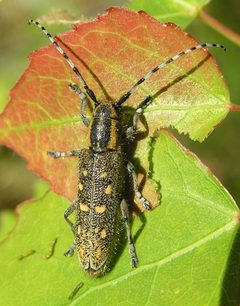
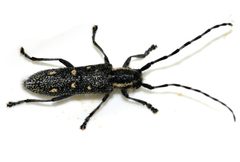
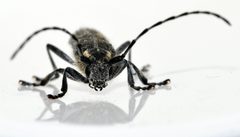
Saperda populnea is a longhorn beetle (Cerambycidae) that forms distinctive woody galls on twigs of poplars and willows. The was described by Linnaeus in 1758 and has a broad distribution across the Northern Hemisphere. Females create characteristic horseshoe-shaped cuts on twigs where are deposited, leading to gall formation. The is of economic concern in hybrid aspen plantations due to damage to young trees.
Pronunciation
How to pronounce Saperda populnea: /sæˈpɛrdə pɒˈpuːlniə/
These audio files are automatically generated. While they are not always 100% accurate, they are a good starting point.
Identification
The is identified by the presence of its characteristic galls on twigs—symmetrical swellings up to 20 mm long on internodes, each containing a single elongate chamber with a yellowish larva or pupa. beetles are present from May to July. The northern Saperda populnea lapponica has shorter male and reduced compared to the nominate subspecies.
Images
Habitat
Found in areas with poplar and willow trees, particularly on young twigs of aspen (Populus tremula). Most common on young, vigorous growth in stands and plantations. In Britain, galls are most frequent on young aspen twigs.
Distribution
Recorded across Europe (including Albania, Austria, Belarus, Belgium, Bulgaria, Croatia, Czech Republic, France, Germany, Hungary, Italy, Poland, Romania, Russia, Scandinavia, Spain, Switzerland, Turkey, United Kingdom), Asia (China, Japan, Kazakhstan, Mongolia, North Korea), and North America (Canada, United States, Mexico). Also recorded in North Africa (Algeria, Morocco).
Seasonality
beetles active from May to July. In Sweden, the is predominantly two-year (), with 90–97% of the flying in odd-numbered years; northern populations show less strict cycling.
Diet
Larvae feed internally within woody galls on poplar and willow twigs. plants include aspen (Populus tremula), black cottonwood (P. trichocarpa), black poplar (P. nigra), and goat willow (Salix caprea). respond electrophysiologically and behaviorally to volatile compounds from host plants, particularly from section Aigeiros poplars.
Host Associations
- Populus tremula - larval aspen; most common in Britain and Sweden
- Populus trichocarpa - larval black cottonwood
- Populus nigra - larval black poplar
- Salix caprea - larval goat willow
- Salix lapponum - larval downy willow; exclusive of S. p. lapponica
Life Cycle
Two-year () in most . Female makes a horseshoe-shaped incision on twig and deposits an . Larva develops within a woody gall, creating a single elongate chamber. occurs within the gall. Exit hole is made in spring for .
Behavior
Females create distinctive horseshoe-shaped cuts on twigs prior to oviposition. A single female may produce over 136 such incisions. Prefers twigs of approximately 7–8 mm diameter for oviposition. show selective behavioral and electroantennogram responses to volatile oils from certain Populus varieties.
Ecological Role
Herbivore and wood-borer in Populus and Salix trees. Gall formation modifies twig growth. Serves as host for a complex including primary parasitoids (Dolichomitus tuberculatus, Xylophrurus lancifer, Iphiaulax impostor, Schreineria populnea) and hyperparasitoids (Gelis ornatulus, Dendrocerus serricornis), as well as the tachinid fly Billaea irrorata. Parasitoid-caused mortality ranges from 2–33% depending on location and year.
Human Relevance
Economic pest in hybrid aspen plantations, where systematic treatment may be required for control. Larval galls can be treated by brushing horseshoe incisions with linseed oil with or without insecticide additives. attempts have included rearing the Ephialtes abbreviatus. The has been used as a model organism for mathematical analysis of pest .
Similar Taxa
- Other Saperda speciesDistinguished by specificity and gall ; S. populnea specifically associated with Populus and Salix twig galls
- Saperda populnea lapponicaNorthern with shorter male and reduced ; specialized exclusively on Salix lapponum rather than multiple Populus
More Details
Subspecies
A northern , Saperda populnea lapponica, was described from Scandinavia based on divergent morphological traits and exclusive association with downy willow (Salix lapponum). The description prompted discussion on subspecies definitions in .
Parasitoid complex
Studies in Bulgaria and Turkey have documented extensive , with Billaea irrorata (Tachinidae) and Dolichomitus populneus (Ichneumonidae) being most abundant. Hyperparasitoids such as Dendrocerus serricornis develop gregariously within tachinid .
Sources and further reading
- BugGuide
- Wikipedia
- GBIF taxonomy match
- iNaturalist taxon
- NCBI Taxonomy
- Catalogue of Life
- Coleoptera | Blog - Part 2
- New parasitoids of Saperda populnea (L.) (Col. Cerambycidae) in Bulgaria
- Effects of Plant Volatiles on the EAG Response and Behaviour of Saperda populnea L. (Coleoptera: Cerambycidae)
- Zum Vorkommen und zur Bekämpfung des Kleinen Aspenbockes Saperda populnea L. in Schweden
- Parasitoids of Saperda populnea (L.) (Coleoptera: Cerambycidae) on aspen (Populus tremula L.) in Bulgaria
- Hopf Bifurcation Analysis of a Class of Saperda populnea Infectious Disease Model with Delay
- The EAG response and behavior of the Saperda populnea L. to volatiles from poplar branches
- Records on parasitoids of smaller poplar borer,Saperda populnea [Coleoptera, Cerambycidae] along the Danube in Bulgaria
- Parasitoids of the Small Poplar Longhorn Beetle, Saperda populnea (L.) (Coleoptera: Cerambycidae), in the Aras Valley (Kars and Erzurum Provinces), Turkey
- Parasitoids of Saperda populnea (L.) (Coleoptera: Cerambycidae) on aspen (Populus tremula L.) in Bulgaria