
Saperda
Fabricius, 1775
flat-faced longhorn beetles
Species Guides
16- Saperda calcarata(Poplar Borer)
- Saperda candida(Round-headed Apple Tree Borer)
- Saperda cretata(Spotted Apple Tree Borer)
- Saperda discoidea(Hickory Saperda)
- Saperda fayi(Thorn-limb Borer)
- Saperda horni
- Saperda imitans(Oblique-banded Longhorn Beetle)
- Saperda inornata(Poplar-gall Saperda)
- Saperda lateralis(Red-edged Saperda)
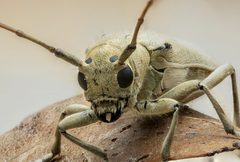
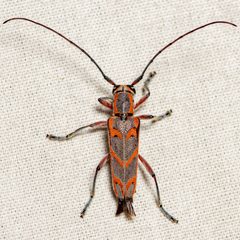
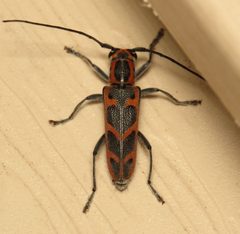
Saperda is a of flat-faced longhorn beetles in the Cerambycidae, Lamiinae, erected by Johan Christian Fabricius in 1775. in this genus are wood-boring beetles whose larvae develop in living or stressed trees, particularly poplars, willows, and other broadleaf . Several species are economically significant pests of plantation trees and fruit crops. The genus has a Holarctic distribution with highest diversity in the Palearctic region.
Pronunciation
How to pronounce Saperda: /sæˈpɛrdə/
These audio files are automatically generated. While they are not always 100% accurate, they are a good starting point.
Images
Distribution
Holarctic distribution, with records from Europe (including Scandinavia), Asia (Turkey, Himalayan region), and North America (Canada and United States). Specific distribution varies by : Saperda populnea occurs across Europe wherever aspen grows, with lowest in northern Sweden; Saperda candida is distributed in eastern North America from Canada (Manitoba, New Brunswick, Nova Scotia, Ontario, Quebec, Saskatchewan) to the United States (Arkansas, Colorado, Florida, Georgia, Illinois, Minnesota, Mississippi, Missouri, New Hampshire, North Dakota, West Virginia); Saperda lateralis occurs across eastern North America with a distinctive S. lateralis rileyi described from the lower Mississippi Delta Region.
Human Relevance
Several Saperda are economically significant pests. Saperda populnea is of particular economic importance in hybrid aspen plantations in Sweden, requiring years of treatment to control. Saperda candida (rounded headed apple tree borer) is a major pest of trees in the rose including apples, pears, crabapples, and hawthorn. Saperda lateralis (red-edged saperda) attacks stressed landscape trees including maples, hickories, elms, basswoods, and oaks. Control methods have included chemical spraying with Gesarol-50 and brushing larval galleries with linseed oil. efforts have explored breeding such as Ephialtes abbreviatus for management.
Sources and further reading
- BugGuide
- Wikipedia
- GBIF taxonomy match
- iNaturalist taxon
- NCBI Taxonomy
- Catalogue of Life
- biodiversity | Blog - Part 42
- Drought, borers and dead trees - Roundheaded borers, Cerambycidae — Bug of the Week
- Recent literature – The Coleopterists Bulletin | Beetles In The Bush
- North America’s most recognizable longhorned beetle | Beetles In The Bush
- Bug Eric: From My Inbox
- Saperda candida . [Distribution map].
- Observations on the Biology of Saperda tridentata Oliv. and Magdalis armicollis Say (Coleoptera)
- New parasitoids of Saperda populnea (L.) (Col. Cerambycidae) in Bulgaria
- Parasitoids of the Small Poplar Longhorn Beetle, Saperda populnea (L.) (Coleoptera: Cerambycidae), in the Aras Valley (Kars and Erzurum Provinces), Turkey
- Microfungi associated with the wood-boring beetles Saperda calcarata (poplar borer) and Cryptorhynchus lapathi (poplar and willow borer)
- Biology of Saperda inornata (Coleoptera: Cerambycidae) in Trembling Aspen, Populus Iremuloides1
- Records on parasitoids of smaller poplar borer,Saperda populnea [Coleoptera, Cerambycidae] along the Danube in Bulgaria
- Zum Vorkommen und zur Bekämpfung des Kleinen Aspenbockes Saperda populnea L. in Schweden