
Saperda lateralis
Fabricius, 1775
Red-edged Saperda
Saperda lateralis is a longhorned beetle in the Cerambycidae, first described by Johan Christian Fabricius in 1775. It is broadly distributed across eastern North America, ranging from Canada through the eastern United States. The is associated with several tree , particularly maples, and is known to attack stressed or declining trees. A distinctive , S. lateralis rileyi, was described in 2010 from the lower Mississippi Delta region based on consistent morphological differences and partial geographic separation from nominate .
Pronunciation
How to pronounce Saperda lateralis: //sæˈpɛər.də læˈtɛr.ə.lɪs//
These audio files are automatically generated. While they are not always 100% accurate, they are a good starting point.
Identification
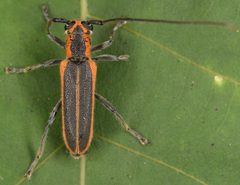
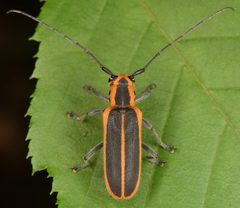
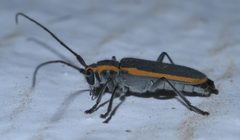
The red-edged pattern distinguishes Saperda lateralis from . Saperda candida (roundheaded apple tree borer) is a close relative that attacks rosaceous trees and lacks the prominent red marginal band. Within S. lateralis, the S. lateralis rileyi can be distinguished by reduced body , slightly different antennal proportions, and geographic occurrence in the lower Mississippi Delta region. Specimens from this region should be examined for the diagnostic traits described by Schiefer and Newell (2010).
Images
Habitat
Associated with deciduous forests and wooded landscapes. Larvae develop beneath the bark of living but stressed or declining trees. are found on trees and nearby vegetation during the active season.
Distribution
Eastern North America from Canada (Manitoba, New Brunswick, Nova Scotia, Ontario) through the eastern and central United States. The S. lateralis rileyi occurs in the lower Mississippi Delta region of the southeastern United States.
Seasonality
are active during the warmer months. Larval development occurs beneath bark, with in galleries and adult in spring.
Diet
Larvae feed on cambium and inner bark tissues of trees. feed on pollen, tender bark, and leaves.
Host Associations
- Acer - larval maples including red maple
- Carya - larval hickories
- Ulmus - larval elms
- Tilia - larval basswoods
- Quercus - larval oaks
Life Cycle
Females detect stressed trees using olfactory cues and deposit on bark. Larvae hatch and tunnel beneath the bark, feeding on cambium and creating galleries that disrupt vascular tissues. Mature larvae pupate in chambers within the wood or beneath bark. emerge through exit holes, feed on vegetation, mate, and seek new trees for oviposition. The typically spans one to two years depending on conditions.
Behavior
are and active during warm weather. Females use to detect chemical signals from stressed or declining trees, which are preferred for oviposition. Larvae are cryptic, feeding beneath bark and remaining hidden from .
Ecological Role
As a cambium-feeding borer, this contributes to nutrient cycling by accelerating the decline and decomposition of stressed or dying trees. It is not typically a primary killer of healthy trees but exploits trees already compromised by drought, , or other stressors. The species serves as prey for woodpeckers and other that excavate bark.
Human Relevance
Considered a secondary pest of landscape and forest trees. Attacks are most common on trees already stressed by drought, poor site conditions, or other factors. The can contribute to decline of ornamental maples and other hardwoods. The S. lateralis rileyi was named in honor of Edward Riley, a prolific collector who contributed substantially to knowledge of North American Cerambycidae.
Similar Taxa
- Saperda candidaSimilar size and , but attacks trees in the rose (Rosaceae) and lacks the red-margined pattern.
- Other Saperda speciesMost lack the distinctive red lateral elytral margins; some have spotted or uniformly colored .
More Details
Subspecies recognition
The Saperda lateralis rileyi was formally described by Schiefer and Newell in 2010 from the lower Mississippi Delta. It is distinguished from nominate S. lateralis by reduced , subtle differences in coloration, and antennal proportions. The two forms are partially , supporting their recognition as distinct subspecies.
Historical taxonomy
Several varietal names have been proposed for this (var. connecta, abbreviata, transeuns, suturalis), but these are not currently recognized as valid . The species has been subject to taxonomic confusion due to its variable appearance across its broad range.
Sources and further reading
- BugGuide
- Wikipedia
- GBIF taxonomy match
- iNaturalist taxon
- NCBI Taxonomy
- Catalogue of Life
- A New Cockroach in Town? | Bug Squad
- Recent literature – The Coleopterists Bulletin | Beetles In The Bush
- Drought, borers and dead trees - Roundheaded borers, Cerambycidae — Bug of the Week
- Bibliography | Beetles In The Bush
- Cerambycidae | Blog
- viper | Blog