
Saperda candida
Fabricius, 1787
Round-headed Apple Tree Borer
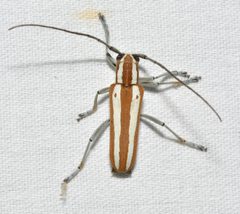
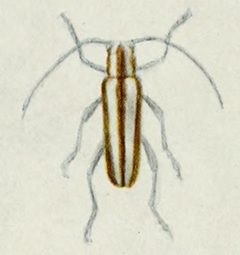
Saperda candida is a longhorned beetle (Cerambycidae) native to North America. It is a significant pest of trees in the rose (Rosaceae), particularly apple, pear, hawthorn, and crabapple. The was described by Fabricius in 1787 and occurs across Canada and the eastern United States. Its larvae are roundheaded borers that tunnel beneath bark and destroy cambium tissue, often killing young or stressed trees.
Pronunciation
How to pronounce Saperda candida: //sæˈpɜrdə ˈkændɪdə//
These audio files are automatically generated. While they are not always 100% accurate, they are a good starting point.
Identification
are characterized by the typical longhorn beetle with elongated . Larvae are legless, cylindrical roundheaded borers with enlarged thoracic segments, distinguishing them from flatheaded borers which have flattened, broadened thoracic segments. The closely resembles Saperda lateralis (red-edged saperda), but S. candida specializes on Rosaceae while S. lateralis attacks a broader range including maples, hickories, elms, basswoods, and oaks.
Images
Habitat
Associated with trees and shrubs in the rose , particularly in orchards, nurseries, and landscapes where apple, pear, hawthorn, crabapple, and related grow. Found in both cultivated and wild settings where plants occur.
Distribution
North America: Canada (Manitoba, New Brunswick, Nova Scotia, Ontario, Quebec, Saskatchewan, Alberta); United States (Arkansas, Colorado, Florida, Georgia, Illinois, Minnesota, Mississippi, Missouri, New Hampshire, North Dakota, West Virginia, and additional eastern states). Also recorded from Germany in Europe, though this may represent introduction or error.
Diet
feed on pollen, tender bark, and leaves. Larvae feed on cambium and inner bark tissues of trees, creating galleries beneath the bark.
Host Associations
- Malus spp. - larval apple
- Pyrus spp. - larval pear
- Crataegus spp. - larval hawthorn
- Cydonia spp. - larval quince
- Prunus spp. - larval plum
- Sorbus spp. - larval
Life Cycle
Females detect stressed or dying trees using antennal chemoreception, then deposit on bark. Larvae hatch and tunnel beneath bark, feeding on cambium and creating galleries. Larvae develop through several instars, in galleries. occurs in spring beneath the bark, with emerging to feed, mate, and begin the cycle again.
Behavior
Females actively locate trees by detecting volatile chemical cues emitted by stressed, dying, or recently dead trees—signals that indicate compromised defensive capacity. are and may be found feeding on host foliage.
Ecological Role
As a native borer, contributes to natural thinning of weakened Rosaceae trees in forest . In natural settings, primarily attacks trees already compromised by drought, , or other stress factors.
Human Relevance
Major economic pest of apple, pear, and ornamental trees in the rose . Can kill young trees and severely damage established specimens in orchards and landscapes. Management focuses on maintaining tree vigor and avoiding stress conditions that predispose to attack.
Similar Taxa
- Saperda lateralisSimilar and larval borer habit, but attacks broader range (maples, hickories, elms, oaks, basswoods) rather than specializing on Rosaceae; distinguished by host association and subtle morphological differences
- Saperda populneaRelated longhorned borer with similar , but specialized on willow and poplar rather than Rosaceae
More Details
Parasitoid association
Larvae are parasitized by the Cenocoelius saperdae, a known agent.
Varietal form
The varietas Saperda candida var. bipunctata has been described, though its taxonomic status may require verification.
Detection method
are indicated by vertical bark cracks, sawdust-like at base of trunk, and premature fall coloration or dieback in trees.
Sources and further reading
- BugGuide
- Wikipedia
- GBIF taxonomy match
- iNaturalist taxon
- Catalogue of Life
- Beetle Mania to Descend on the Bohart | Bug Squad
- Drought, borers and dead trees - Roundheaded borers, Cerambycidae — Bug of the Week
- new species | Blog - Part 23
- Recent literature – The Coleopterists Bulletin | Beetles In The Bush
- North America’s most recognizable longhorned beetle | Beetles In The Bush
- Saperda candida . [Distribution map].