
Saperda calcarata
Say, 1824
Poplar Borer
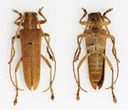
Saperda calcarata, commonly known as the poplar borer, is a longhorned beetle (Cerambycidae) first described by Thomas Say in 1824. The is native to North America, occurring in Canada and the United States. Larvae are significant pests of balsam poplar and related Populus species, tunneling at the junction of the root and stem where they cause structural damage that can girdle and kill trees. The species exhibits a two-year in western Canada and possesses a recognized variety, Saperda calcarata var. adspersa, distinguished by coloration differences between sexes.
Pronunciation
How to pronounce Saperda calcarata: //sæˈpɜːrdə kælˈkærətə//
These audio files are automatically generated. While they are not always 100% accurate, they are a good starting point.
Identification
are longhorned beetles with the elongated characteristic of Cerambycidae. The is recognized by its association with poplar and the specific damage pattern of larval galleries at the root collar. The variety adspersa exhibits in coloration: females have mainly bluish while males have mostly brownish elytra.
Images
Habitat
Stands of balsam poplar and other Populus ; larvae specifically inhabit the junction of root and stem (root collar) of trees, while are found on host foliage and bark.
Distribution
Canada (Alberta, British Columbia, Manitoba, New Brunswick) and the United States.
Seasonality
emerge and are active from July to August; are laid during this period.
Diet
Larvae feed on inner bark and heartwood of balsam poplar and related Populus ; feed on leaf petioles and bark of young branches.
Host Associations
- Populus balsamifera - larval primary ; larvae tunnel at root collar causing significant damage
- Populus tremuloides - larval trembling aspen; larvae reported in stem
Life Cycle
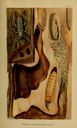
Two-year : laid in bark crevices near the root collar during July-August; larvae feed initially in inner bark, then bore into heartwood through the first year; overwinter as larvae; occurs in spring of the second year; emerge July-August of the second year.
Behavior
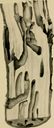
Larvae create extensive galleries in the heartwood at the root collar that can girdle trees, causing structural weakness and mortality. feed on leaf petioles causing minor damage. Females locate trees and deposit in bark crevices near the root collar.
Ecological Role
Primary pest of balsam poplar; larval tunneling causes tree mortality and structural weakness. The serves as a for microfungi, potentially facilitating fungal of trees. Documented associations include eight species of , two species of , and five associated insect species.
Human Relevance
Significant forestry pest causing economic damage to balsam poplar stands. Chemical control using such as dimethoate applied as soil drenches to the root collar area in late spring to early summer can reduce larval survival.
Similar Taxa
- Saperda lateralisRed-edged saperda; also attacks stressed hardwoods including maples, but differs in range and geographic distribution
- Saperda candidaRoundheaded apple tree borer; similar but specialized on trees in the rose (Rosaceae)
- Saperda populneaRelated saperdine with similar ; distinguished by associations and geographic distribution
Sources and further reading
- BugGuide
- Wikipedia
- GBIF taxonomy match
- iNaturalist taxon
- NCBI Taxonomy
- Catalogue of Life
- How a Newly Described Bacteria Species Became a Kimsey | Bug Squad
- Pensoft Editorial Team | Blog - Part 90
- Drought, borers and dead trees - Roundheaded borers, Cerambycidae — Bug of the Week
- Recent literature – The Coleopterists Bulletin | Beetles In The Bush
- North America’s most recognizable longhorned beetle | Beetles In The Bush
- Bug Eric: From My Inbox
- Microfungi associated with the wood-boring beetles Saperda calcarata (poplar borer) and Cryptorhynchus lapathi (poplar and willow borer)
- Biology, Damage, and Chemical Control of the Poplar Borer (Saperdacalcarata) in the Junction of the Root and Stem of Balsam Poplar in Western Canada