
Delta
de Saussure, 1855
potter wasps
Species Guides
2- Delta esuriens(Okinawa Mud Wasp)
- Delta higletti
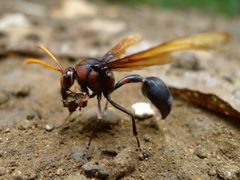
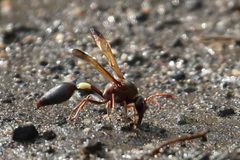
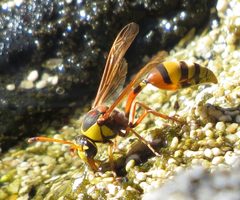
Delta is a of Old World potter wasps in the Vespidae, Eumeninae. The genus was established by Henri Louis Frédéric de Saussure in 1855. are predominantly distributed through tropical Africa and Asia, with some representation in the Palearctic region. A few species have been introduced to the Nearctic and Neotropical regions. Delta construct characteristic pot-shaped mud nests and provision them with paralyzed caterpillars for their developing larvae.
Pronunciation
How to pronounce Delta: //ˈdɛltə//
These audio files are automatically generated. While they are not always 100% accurate, they are a good starting point.
Identification
Delta can be distinguished from similar potter wasp by its elongated petiole combined with specific nest architecture. The genus resembles Eumenes and Zeta in petiole length but differs in details of structure and nest form. -level identification requires examination of clypeal shape, pronotal structure, and color pattern details. The pot-shaped mud nests with narrow necks are diagnostic for the genus.
Images
Habitat
Found in diverse terrestrial across tropical and subtropical regions, including savanna, woodland, forest edges, and anthropogenic environments. occupy areas where mud for nest construction and caterpillar prey are available. Some species adapt to urban and agricultural settings.
Distribution
Native to tropical Africa, tropical Asia, and parts of the Palearctic region. Introduced established in Nearctic and Neotropical regions. The shows highest diversity in the Afrotropical and Oriental biogeographic realms.
Seasonality
Activity patterns vary by latitude and climate. In tropical regions, are active year-round. In temperate parts of the range, activity is restricted to warmer months. Nesting activity peaks during periods of abundant caterpillar prey availability.
Diet
feed on nectar from flowers. Larvae are , provisioned with paralyzed caterpillars (Lepidoptera larvae) captured by females and sealed inside individual nest .
Life Cycle
Solitary with complete . Females construct mud nests, typically pot-shaped with narrow necks, attached to vegetation or substrates. Each nest is provisioned with multiple paralyzed caterpillars, then sealed with mud. A single is laid per cell. Larvae develop through several instars, pupate within the sealed cell, and emerge as . No ; all females are reproductive.
Behavior
Females exhibit solitary nesting , constructing characteristic pot-shaped mud nests. They hunt caterpillars, paralyzing them with venom rather than killing them, to preserve freshness for larval consumption. Nest construction involves mud-gathering to water sources. Males patrol territories and engage in aerial pursuit of females. No cooperative colony behavior; each female independently provisions her own nests.
Ecological Role
of caterpillars, contributing to natural regulation of Lepidoptera . Pollination services through nectar feeding. The mud nests contribute to soil nutrient cycling in some .
Human Relevance
Generally beneficial insects due to caterpillar , potentially reducing pest in gardens and agriculture. Rarely sting humans unless handled. Some introduced have established in new regions, occasionally becoming noticeable in urban environments. No significant negative economic impacts documented.
Similar Taxa
- EumenesSimilar elongated petiole and potter wasp ; distinguished by capsule shape and nest architecture details
- ZetaShares long petiole characteristic; differs in pronotal structure and geographic distribution patterns
More Details
Taxonomic history
The was established by Henri Louis Frédéric de Saussure in 1855. It has undergone various taxonomic revisions, with some formerly placed in related genera subsequently transferred to Delta based on morphological and nest architecture characters.
Nesting biology
The pot-shaped nest with narrow neck is a defining behavioral trait. Nest architecture has been used as a taxonomic character distinguishing Delta from related eumenine with different nest forms.
Sources and further reading
- BugGuide
- Wikipedia
- iNaturalist taxon
- NCBI Taxonomy
- Catalogue of Life
- Emily Bick: Salinity, the Water Hyacinth and a Weevil | Bug Squad
- Scientific Annals of the Danube Delta Institute | Blog
- Field Tour Gets First-Hand Look at IPM and Pollinator Health in Mississippi
- Assessments of alien species impacts are reliable to prioritize resources | Blog
- diamond open access | Blog
- Cicindela scutellaris lecontei x scutellaris unicolor intergrades in southeast Missouri | Beetles In The Bush
- ENERGY AUDIT AND POWER USAGE FOR OLEH CAMPUS, DELTA STATE UNIVERSITY, ABRAKA: A CASE STUDY