
Eumenes
Latreille, 1802
potter wasps
Species Guides
8- Eumenes americanus(American Potter Wasp)
- Eumenes bollii(Boll's Potter Wasp)
- Eumenes consobrinus
- Eumenes crucifera(Cross Potter Wasp)
- Eumenes fraternus(Fraternal Potter Wasp)
- Eumenes mediterraneus(Mediterranean Potter Wasp)
- Eumenes smithii(Smith's Potter Wasp)
- Eumenes verticalis(Vertical potter wasp)
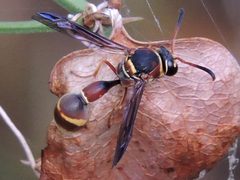
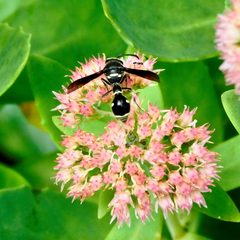
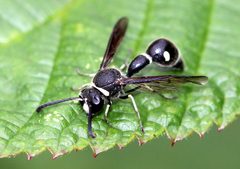
Eumenes is the type of the Eumeninae, commonly known as potter wasps. This large and widespread genus contains over 100 ( and ), predominantly distributed in temperate regions of the Northern Hemisphere. Females construct distinctive free-form mud nests—urn-shaped about the size of a marble, often with fluted necks—each housing a single offspring provisioned with paralyzed caterpillars. The genus is characterized by black or brown coloration with striking contrasting patterns of yellow, white, orange, or red.
Pronunciation
How to pronounce Eumenes: /ˈjuːmɪniːz/
These audio files are automatically generated. While they are not always 100% accurate, they are a good starting point.
Identification
Eumenes are distinguished from other Eumeninae by their characteristic pot-shaped mud nests, which are completed as entire units before provisioning rather than built incrementally. They can be separated from similar mud-nesting like Sceliphron (mud daubers) by nest architecture: Eumenes builds discrete urn-shaped , while Sceliphron constructs clustered cylindrical cells covered in additional mud layers. Within Eumenes, species identification relies on color pattern details, particularly the arrangement and extent of pale markings on the metasoma and legs. The first metasomal segment is notably narrow and . Wings fold longitudinally at rest, a trait shared with social vespids. For Far Eastern species, a revised identification key incorporating both morphological and data is available.
Images
Habitat
Temperate regions of the Northern Hemisphere. Nests are constructed in sheltered situations including recessed window frames, tree hollows, and various man-made structures. Some attach nests to vegetation such as pine needles. The specific preferences of individual species within the are not well documented.
Distribution
Widespread across the Northern Hemisphere, with greatest diversity in temperate regions. Documented from Europe (Denmark, Norway, Sweden), North America (including Vermont, USA), and the Far East (Korea, with E. rubrofemoratus newly recorded from South Korea). The occurs across multiple continents with over 100 described .
Seasonality
activity and nest construction occur during warmer months. In temperate regions, females construct nests in spring and summer. Development from to adult typically takes several weeks, though some individuals may overwinter as pupae and emerge the following season. Specific seasonal patterns vary by and geographic location.
Life Cycle
Females construct complete urn-shaped mud before provisioning. Each cell receives multiple paralyzed caterpillars as food for a single larva. The female lays one per cell, suspended from the roof by a silken thread, then seals the cell with a mud plug. The larva hatches, drops onto the prey cache, and feeds on the paralyzed caterpillars. The venom preserves the prey in a fresh state. After feeding, the larva into a pupa; emerge by chewing a large exit hole in the side of the pot. Some may overwinter as pupae.
Behavior
Solitary nesting with no colony or social structure. Females work alone, constructing nests through sequential mud-gathering trips: they collect water, then soil particles, forming moist boluses carried in the . Each urn requires multiple foraging trips to complete. Females are not aggressive and do not defend nests actively; they abandon the site after sealing the and move to construct additional nests elsewhere. Males do not participate in nest construction or provisioning.
Ecological Role
of caterpillars, providing natural pest control in various . The specific ecological impact at the level has not been quantified. Nests may be reused by other organisms; some spider wasps (Pompilidae: Auplopini) build their mud inside old Eumenes nests.
Human Relevance
Nests are sometimes considered unsightly when attached to buildings, leading to destruction by homeowners. However, solitary pose minimal sting risk and are ecologically beneficial. Nests are of aesthetic and scientific interest; the urn-shaped architecture has been compared to human pottery and may have inspired Native American vessel designs. Rearing mud nests can contribute to scientific knowledge of - relationships, as various parasite may emerge.
Similar Taxa
- SceliphronAlso constructs mud nests, but builds clustered cylindrical covered with additional mud layers rather than discrete urn-shaped pots; belongs to Sphecidae (thread-waisted wasps)
- TrypoxylonBuilds linear mud tubes with internal partitions; males often participate in nest defense; belongs to Crabronidae
- AncistrocerusAlso Eumeninae, but constructs cylindrical mud attached to hard surfaces (rocks, concrete) with multiple adjoining cells, not free-form urns; has prominent transverse carina on first abdominal segment
- AuplopusSpider-hunting wasps in Pompilidae that build mud , but often construct these inside pre-existing cavities including old Trypoxylon or Eumenes nests
More Details
Taxonomic complexity
The Far Eastern Eumenes fauna includes problematic pairs requiring additional molecular tests for resolution. E. rubrofemoratus has been confirmed as distinct from the transpalearctic E. coarctatus based on , despite low genetic divergence suggesting recent origin.
Nest architecture variation
Nest quality and appearance varies with soil type available; in areas with sandy, poorly cohesive soils (e.g., Tucson, Arizona), nests may appear rougher than those constructed from finer clay soils.
Sources and further reading
- BugGuide
- Wikipedia
- GBIF taxonomy match
- iNaturalist taxon
- NCBI Taxonomy
- Catalogue of Life
- Bug Eric: Mud Masterpieces
- Bug Eric: January 2010
- Bug Eric: Bee Flies
- Bug Eric: Wasp Wednesday: Walden's Mason Wasp, Ancistrocerus waldenii
- An Introduction to the Wonderful World of Wasps: Meet the Heath Sand Wasp - Buglife Blog - Buglife
- Bug Eric: April 2010
- Taxonomy of Eumenes punctatus-complex (Hymenoptera: Vespidae: Eumeninae) from Korea with DNA barcoding and key to Far Eastern species of the genus Eumenes Latreille, 1802