
Asemum striatum
(Linnaeus, 1758)
black spruce borer
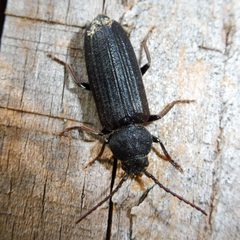
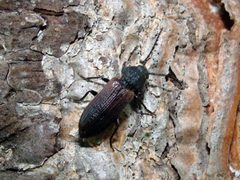
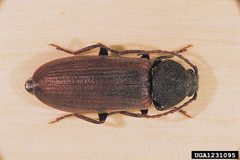
Asemum striatum, commonly known as the black spruce borer, is a Holarctic longhorn beetle (Cerambycidae: Spondylidinae) distributed across Europe, Asia, and North America. are active from May through August and are in coniferous trees. The develops under bark of plants, with larvae later tunneling into dead branches and stumps. It has been used as a comparative reference species in morphological studies of related such as Asemum tenuicorne.
Pronunciation
How to pronounce Asemum striatum: /əˈsiːməm ˈstraɪətəm/
These audio files are automatically generated. While they are not always 100% accurate, they are a good starting point.
Identification
Distinguished from similar Asemum by the combination of striated , black to brownish coloration, and body size. Morphological comparison with Asemum tenuicorne reveals differences in external features, male copulatory organ shape, and wing venation. The striated elytra separate it from smooth-elytra .
Images
Habitat
Coniferous forests. Associated with dead and dying coniferous trees, particularly under bark of plants and in dead branches and stumps.
Distribution
Holarctic distribution encompassing most of Europe, the East , the Near East, the , and the Indomalayan realm. Present in North America, Europe, and Northern Asia.
Seasonality
active from May through August.
Diet
in coniferous trees. Larvae feed under bark and in wood of plants.
Host Associations
- Pinus sylvestris - primary
- Pinus mugo - primary
- Pinus nigra - primary
- Picea abies - secondary
- Abies - -level association
- Larix - -level association
Life Cycle
Completes in two to three years. Larvae develop under bark of plants, later tunneling into dead branches and stumps. occurs in wood.
Ecological Role
Wood-boring contributing to decomposition of dead coniferous wood. Serves as for tylenchid entomoparasitic .
Human Relevance
May be encountered in forestry contexts due to association with coniferous timber. No significant economic impact documented.
Similar Taxa
- Asemum tenuicorneClosely related with overlapping ; distinguished by detailed examination of external features, male copulatory organs, and wing venation. A. tenuicorne has more restricted distribution (Southern Europe and isolated Swedish locality) compared to widely distributed A. striatum.
- Spondylis buprestoidesShares Spondylidinae and similar wood-boring ; both serve as for related tylenchid entomoparasitic .
More Details
Parasite Host
Documented for tylenchid entomoparasitic , with stylet-bearing parasitic juveniles found in of A. striatum in Ithaca, New York, USA. The isolate is phylogenetically related to Deladenus siricidicola.
Morphological Reference
Serves as a widely distributed comparative in morphological studies of Asemum tenuicorne, with 63 specimens examined for comparison of external features, morphometrics, male genitalia, and wing venation.
Sources and further reading
- BugGuide
- Wikipedia
- GBIF taxonomy match
- iNaturalist taxon
- NCBI Taxonomy
- Catalogue of Life
- Primary Type List | Entomology Research Museum
- A winter longhorned beetle | Beetles In The Bush
- Eumastacidae | Beetles In The Bush
- Tylenchid entomoparasites isolated from Spondylis buprestoides (L.) and Asemum striatum (L.) (Coleoptera: Cerambycidae)
- New data on the distribution, biology and morphology of Asemum tenuicorne Kraatz, 1879 (Coleoptera: Cerambycidae), with new records from Poland