
Pachyta lamed
(Linnaeus, 1758)
Species Guides
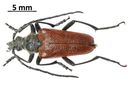
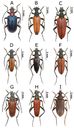
1Pachyta lamed is a Holarctic long-horned beetle (Cerambycidae) in the Lepturinae. The occurs across northern Eurasia and North America, with two recognized : P. lamed lamed (Eurasian) and P. lamed liturata (North American). are associated with coniferous trees, particularly spruce. Larvae develop in dead or decaying conifer wood, completing development over multiple years.
Pronunciation
How to pronounce Pachyta lamed: /ˈpækɪtə ˈlæmɛd/
These audio files are automatically generated. While they are not always 100% accurate, they are a good starting point.
Images
Habitat
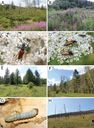
Coniferous forests, particularly those containing spruce (Picea spp.) and fir (Abies spp.). Larvae inhabit dead or decaying wood of coniferous trees, residing within roots and stumps.
Distribution
Holarctic: Austria, Belarus, Bulgaria, Czech Republic, Denmark, Estonia, Finland, France, Germany, Hungary, Italy, Japan, Latvia, Lithuania, Moldova, Mongolia, Norway, Poland, Romania, Russia, Slovakia, Slovenia, Sweden, Switzerland, Ukraine, United States, and Canada.
Diet
feed on Norway spruce (Picea abies). Larvae feed on decomposing wood tissues of dead or decaying coniferous trees, particularly spruce and fir.
Host Associations
- Picea abies - food sourceNorway spruce
- Picea spp. - larval spruce
- Abies spp. - larval fir
Life Cycle
Larvae reside within roots or stumps of dead coniferous trees, digging into wood and feeding on decomposing tissues. The larval stage spans multiple years. and timing not specified in available sources.
Ecological Role
Decomposer in coniferous forest . Larvae contribute to wood decomposition by feeding on dead and decaying conifer tissues.
Similar Taxa
- Rhagium inquisitorAlso a Holarctic Lepturinae associated with conifers; both share similar geographic distribution and conifer-breeding , though R. inquisitor pupates under bark and has distinctive ribbed .
More Details
Subspecies
Two recognized: Pachyta lamed lamed (Linnaeus, 1758) — Eurasian; Pachyta lamed liturata Kirby, 1837 — North American.