
Judolia
Mulsant, 1863
Species Guides
9- Judolia cordifera(Chestnut Longhorn Beetle)
- Judolia gaurotoides(Black-banded Long-horned Beetle)
- Judolia impura
- Judolia instabilis
- Judolia montivagans
- Judolia quadrata
- Judolia scapularis
- Judolia sexspilota
- Judolia swainei
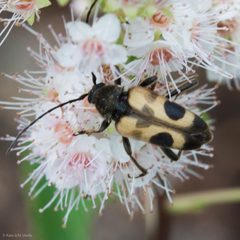
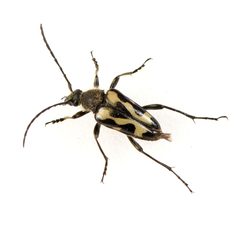
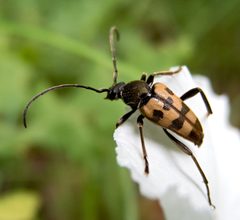
Judolia is a of longhorned beetles in the Cerambycidae, Lepturinae. The genus was established by Mulsant in 1863 and contains approximately 14 recognized distributed across the Holarctic region, with representatives in North America, Europe, and Asia. Species within this genus are typically associated with coniferous and deciduous forest .
Pronunciation
How to pronounce Judolia: //dʒuːˈdoʊ.li.ə//
These audio files are automatically generated. While they are not always 100% accurate, they are a good starting point.
Identification
Members of Judolia can be distinguished from other Lepturini by their compact body form, moderately short relative to body length, and characteristic elytral patterns often featuring spots or bands. The genus is morphologically similar to related genera such as Brachyta and Pidonia, but differs in details of antennal structure and pronotal shape. Specific identification to level typically requires examination of genitalia and detailed elytral .
Images
Habitat
of Judolia are primarily found in forested environments, particularly coniferous and mixed woodlands. Based on collection records, they occur in montane and forest zones, with some species showing affinity for specific trees including pines (Pinus spp.) and other conifers. The includes species adapted to both temperate and subarctic conditions.
Distribution
The Judolia has a Holarctic distribution. North American occur across Canada and the northern United States, with records from Vermont and other northeastern states, as well as western mountain regions including Arizona. European and Asian species are documented from Scandinavia (Denmark, Norway, Sweden) and extend across northern Eurasia. Specific species show more restricted ranges within this broad distribution.
Seasonality
of Judolia are generally active during spring and early summer months. One species, Judolia instabilis, has been recorded as active in early June in montane Arizona . The winter-active longhorned beetle Rhagium inquisitor has been historically confused with or discussed alongside Judolia species in literature, but true Judolia adults are primarily spring-emergent.
Host Associations
- Pinus - larval Coniferous trees, particularly pines, serve as larval development for some
Behavior
have been observed visiting flowers, including goldenrod (Solidago), where they feed on nectar and pollen. This flower-visiting is typical of many Lepturinae and facilitates identification in the field. Larval stages are wood-borers, developing in dead or dying coniferous wood.
Ecological Role
As larvae, Judolia contribute to wood decomposition in forest by tunneling in dead coniferous wood. As , they function as when visiting flowers for nectar. Their role in forest nutrient cycling parallels that of other cerambycid wood-borers.
Human Relevance
The has minor significance to humans. are occasionally encountered by entomologists and naturalists during field surveys. One , Judolia cordifera, was featured in a survey event in Massachusetts, demonstrating their incidental capture in monitoring. They are not considered pests of living trees or timber.
Similar Taxa
- BrachytaSimilar compact body form and Lepturinae placement; distinguished by antennal and pronotal characters
- PidoniaOverlapping distribution and preferences; distinguished by elytral pattern details and genitalia structure
- RhagiumHistorically discussed in same literature contexts and similar conifer-association; distinguished by and more strongly ribbed in R. inquisitor
More Details
Species diversity
The contains approximately 14 recognized including: J. antecurrens (fossil), J. cometes, J. cordifera, J. gaurotoides, J. impura, J. instabilis, J. japonica, J. longipes, J. montivagans, J. quadrata, J. scapularis, J. sexmaculata, J. sexspilota, and J. swainei.