
Enaphalodes
Haldeman, 1847
Species Guides
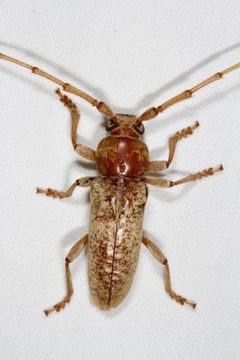
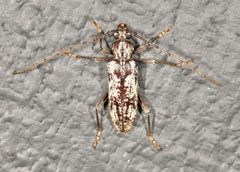
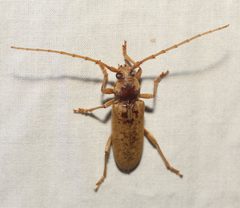
8Enaphalodes is a of longhorn beetles (Cerambycidae) in the tribe Elaphidiini, established by Haldeman in 1847. The genus contains approximately ten described distributed across North America, with several species being significant wood-boring pests of oak trees. The most extensively studied species, E. rufulus (red oak borer), has been implicated in major oak mortality events in the Ozark and Ouachita Mountains during conditions. Species in this genus are characterized by their association with hardwood , particularly oaks (Quercus spp.), and their larvae create extensive galleries in the phloem and wood of host trees.
Pronunciation
How to pronounce Enaphalodes: //ˌɛnəfəˈloʊdiːz//
These audio files are automatically generated. While they are not always 100% accurate, they are a good starting point.
Images
Habitat
in this are associated with hardwood forests, particularly those containing oak species. Based on documented records for E. rufulus and E. atomarius, include mesic lowland deciduous forests, dry upland deciduous forests, xeric sand prairies, and post oak woodlands. The genus shows affinity for areas with standing or recently downed oak trees in various conditions from healthy to declining.
Distribution
North America, with records from Canada (Ontario, Quebec) and the United States. U.S. distribution includes: Alabama, Arkansas, Connecticut, Delaware, Florida, Georgia, Illinois, Indiana, Iowa, Kentucky, Louisiana, Maine, Maryland, Massachusetts, Michigan, Minnesota, Mississippi, Missouri, New Hampshire, New Jersey, New York, North Carolina, Ohio, Oklahoma, Pennsylvania, Rhode Island, South Carolina, Tennessee, Texas, Vermont, Virginia, West Virginia, and Wisconsin.
Host Associations
- Quercus rubra - larval primary for E. rufulus; larvae develop in phloem and wood
- Quercus velutina - larval documented for E. rufulus
- Quercus coccinea - larval documented for E. rufulus
- Quercus marilandica - associatedblackjack oak; E. atomarius collected from this
- Quercus falcata - associatedsouthern red oak; E. atomarius collected from this
- Quercus spp. - larval -level association for multiple Enaphalodes
Life Cycle
Larval development occurs within galleries excavated in the phloem and xylem of trees. For E. rufulus, larval galleries have been documented throughout the entire tree bole from ground level to upper stem, with highest larval densities in the middle bole (4.6-9.1 m height). Gallery length varies with position, being longer in the upper bole. emerge from exit holes at various heights, with greater frequency from lower and middle bole sections. time and specific developmental stages for most are not well documented.
Behavior
have been observed at UV/MV light sources, indicating activity patterns. Larvae are wood-borers that create galleries in living or recently dead trees. During conditions, E. rufulus shows clustered attack patterns within trees, with toward lower and middle bole and on south-facing sides, potentially related to temperature preferences.
Ecological Role
Native wood-boring beetles that function as part of natural forest dynamics, typically attacking stressed, declining, or recently dead trees. Under conditions, E. rufulus has been documented as a major contributing factor to regional oak mortality events. The beetles create entry points for secondary organisms and contribute to nutrient cycling through wood decomposition, though this role is not well quantified.
Human Relevance
E. rufulus (red oak borer) is considered a significant forest pest during conditions, having contributed to extensive mortality of northern red oak in the Ozark and Ouachita Mountains during the late 1990s and early 2000s. The is of concern to forest managers in affected regions. Other species appear to have minimal economic impact.
Similar Taxa
- ElaphidionBoth belong to tribe Elaphidiini and share similar general body forms; Enaphalodes tend to be more robust with different antennal proportions
- AnelaphusSimilar elaphidiine ; Enaphalodes typically distinguished by more pronounced pronotal and elytral patterns
- EburiaBoth contain oak-associated with similar size ranges; Enaphalodes lacks the distinctive elytral maculations typical of many Eburia species
More Details
Species included in genus
Enaphalodes archboldi, E. atomarius (robust oak borer), E. boyacanus, E. coronatus, E. cortiphagus, E. hispicornis, E. niveitectus, E. rufulus (red oak borer), E. seminitidus, E. taeniatus
Outbreak dynamics
Research on E. rufulus indicates that growth increased from 1976 to 2000, with 11 of increase prior to the 2000s . Summer soil moisture availability explained nearly half the variation in population growth, suggesting drought as a contributing factor. Sites with higher outbreak densities sustained incipient populations for longer periods than lower- sites.
Tree defense interactions
Healthy Quercus rubra trees exhibit better compartmentalization capacity against E. rufulus, with shorter larval galleries and faster wound closure than declining trees. Callus formation appears to function as a physical defense in healthy trees, though bark moisture does not vary predictably with levels.
Sources and further reading
- BugGuide
- Wikipedia
- GBIF taxonomy match
- iNaturalist taxon
- NCBI Taxonomy
- Catalogue of Life
- Beetle Mania to Descend on the Bohart | Bug Squad
- Ascalaphidae | Beetles In The Bush
- August | 2022 | Beetles In The Bush
- ID Challenge #11 | Beetles In The Bush
- Ovipositing Pigeon Horntail | Beetles In The Bush
- August “jug trap” run | Beetles In The Bush
- Enaphalodes rufulus . [Distribution map].
- Vertical Distribution of the Red Oak Borer, Enaphalodes rufulus (Coleoptera: Cerambycidae), in Red Oak
- Dendroentomological evidence associated with an outbreak of the native wood-boring beetleEnaphalodes rufulus
- Factors Affecting Suitability ofQuercus rubraas Hosts forEnaphalodes rufulus(Coleoptera: Cerambycidae)
- Factors that affect compartmentalization and wound closure of Quercus rubra infested with Enaphalodes rufulus
- Stand and individual tree characteristics associated with Enaphalodes rufulus (Haldeman) (Coleoptera: Cerambycidae) infestations within the Ozark and Ouachita National Forests
- Historical dynamics of a native cerambycid, Enaphalodes rufulus , in relation to climate in the Ozark and Ouachita Mountains of Arkansas
- Spatial patterns of within-treeEnaphalodes rufulus(Coleoptera: Cerambycidae) attacks during outbreak conditions in the Ozark National Forest in Arkansas, United States of America
- Callus formation and bark moisture as potential physical defenses of northern red oak,Quercus rubra, against red oak borer,Enaphalodes rufulus(Coleoptera: Cerambycidae)