
Elaphidiini
Genus Guides
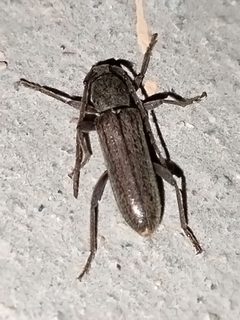
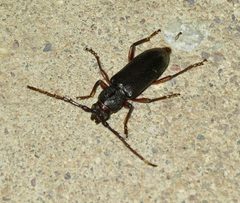
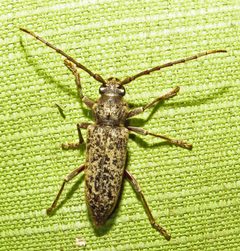
25Elaphidiini is a tribe of longhorn beetles ( Cerambycidae) within the Cerambycinae. The tribe has historically been spelled "Elaphidionini" in some literature. It contains numerous distributed across the Americas, with particularly high diversity in the Neotropical region. Recent taxonomic work has described new from Colombia, Mexico, and the Caribbean, including Sphaerion , Mephritus costae, Eurysthea nogueirai, and Eurysthea nakagomei. The genus Elaphidion occurs in the Puerto Rican Bank and Antigua, with known plant associations and described larval for some species.
Pronunciation
How to pronounce Elaphidiini: /ɛlɑfɪˈdiːɪnaɪ/
These audio files are automatically generated. While they are not always 100% accurate, they are a good starting point.
Identification
Members of Elaphidiini can be distinguished from other cerambycine tribes by a combination of morphological characters including antennal structure, pronotal shape, and elytral . Identification to and level typically requires examination of genitalic structures and detailed morphological analysis. Published keys exist for several genera including Sphaerion, Mephritus, and Elaphidion. Some species exhibit chromatic variation that can complicate field identification.
Images
Habitat
Tropical dry forest (inferred from regional studies in Caribbean Colombia). Specific associations vary by and ; some species are associated with particular plants including Cordia spp., Ehretia anacua, and other Boraginaceae.
Distribution
Widespread in the Americas with highest diversity in the Neotropical region. Documented from: Caribbean region of Colombia, Mexico (Oaxaca), Puerto Rico, Virgin Islands (St. Thomas), Antigua, Guadeloupe, and the southwestern United States (Texas). The tribe extends from the southern United States through Central America and South America, with numerous island in the Caribbean.
Host Associations
- Cordia spp. - larval reared from Cordia eleagnoides; adults collected on Cordia spp. in Texas
- Ehretia anacua - larval Collected in Texas
- Patagonula americana (guayaibi) - probable larval found exclusively on this in Corrientes, Argentina
- Solidago chilensis - food source observed feeding on flowers in Chaco Province, Argentina
- Prosopis glandulosa - associationBeating produced in New Mexico
- Quercus spp. - associationBeating oaks produced in New Mexico and Texas
Behavior
of some are attracted to fermenting baits including sweet red wine (SRW) and ethanol (EtOH). activity patterns have been observed in some species. Adults of certain (e.g., Aglaoschema) are and commonly found on flowers.
Similar Taxa
- TrachyderiniSuperficially similar , brightly colored ; distinguished by different antennal and genitalic characters. Aglaoschema species were historically confused with this tribe.
- CompsoceriniTribe containing Aglaoschema, which was moved from superficial similarity to Trachyderini based on phylogenetic analysis; distinguished by antennal scape structure.
More Details
Taxonomic history
The tribe has been subject to significant taxonomic revision. Linsley's 1963 work on Cerambycidae of North America established the tribal classification within Cerambycinae. The spelling "Elaphidionini" has been used historically but "Elaphidiini" is now preferred. Molecular phylogenetic studies have clarified relationships, such as demonstrating that the Guadalupe Mountains formerly treated as Cicindela politula petrophila is actually with C. laetipennis, a Mexican .
Research methods
Recent studies have employed jug traps baited with sweet red wine (SRW), ethanol (EtOH), or combinations thereof to Elaphidiini diversity. Traps have proven effective in oak-juniper-pinyon woodlands and montane coniferous forests, though catch rates vary with elevation and type. High-elevation sites (~9000 ft) in coniferous forests have yielded unexpected diversity, suggesting ethanol components may attract conifer-associated .
Conservation notes
Several have restricted distributions on Caribbean islands, making them potentially vulnerable to loss. The Puerto Rican Bank fauna includes six species of Elaphidion, two of which were described as new species in 2004. Island endemics include E. antiguensis from Antigua and E. michelii and E. mayesae from Puerto Rico and St. Thomas.
Sources and further reading
- BugGuide
- Wikipedia
- NCBI Taxonomy
- Catalogue of Life
- Argentina | Beetles In The Bush | Page 4
- Mantispidae | Beetles In The Bush
- Bibliography | Beetles In The Bush
- July | 2024 | Beetles In The Bush
- Elaphidiini (Coleoptera, Cerambycidae) from the Caribbean region of Colombia: New species, taxonomic notes and new geographical records
- Two new species of Novantinoe (Disteniini, Disteniidae), two new species of Eurysthea (Elaphidiini, Cerambycinae, Cerambycidae), and new geographical records
- Erratum: Elaphidiini (Coleoptera, Cerambycidae) from the Caribbean region of Colombia: New species, taxonomic notes and new geographical records
- The Elaphidion Audinet-Serville of the Puerto Rican Bank: new species, distributions, taxonomic corrections, and a key to species (Coleoptera: Cerambycidae: Elaphidiini)
- A new species of Elaphidion Audinet-Serville, 1834, from Antigua and comparison with E. excelsum Gahan, 1895, from Guadeloupe (Coleoptera: Cerambycidae: Elaphidiini)