
Tragosoma spiculum
Casey, 1890
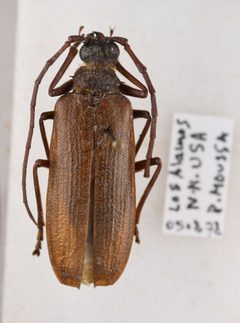
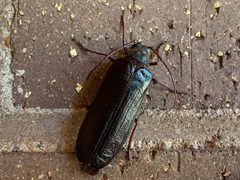
Tragosoma spiculum is a long-horned beetle in the Cerambycidae, Prioninae. The is found in North America, with records from western Canada (Alberta, British Columbia, Manitoba) and the western United States. Like other members of the Tragosoma, it is a wood-boring associated with coniferous forests. The species is attracted to sweet red wine-baited jug traps, suggesting feeding on fermenting sap or other sugar sources.
Pronunciation
How to pronounce Tragosoma spiculum: /trəˈɡoʊsəma ˈspɪkjələm/
These audio files are automatically generated. While they are not always 100% accurate, they are a good starting point.
Identification
Members of the Tragosoma are large, robust prionine beetles with distinctive . Within the genus, T. spiculum can be distinguished from the more widespread T. depsarium by differences in antennal structure and body proportions. T. spiculum has been treated as both a valid and a synonym of T. harrisii in different taxonomic treatments; current sources indicate accepted status. Specimens are characterized by their substantial size and prionine features typical of the tribe Meroscelisini.
Images
Habitat
Coniferous forest , particularly ponderosa pine (Pinus ponderosa) and pinyon-juniper woodlands. The has been collected in montane and subalpine zones, with trap records from elevations around 6000–8300 feet in the southwestern United States. Associated with mature conifer stands and areas with dead or dying wood.
Distribution
North America. Canadian records: Alberta, British Columbia, Manitoba, New Brunswick, Newfoundland. United States: southwestern states including Utah (Kane County, Garfield County), Nevada (Clark County), and likely other western states. The distribution appears to be western North American, with some eastern Canadian records possibly representing misidentifications or vagrant specimens.
Seasonality
have been collected in September, with trap records from early to mid-September in Utah and Nevada. This late-season activity pattern is consistent with other Tragosoma and distinguishes them from many spring-active cerambycids.
Life Cycle
Larvae are wood-borers in conifers. Based on related , development likely occurs in dead or dying pine and juniper wood. are attracted to fermented , suggesting they may feed on sap flows or fermenting plant material.
Behavior
are and attracted to sweet fermenting baits such as red wine. They have been captured in SRW-baited jug traps placed in coniferous woodland . Nocturnal activity on tree trunks has not been specifically documented for this , but is typical for the .
Ecological Role
As a wood-boring , larvae contribute to decomposition of dead conifer wood, facilitating nutrient cycling in forest . The is part of the saproxylic beetle in western North American conifer forests.
Human Relevance
Of interest to coleopterists and collectors due to its size and relative rarity. The is not considered an economic pest; it colonizes dead or dying wood rather than living trees. Attracted to wine-baited traps used for surveys and collecting.
Similar Taxa
- Tragosoma depsariumLarger and more widespread congeneric with Holarctic distribution; differs in antennal structure and body proportions. T. depsarium is active earlier in the season (spring to early summer) compared to the late-season activity of T. spiculum.
- Tragosoma harrisiiTaxonomic relationship unclear; T. spiculum has been treated as a synonym of T. harrisii in some treatments. Distinctions, if valid, require examination of and detailed morphological comparison.
More Details
Taxonomic Status
The taxonomic status of T. spiculum has been debated. GBIF records indicate it as a synonym of T. harrisii, while Catalogue of Life and other sources list it as accepted. The 1924 date in some references appears to be an error for the original 1890 description.
Collection Methods
Effectively collected using SRW (sweet red wine)-baited jug traps placed in suitable coniferous . Bottle traps appear less effective for this compared to fermented traps.