
Trichocnemis
LeConte, 1851
Species Guides
2- Trichocnemis pauper
- Trichocnemis spiculatus(Spined Woodborer)
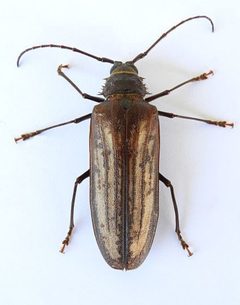
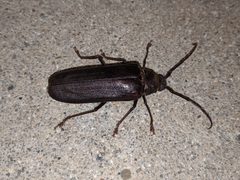
Trichocnemis is a of longhorn beetles (Cerambycidae) in the Prioninae. The genus contains two distributed in western North America: Trichocnemis pauper and Trichocnemis spiculatus (the ponderosus borer). Historically, species of Trichocnemis have often been treated as members of the genus Ergates, but modern taxonomic treatments separate them based on morphological differences including size, shape, and length. The larvae of T. spiculatus are notable wood-borers in ponderosa pine and inspired improvements to chainsaw design.
Pronunciation
How to pronounce Trichocnemis: /trɪkoʊkˈniːmɪs/
These audio files are automatically generated. While they are not always 100% accurate, they are a good starting point.
Identification
Trichocnemis is distinguished from the related Ergates by a proportionally smaller , shorter , and that are less than half the length of the head and curve inward. Beetles in this genus have large, elongated bodies in shades of brown, usually with lighter . They possess small heads with large . These morphological differences in body and leg structure are used by authors who recognize Trichocnemis as a separate genus.
Images
Distribution
Western North America from southwestern Canada to Baja California.
Host Associations
- Pinus ponderosa - larval Larvae of T. spiculatus are wood-borers in ponderosa pine
Life Cycle
Larvae are wood-borers that develop in dead or dying coniferous trees, particularly ponderosa pine. Larvae possess large, opposable adapted for gnawing through wood. The larval stage is notably large; mature larvae and pupae can be found in pupal within the wood of trees.
Ecological Role
As wood-boring insects, larvae contribute to the decomposition of dead and dying coniferous trees. The serves as prey for certain , including Cerceris fumipennis, which paralyzes and provisions nests with cerambycid beetles.
Human Relevance
The larval of Trichocnemis spiculatus inspired a significant technological innovation. In 1947, Joe Cox of Portland, Oregon, observed the opposable mandibles of the wood-boring larva and developed a new chainsaw chain design with alternating 'right' and 'left' cutting teeth. This design, manufactured initially as Oregon Sawchain Corporation and later Omark Industries, became an international standard. The is commonly known as the 'ponderosus borer' or 'ponderosa borer' reflecting its association with ponderosa pine.