
Lucanus capreolus
(Linnaeus, 1763)
reddish-brown stag beetle, pinching beetle
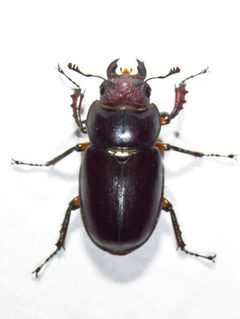
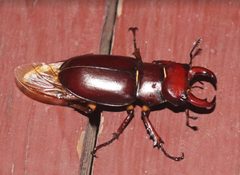
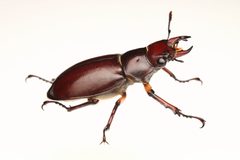
Lucanus capreolus is a large in the Lucanidae, native to eastern North America. Males possess elongated, curved resembling sickles or deer antlers, which they use in combat with other males at breeding sites. The exhibits pronounced , with males larger and more dramatically mandibled than females. Larvae develop in decaying wood of deciduous trees, taking approximately two years to mature.
Pronunciation
How to pronounce Lucanus capreolus: /luˈkanʊs kaˈpre.o.lus/
These audio files are automatically generated. While they are not always 100% accurate, they are a good starting point.
Identification
Males identified by moderately large, curved that are smaller than those of Lucanus elaphus and lack the teeth present on L. placidus. Orange-brown separate it from L. placidus, which has dark femora. Females lack prominent mandibles and resemble other large lucanids; association with males or larval provides supporting evidence.
Images
Habitat
Deciduous forests and adjacent edge . Breeds in decaying logs and stumps. Larvae inhabit inner wood of decaying deciduous trees. sometimes found in soil, mulch, or leaf litter near breeding sites.
Distribution
Eastern United States and southeastern Canada. Records from Alabama, California, Connecticut, Delaware, Idaho, Illinois, Indiana, Iowa, Kansas, Kentucky, Maryland, Massachusetts, Michigan, Missouri, Nebraska, New York, North Carolina, Ohio, Oklahoma, Pennsylvania, Rhode Island, South Carolina, Tennessee, Texas, Virginia, West Virginia, Wisconsin; and Ontario and Quebec, Canada. Western records (California, Idaho) likely represent introductions or misidentifications.
Seasonality
active primarily in late spring and summer. Attracted to lights at night. Larval development spans approximately two years.
Diet
Larvae feed on inner wood of decaying deciduous trees. feeding habits poorly documented; adults may consume little or no food.
Host Associations
- deciduous trees - larval developmentlarvae feed on decaying wood in trunks, logs, and stumps
Life Cycle
deposited in rotting wood. Larvae live in decaying wood, feeding and growing for approximately two years. occurs in nearby soil. emerge and disperse; lifespan as adults relatively brief.
Behavior
Males use to fight other males at breeding sites, grappling and attempting to flip opponents. attracted to lights at night. In captivity, adults have been observed to burrow in soil and mulch.
Ecological Role
Larvae contribute to wood decomposition in forest , processing decaying hardwood and recycling nutrients. serve as prey for vertebrate including birds and mammals.
Human Relevance
Occasionally kept in captivity by enthusiasts. can deliver a noticeable pinch if handled carelessly, though not medically significant. Attracted to outdoor lighting, bringing it into incidental contact with humans.
Similar Taxa
- Lucanus elaphusLarger with more dramatically enlarged male ; males of L. capreolus have distinctly smaller jaws
- Lucanus placidusSmaller with two or more teeth on male and dark (not orange-brown)
- Lucanus cervusEuropean not naturally occurring in North America; larger with different structure
Misconceptions
Despite the 'pinching ,' the of males are used primarily for male-male combat, not defense against humans. The pinch, while noticeable, is not dangerous.
More Details
Etymology
Specific epithet capreolus derived from Latin for 'roe deer' or literally 'little goat,' referring to the resemblance of male to deer antlers
Taxonomic history
Originally described by Linnaeus in 1763 as Scarabaeus capreolus in Centuria Insectorum