
Lucanus
Scopoli, 1763
stag beetles
Species Guides
4- Lucanus capreolus(reddish-brown stag beetle)
- Lucanus elaphus(Elk Stag Beetle)
- Lucanus mazama(Cottonwood Stag Beetle)
- Lucanus placidus(Smooth Stag Beetle)
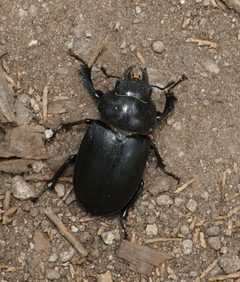
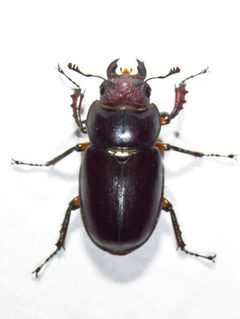
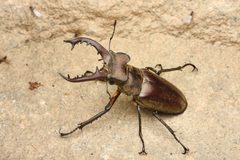
Lucanus is a of stag beetles ( Lucanidae) distributed across Europe and Asia, with well-documented in Europe (e.g., L. cervus) and Taiwan (e.g., L. kanoi complex). The genus includes the largest saproxylic beetles in Europe and is characterized by pronounced , particularly enlarged in males used in combat. Species are associated with mature forests containing decaying wood, which serves as larval .
Pronunciation
How to pronounce Lucanus: /luˈkaːnʊs/
These audio files are automatically generated. While they are not always 100% accurate, they are a good starting point.
Identification
Males distinguished by enlarged, often branched used in intraspecific combat; females possess smaller, more functional mandibles. Body robust, typically dark brown to black. Specific identification requires examination of mandible , genitalia, and in some cases molecular analysis (e.g., CO1, 16S rRNA, Wnt genes used for Taiwanese delineation).
Images
Habitat
Mature deciduous or mixed forests with abundant deadwood; European (e.g., L. cervus) occur in lowland to medium-altitude oak woodlands with rotten wood at ground level. Asian species (e.g., L. kanoi complex) occupy temperate old-growth forests at mid-elevations (1,569–2,564 m) and tropical broadleaf forests at lower elevations.
Distribution
Widespread in Europe (e.g., L. cervus throughout continent, syntopic with L. tetraodon in central Italy, replaced by latter in southern regions including Sicily); Taiwan (L. kanoi, L. piceus, L. ogakii, and L. k. kavulunganus) with discrete geographic ranges across island; additional Asian distribution records from GBIF include Denmark, Norway, Sweden, and Vermont, USA.
Seasonality
activity seasonally variable: in Europe, single males most commonly observed in July, male-female couples peak in June; timing likely varies by latitude and elevation across range.
Diet
feed on sap of trees and mature fruits; contact with these food sources observed in L. cervus. Larval diet unknown at level but presumed to feed on decaying wood based on saproxylic .
Behavior
Males exhibit aggressive including threatening displays (body and erected, wide open, legs raised) and physical combat (mandibles touching, crossed, or grasping opponent). Standing and behaviors for solitary individuals; reproductive behavior predominant in paired male-female encounters. Males show affinity for natural wood substrates; females prefer bare ground. Males more easily detected due to larger size and greater mobility; females more elusive.
Ecological Role
Largest saproxylic beetles in Europe; serve as umbrella for identification and conservation of suitable for other saproxylic beetles. Contribute to nutrient cycling through association with decaying wood systems.
Human Relevance
Subject of citizen science monitoring programs (e.g., photographic records of L. cervus in Italy spanning 1994–2022). Cultural interest due to impressive male . Conservation concern in parts of range due to loss from reduction in mature forest and deadwood availability.
Similar Taxa
- DorcusAnother with enlarged male ; distinguished by differences in mandible , body proportions, and genitalic structures requiring expert examination
- SinodendronSmaller with less pronounced ; males lack the dramatically enlarged characteristic of Lucanus
- LissotesAustralian ; geographic separation and distinct distinguish from Lucanus
More Details
Research methodology note
Behavioral data for L. cervus derived from repurposed citizen science distribution-monitoring images; acknowledged limitations include lack of detailed environmental cues and potential sex-based detection favoring males
Taxonomic complexity
Taiwanese L. kanoi includes cryptic diversity resolved through integration of morphological, biogeographical, and multi-gene molecular data (CO1, 16S rRNA, Wnt)
Sources and further reading
- BugGuide
- Wikipedia
- GBIF taxonomy match
- iNaturalist taxon
- NCBI Taxonomy
- Catalogue of Life
- Systematic revision and biogeography of the endemic Lucanus kanoi species complex (Coleoptera, Lucanidae) from Taiwan, with the description of a new subspecies.
- Recycle and reuse: an ethological perspective for citizen science data on Lucanus cervus (Coleoptera: Lucanidae).