
Lucanus elaphus
Fabricius, 1775
Elk Stag Beetle, Giant Stag Beetle
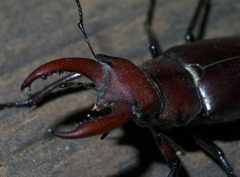
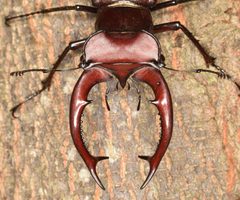
Lucanus elaphus is the largest in North America, reaching lengths up to 60 mm. Males possess prominent, curved used in combat with rival males. The inhabits hardwood forests of eastern North America where larvae develop in decaying wood. are primarily and have been documented flying at heights up to 15 meters along forest edges. trends remain poorly documented, though loss represents a potential conservation concern.
Pronunciation
How to pronounce Lucanus elaphus: /luːˈkaːnʊs ˈɛlaphʊs/
These audio files are automatically generated. While they are not always 100% accurate, they are a good starting point.
Identification
Males distinguished by large, antler-like with multiple teeth; females have smaller, functional mandibles. Body dark reddish-brown to black. recognized by large size (35–60 mm), making them the largest Lucanidae in North America. Males of the related Lucanus capreolus have shorter, less branched mandibles. Larvae morphologically indistinguishable from related ; molecular identification via COI gene sequencing required for definitive larval identification.
Images
Habitat
Mississippi floodplain forests and other hardwood-dominated lowland forests. Larvae recovered from wide range of log sizes and rot types, tunneling within wood or feeding beneath logs at the soil–wood interface. Requires adequate dead wood substrates and lowland forest cover.
Distribution
Eastern North America from southern Ontario south to Florida, west to Texas, Oklahoma, Kansas, Nebraska, and Minnesota. GBIF records document presence in 25 U.S. states plus Ontario, Canada.
Host Associations
- Zelia vertebrata - Tachinid fly of
Life Cycle
Development requires 1–2 years. Sex ratio 1:1. Larvae develop in decaying hardwood logs.
Behavior
males captured exclusively in intercept traps placed at 15 m height on forest edges, suggesting -level flight activity. Males use in combat with rival males.
Ecological Role
Larvae contribute to wood decomposition in forest .
Human Relevance
Sometimes kept as pets. Misidentified in some sources as "elephant ."
Similar Taxa
- Lucanus capreolusOverlapping range; males distinguished by shorter, less elaborately branched and generally smaller size
- Lucanus cervusEuropean ; not present in North America but frequently referenced in conservation literature due to documented declines
Misconceptions
Erroneously referred to as "elephant " in some sources; the specific epithet elaphus derives from Greek for deer (referring to elk/red deer), not elephant.
Sources and further reading
- BugGuide
- Wikipedia
- GBIF taxonomy match
- iNaturalist taxon
- NCBI Taxonomy
- Catalogue of Life
- Distribution ofLucanus elaphusLinnaeus (Coleoptera: Lucanidae) in North America
- Insights into the ecology, genetics and distribution of Lucanus elaphus Fabricius (Coleoptera: Lucanidae), North America's giant stag beetle