
Zelia vertebrata
(Say, 1829)
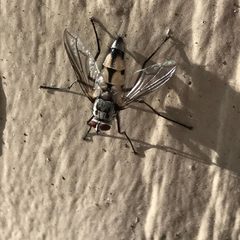
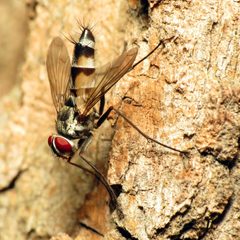
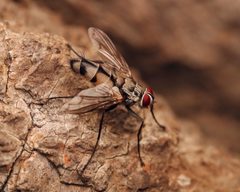
Zelia vertebrata is a of bristle fly in the Tachinidae, characterized by a long body, strong abdominal bristles, and a distinctive abdominal pattern resembling vertebrae. It is a targeting larvae in multiple families. The species has a widespread North American distribution and is most active during the day.
Pronunciation
How to pronounce Zelia vertebrata: //ˈze.li.a ˌvɛr.təˈbɹeɪ.tə//
These audio files are automatically generated. While they are not always 100% accurate, they are a good starting point.
Identification
Zelia vertebrata can be distinguished from similar tachinid flies by its long body, strong abdominal bristles, and distinctive abdominal pattern that resembles vertebrae.
Images
Distribution
Zelia vertebrata has a widespread North American range, with records from Washington to Maine in the east-west direction, and from Québec to Florida in the north-south direction. Additional records exist from Utah, Guatemala, and Mexico.
Host Associations
- Melanoplus femur-rubrum - (Orthoptera: Acrididae)
- Passalidae - larvae
- Scarabaeidae - larvae
- Tenebrionidae - larvae
- Cerambycidae - larvae
Life Cycle
Gravid females give birth to live larvae rather than near entrances of larval tunnels. The worm-like parasitic larvae crawl through host tunnels until encountering a host, which they burrow into. The parasitic larvae possess a modified with located on terminal abdominal segments, allowing them to breathe while almost entirely immersed in host tissue. As the larva grows within its host, it must disengage from the host's cuticular outgrowth to access untapped tissues.
Behavior
Most active during the day. Females exhibit live birth (viviparity) of larvae rather than laying .
Ecological Role
Saproxylic dependent on moist rotting wood as for its larval . Acts as a controlling of larvae in forest .
Similar Taxa
- Zelia species (undescribed)A morphologically similar fly was collected in the Red River Gorge, eastern Kentucky, and supported as a distinct by mitochondrial COI and morphological data.
Sources and further reading
- BugGuide
- Wikipedia
- GBIF taxonomy match
- iNaturalist taxon
- NCBI Taxonomy
- Catalogue of Life
- Vertebrata | Beetles In The Bush | Page 6
- Vertebrata | Beetles In The Bush | Page 7
- Vertebrata | Beetles In The Bush | Page 8
- Vertebrata | Beetles In The Bush | Page 9
- Vertebrata | Beetles In The Bush | Page 4
- Vertebrata | Beetles In The Bush | Page 5
- The Host of Zelia Vertebrata (Diptera, Dexlidae)