
Megacyllene antennata
(White, 1855)
Mesquite Borer
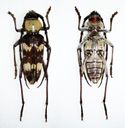
Megacyllene antennata is a longhorn beetle (Cerambycidae) native to the southwestern United States and Mexico. Larvae develop in woody tissues of mesquite trees (Prosopis spp., Fabaceae). males produce a blend containing (S)-α-terpineol and (E)-2-hexenol, which attracts both sexes. The was described by White in 1855 and is less boldly patterned than related eastern species such as M. robiniae and M. caryae.
Pronunciation
How to pronounce Megacyllene antennata: /mɛɡəˈsɪləni ænˈtɛnætə/
These audio files are automatically generated. While they are not always 100% accurate, they are a good starting point.
Identification
Megacyllene antennata can be distinguished from related by its less vivid coloration compared to the striking yellow-and-black banded patterns of M. robiniae (locust borer) and M. caryae (hickory borer). The elytral pubescent bands are narrower and less contrasting. Geographic range provides the most reliable separation: M. antennata occurs in the southwestern United States and Mexico, while M. robiniae and M. caryae are eastern species. Unlike M. caryae, which is active in spring, or M. robiniae, which is active in fall, the activity period of M. antennata has not been explicitly documented in available sources.
Images
Habitat
Arid and semi-arid regions of the southwestern United States and Mexico, specifically areas where mesquite trees (Prosopis spp.) occur. Mesquite-dominated woodlands, riparian corridors, and desert scrub with sufficient woody to support larval development.
Distribution
Southwestern United States (Arizona, New Mexico, Texas) and Mexico. Records exist from Arizona and Texas; the ' range corresponds broadly with that of its plant Prosopis.
Diet
Larvae feed on woody tissues of mesquite trees (Prosopis spp., Fabaceae). The specific feeding habits of have not been documented.
Host Associations
- Prosopis - larval woody tissues
Behavior
males produce a sex-specific blend containing (S)-α-terpineol, (E)-2-hexenol, (S)-limonene, terpinolene, (R)-1-phenylethanol, 2-phenylethanol, (E)-2-hexenal, and 1-hexanol. Field demonstrate that synthetic reconstructions of this blend attract both males and females, with strongest attraction to blends where (S)-α-terpineol and (E)-2-hexenol approach equal ratios. These pheromone components are common natural products not present in plant volatile emissions.
Ecological Role
Wood-boring whose larvae contribute to decomposition of mesquite wood and nutrient cycling in desert and semi-arid woodland .
Similar Taxa
- Megacyllene robiniaeSimilar banded elytral pattern, but occurs in eastern North America, is active in fall, and has broader, more complete yellow bands on ; breeds in black locust (Robinia pseudoacacia)
- Megacyllene caryaeSimilar overall appearance, but occurs in eastern North America, is active in early spring, and often has reddish legs and alternating yellow-white elytral bands; breeds in hickory (Carya spp.) and related
- Megacyllene decoraLarger and more boldly marked than M. antennata; occurs in regions of range overlap but has more vivid coloration
Sources and further reading
- BugGuide
- Wikipedia
- GBIF taxonomy match
- iNaturalist taxon
- Catalogue of Life
- When is a locust borer not a locust borer? | Beetles In The Bush
- Megacyllene comanchei revisited | Beetles In The Bush
- The Common Natural Products (S)-α-Terpineol and (E)-2-Hexenol are Important Pheromone Components of Megacyllene antennata (Coleoptera: Cerambycidae)