
Cyrtinus
LeConte, 1852
Species Guides
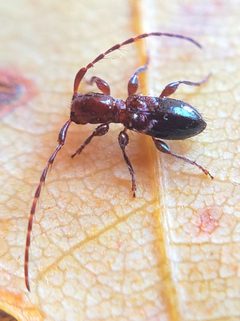
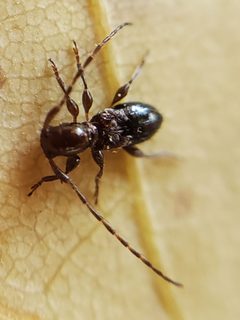
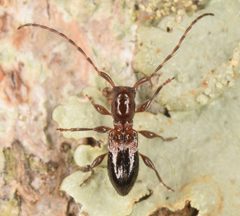
2Cyrtinus is a of minute longhorn beetles (Cerambycidae: Lamiinae) comprising approximately 30 described distributed across the Americas. The genus is notable for containing some of the smallest members of the , with of certain species measuring only 2–3 millimeters in length. Species occur in eastern North America, the Caribbean, Central America, and South America. The type species, Cyrtinus pygmaeus, is among the smallest North American cerambycids and exhibits effective mimicry.
Pronunciation
How to pronounce Cyrtinus: //sɪrˈtaɪ.nəs//
These audio files are automatically generated. While they are not always 100% accurate, they are a good starting point.
Identification
are distinguished from other Lamiinae by their extremely small size (2–5 mm), compact body form, and frequent -mimetic appearance. Many possess humped with prominent or humps near the bases, creating the illusion of a narrow-waisted ant. The elytra often bear bands or patches of white or pale . are relatively short for cerambycids. The combination of small size, compact form, and ant-like appearance separates Cyrtinus from other North American Lamiinae such as Leptostylus.
Images
Habitat
are associated with dead wood of hardwood trees. Cyrtinus pygmaeus has been reared from dead branches of river birch (Betula nigra), chinquapin oak (Quercus muhlenbergii), willow oak (Quercus phellos), and black oak (Quercus velutina). are found on dead twigs and branches among ants.
Distribution
The occurs in the eastern United States (Cyrtinus pygmaeus), Jamaica (C. jamaicensis, C. granulifrons, C. sandersoni, C. farri), and extends through Central and South America with numerous described from Venezuela and elsewhere in the Neotropics.
Host Associations
- Betula nigra - larval reared from dead branches
- Quercus muhlenbergii - larval reared from dead branches
- Quercus phellos - larval reared from dead branches
- Quercus velutina - larval reared from dead branches
Life Cycle
Larvae develop within dead branches and twigs of hardwood trees. emerge from wood and have been observed in association with small ants such as Lasius americanus.
Behavior
of Cyrtinus pygmaeus move slowly and clumsily, resembling the movement of small ants rather than the rapid, frenetic movement typical of most cerambycid beetles. This slow movement enhances their mimicry. When disturbed, they do not readily take but instead maintain their ant-like appearance.
Ecological Role
As larvae, contribute to wood decomposition by tunneling in dead branches. The -mimetic appearance of suggests a defensive against .
Similar Taxa
- EudercesBoth are small, -mimicking cerambycids, but Euderces are generally larger, more active runners, and possess different antennal and elytral proportions.
- CyrtophorusSimilar -mimetic appearance with humped , but Cyrtophorus are larger and have distinct morphological differences in pronotum shape.
- TilloclytusSmall -mimicking cerambycids with similar preferences, but Tilloclytus have more elongated bodies and different elytral markings.
- LeptostylusBoth are Lamiinae associated with dead wood, but Leptostylus are substantially larger (typically 10–20 mm), lack mimicry, and have mottled bark-like coloration.
Sources and further reading
- BugGuide
- Wikipedia
- GBIF taxonomy match
- iNaturalist taxon
- Catalogue of Life
- Cerambycidae | Beetles In The Bush | Page 10
- The “silky-bellied humpbacked” ant | Beetles In The Bush
- Flower ants? Check again! | Beetles In The Bush
- August | 2015 | Beetles In The Bush
- JAMAICAN CYRTINUS, WITH DESCRIPTIONS OF TWO NEW SPECIES (COLEOPTERA: CERAMBYCIDAE)