
Euderces
LeConte, 1850
Species Guides
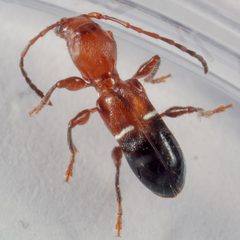
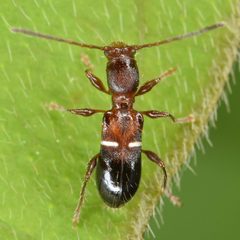
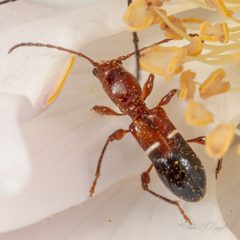
4Euderces is a of small longhorn beetles in the Cerambycidae, characterized by remarkable -mimicry. Most measure less than 5 mm in length and exhibit of ants, particularly species of Camponotus. The genus has its center of diversity in southern Mexico and Guatemala, with species distributed from North America through South America. Notable examples include E. velutinus, which closely resembles the tropical ant Camponotus sericeiventris. Four species occur in the United States.
Pronunciation
How to pronounce Euderces: /juːˈdɜːrsiz/
These audio files are automatically generated. While they are not always 100% accurate, they are a good starting point.
Identification
Distinguished from true ants by: present (ants have membranous wings or wingless ), not elbowed (though may appear so), and body not actually constricted at waist (only appears so due to pubescent markings). Distinguished from other -mimic cerambycids by small size, specific pattern of elytral humps and , and association with particular ant models. Euderces picipes shows geographic color variation (all-black north, red-black southwest). E. reichei and E. velutinus are tropical with specific ant model associations. Separation from Molorchus, Tilloclytus, and Cyrtophorus requires examination of elytral hump configuration, antennal structure, and precise pattern of pubescent markings.
Images
Habitat
found on flowers of flowering trees, particularly dogwood (Cornus florida), and on dead twigs and branches. Larval is wood-boring in dead or dying hardwood branches. Associated with forested environments where trees and model co-occur. Adults often encountered on low vegetation and tree trunks where ants forage.
Distribution
New World distribution: North America, Central America, and South America. Center of diversity in southern Mexico and Guatemala. Four recorded from the United States. Species documented from Colorado, Vermont, and throughout eastern North America southward through the Neotropics.
Seasonality
activity primarily in spring. E. pini active March to June. E. reichei and related active during peak flowering of trees (early May in temperate regions). Activity period coincides with flowering of dogwood and other host plants, and with of model species.
Diet
feed on pollen and nectar from flowers of various trees and shrubs, including dogwood (Cornus florida), hawthorn (Crataegus), and dandelion (Taraxacum). Larvae bore in dead hardwood branches, feeding on wood; recorded include pecan (Carya illinoinensis), winged elm (Ulmus alata), American beech (Fagus grandifolia), and various oaks.
Host Associations
- Cornus florida - food sourceflowering dogwood, major site
- Crataegus - food sourcehawthorn flowers
- Carya illinoinensis - larval pecan
- Ulmus alata - larval winged elm
- Fagus grandifolia - larval American beech
- Camponotus sericeiventris - mimicry modelmodel for E. velutinus and other tropical species
Life Cycle
Complete . Larvae are wood-borers in dead branches of hardwood trees. occurs within larval galleries. emerge to feed on flowers, mate, and oviposit into suitable material. Specific developmental timing varies by and latitude.
Behavior
exhibit slow, deliberate movement that enhances -mimicry effectiveness—distinctly slower than typical cerambycid and more similar to that of ants. Adults frequently encountered on flowers, where they may be mistaken for ants by casual observers. When disturbed, behavior reinforces ant-like appearance. Mimicry appears to be primarily visual, based on body form, coloration, and movement pattern.
Ecological Role
As larvae, contribute to decomposition of dead hardwood branches in forest . As , minor of flowering trees. -mimicry provides protection from visual that avoid ants. Part of diverse guild of ant-mimetic insects in Neotropical and Nearctic forests.
Human Relevance
Not considered agricultural or forest pests. Occasionally encountered by entomologists and naturalists due to effective mimicry; frequently overlooked because of small size and -like appearance. Subject of interest in studies of and evolutionary . Some (e.g., E. pini) documented in urban and suburban settings.
Similar Taxa
- MolorchusSimilar small size and -mimicry; distinguished by different elytral hump configuration and typically more convex body profile
- TilloclytusSimilar -mimicry and flower-visiting ; distinguished by different pattern of elytral markings and hump structure
- CyrtophorusSimilar -mimicry and wood-boring larvae; C. verrucosus distinguished by more pronounced thoracic features and different associations
- CyrtinusExtremely small -mimic cerambycids; Cyrtinus pygmaeus is smaller (2-3 mm), in Lamiinae rather than Cerambycinae, with different ant model (Lasius americanus)
Misconceptions
Frequently mistaken for actual ants by observers, including experienced entomologists, due to highly effective mimicry. The name "velutinus" and similar epithets refer to the velvety appearance matching that of model ants, not to any taxonomic relationship with velvet ants (Mutillidae).
More Details
Mimicry specificity
Different Euderces mimic different species. E. velutinus specifically mimics Camponotus sericeiventris, a large, conspicuous tropical ant with silky-golden abdominal . This specificity suggests close coevolutionary or ecological association between particular and ant species.
Taxonomic history
E. velutinus was originally described as Eplophorus velutinus (Fisher 1931). E. cleriformis was originally described as Apilocera cleriformis. These transfers reflect improved understanding of relationships within Tillomorphini.
Collection challenges
The effectiveness of -mimicry makes these beetles difficult to collect in standard surveys. They are frequently overlooked on beating sheets and in visual searches. Best collected by careful examination of flowers during peak bloom, or by rearing from dead branches of known trees.
Sources and further reading
- BugGuide
- Wikipedia
- GBIF taxonomy match
- iNaturalist taxon
- NCBI Taxonomy
- Catalogue of Life
- Bug Eric: That's Not an Ant?!
- Flower ants? Check again! | Beetles In The Bush
- Formicidae | Beetles In The Bush | Page 2
- North America’s itsiest bitsiest longhorned beetle | Beetles In The Bush
- Beetle Collecting 101: How to pin a beetle | Beetles In The Bush