
Euderces pini
(Olivier, 1795)
Euderces pini is a small longhorned beetle in the Cerambycidae, notable for its striking -mimicking appearance. measure 7–8 millimeters in length with slender bodies. The occurs in the southern half of the eastern United States, with adults active from March to June. Larvae develop in various hardwood trees including Flowering Dogwood, Pecan, Winged Elm, and American Beech. Adults frequently visit flowers to feed on pollen and nectar, including dandelions before native trees bloom. The species is not considered an agricultural or forestry pest.
Pronunciation
How to pronounce Euderces pini: /juːˈdɛrsiːz ˈpaɪnaɪ/
These audio files are automatically generated. While they are not always 100% accurate, they are a good starting point.
Identification
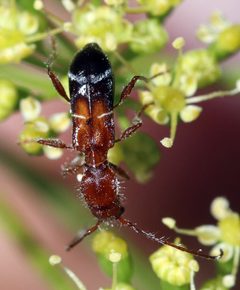
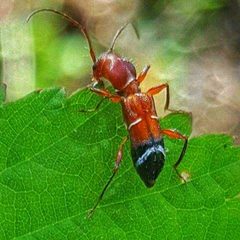
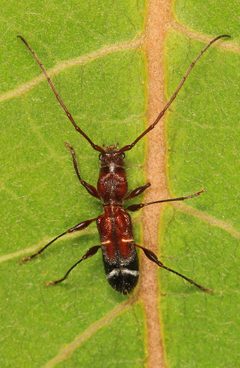
Euderces pini can be distinguished from other small cerambycids by its pronounced -mimicking : slender body, 7–8 mm length, and white streaks or bars on the that create the illusion of body segmentation. These markings mimic the constricted waist (petiole) of ants, with the appearing as an enlarged ant and the elytra suggesting thorax and . The true head is relatively small and directed downward. The runs rapidly and flies well, consistent with its ant-like disguise. It is more slender than the related Cyrtophorus verrucosus (9 mm) and larger than Psenocerus supernotatus (4 mm).
Images
Distribution
Southern half of the eastern United States, ranging from eastern parts of the country west to Texas.
Seasonality
active from March to June, with peak abundance in early spring.
Diet
feed on pollen and nectar from flowers, including dandelions and other early spring blooms. Larvae bore in wood of various hardwood trees.
Host Associations
- Flowering Dogwood - larval
- Pecan - larval
- Winged Elm - larval
- American Beech - larval
- persimmon - rearing have been reared on persimmon trees
Life Cycle
Complete with larval boring stage in hardwood trees and in spring. Specific pupal chamber construction and duration of developmental stages not documented.
Behavior
are frequently found on flowers. The exhibits -mimicry in body form and movement, including rapid running . Adults have been observed on the ground in woodland settings, such as on bark of fallen branches.
Ecological Role
Larvae function as wood-borers in dead or dying hardwood trees, contributing to nutrient cycling and wood decomposition. serve as when visiting flowers for nectar and pollen.
Human Relevance
Not considered a pest . Occasionally encountered by entomologists and naturalists due to its -mimicking appearance, which may cause initial misidentification.
Similar Taxa
- Cyrtophorus verrucosusSimilar -mimicking longhorned beetle, but larger (9 mm vs. 7–8 mm) and with different elytral markings
- Psenocerus supernotatusSmaller -mimicking cerambycid (4 mm) with similar body plan but reduced size and different associations
- Euderces other species share -mimicking and require close examination for identification