
Cyrtophorus verrucosus
(Olivier, 1795)
Ant-like Longhorn Beetle, Ant-mimic Longhorn Beetle
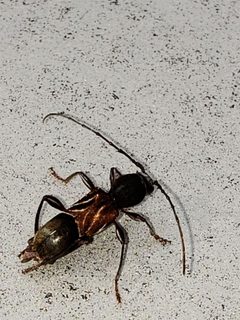
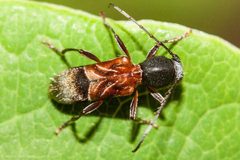
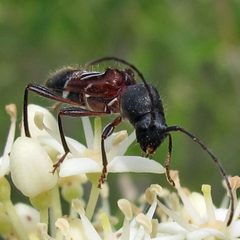
Cyrtophorus verrucosus is a small longhorn beetle (Cerambycidae) remarkable for its specialized mimicry, including ant-like movement patterns. The exhibits color with red and black morphs, each thought to mimic different Camponotus ant species. feed on pollen and nectar from spring flowers, while larvae develop in dead wood of various hardwood trees. Native to eastern North America and southern Canada, this is most active in early spring and serves as a useful for forest quality.
Pronunciation
How to pronounce Cyrtophorus verrucosus: //sɜrˈtɒfərəs vɛrˈrukəsəs//
These audio files are automatically generated. While they are not always 100% accurate, they are a good starting point.
Identification
Distinguished from true ants by: concealed small directed downward (ants have exposed head with elbowed ); lack of constricted petiole between and (markings create illusion but true constriction absent); presence of (hardened wing covers) rather than exposed membranous wings or wingless condition of ants. Separated from other -mimic cerambycids (Euderces, Tilloclytus, Molorchus) by pronotal knobs, specific white setal pattern, and larger size relative to Euderces and Molorchus. Distinguished from Tilloclytus geminatus by different elytral marking pattern (oblique vs. transverse ) and association with flowers.
Images
Habitat
Deciduous forests; urban forest fragments; areas with abundant spring-flowering trees and shrubs. frequently found on spring flowers. Larval development occurs in dead portions of living trees, dead stems in contact with moist soil, and dead scar tissue following damage. Specific microhabitats include: lower portions of thick dead stems; transition zones between living and rotting root tissues; dead wood of various hardwood .
Distribution
Eastern North America from southern Canada (Ontario, Quebec, New Brunswick, Nova Scotia, Manitoba, Alberta) through eastern United States; most abundant in Carolinian Forest region, Great Lakes-St. Lawrence region, and areas along Lake Ontario, Lake Huron, and Niagara Peninsula. Western limit in Canada extends to Alberta. Range has contracted in Ontario due to loss.
Seasonality
active March through July, with peak abundance in early spring (April-May). period and vary geographically. Activity triggered by spring flowering of plants.
Diet
feed on pollen and nectar extracted from spring flowers of various tree and shrub . Larvae feed on wood of dead or dying hardwood trees and shrubs.
Host Associations
- Acer - larval maple
- Betula - larval birch
- Cercis - larval redbud
- Ulmus - larval elm
- Carya - larval hickory
- Quercus - larval oak
- Castanea - larval chestnut
- Cornus - larval dogwood; also observed on flowers
- Fagus - larval American beech
- Pinus - larval pine; less common
- Shepherdia canadensis - larval roots
- Vaccinium corymbosum - larval lower dead stems
- Hamamelis virginiana - larval dead scar tissue
- Celtis occidentalis - larval dead scar tissue
- Platanus occidentalis - floral sycamore
- Juglans nigra - floral black walnut
- Fraxinus - floral ash
Life Cycle
Complete . Larvae develop in wood of trees, typically in dead portions of living trees, dead stems retaining moisture, or dead scar tissue. Larvae have been observed in root tissues and lower stem portions. emerge in spring and are active during daylight hours. Specific details of and stages not well documented.
Behavior
Specialized mimicry includes not only visual resemblance but ant-like movement patterns. run rapidly and fly well. Adults attracted to ethanol emissions from stressed trees, using this cue to locate potential larval even in absence of signals. Males produce - ((R)-3-hydroxyhexan-2-one and nonan-2-one) to attract females. Adults frequently found on flowers, suggesting regular nectar and pollen foraging .
Ecological Role
Larvae function as wood decomposers in forest , contributing to nutrient cycling. serve as of spring-flowering trees and shrubs, facilitating cross-pollination and plant reproductive success. Used as bioindicator for forest quality and biodiversity due to specific habitat requirements and ease of sampling.
Human Relevance
Not considered an agricultural or forestry pest despite larval wood-boring habit, as are typically non-commercial hardwood or already damaged trees. Used in ecological research as indicator of quality and forest biodiversity. Subject of scientific interest regarding mimicry evolution and chemical of communication.
Similar Taxa
- Euderces piniSimilar -mimic longhorn beetle but smaller (7-8 mm), more slender, with different pronotal structure and elytral markings; occurs in southern half of eastern United States
- Tilloclytus geminatus-mimic cerambycid with different elytral marking pattern (oblique markings creating waist illusion vs. transverse markings in C. verrucosus); less frequently associated with flowers
- Molorchus bimaculatusSmall -mimic cerambycid (<10 mm), common on flowering trees in early spring, but with different body proportions and elytral pattern
- Psenocerus supernotatus-mimic longhorn beetle (Currant-tip Borer) with extremely small directed downward and hidden by pronotum, but much smaller (4 mm) and with different overall proportions
More Details
Conservation Status
declines documented in Ontario region (approximately 10% decline), attributed to fragmentation and loss of forest cover for agriculture and urban development. is considered sensitive to environmental change and serves as a reliable indicator of health.
Research Applications
chemistry has been studied for potential use in multi- attractants for cerambycid beetle monitoring. Ethanol-baited traps combined with pheromone blends are effective for studies.