
Molorchus bimaculatus
Say, 1824
Bimaculate Longhorn Beetle
Species Guides
3- Molorchus bimaculatus bimaculatus(ant-mimic longhorned beetle)
- Molorchus bimaculatus corni
- Molorchus bimaculatus semiustus
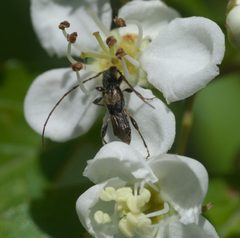
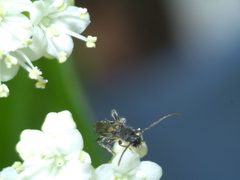
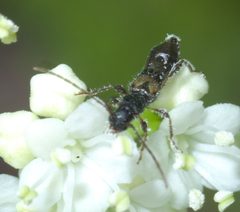
Molorchus bimaculatus is a small longhorned beetle in the Cerambycidae, described by Thomas Say in 1824. exhibit Batesian mimicry, with a convex body profile and markings that create the illusion of a constricted waist. The is commonly found on flowering trees during early spring, particularly in eastern North America. Larvae develop within the woody tissues of hardwood trees and lianas.
Pronunciation
How to pronounce Molorchus bimaculatus: /mɔˈlɔʁ.kʊs ˌbɪ.mæ.kjʊˈleɪ.təs/
These audio files are automatically generated. While they are not always 100% accurate, they are a good starting point.
Identification
Distinguished from true ants by convex body profile and from other -mimicking cerambycids in the same by specific elytral markings. Resembles other Molorchus and Euderces species, which also occur on flowering dogwood. Distinguished from Tilloclytus geminatus by smaller size and less convex profile; T. geminatus appears 'too big and convex' to be Molorchus.
Images
Appearance
Small , less than 10 mm in length. Body convex in profile, resembling ants in size and shape. Markings on the include oblique markings that create the illusion of a constricted 'waist' and transverse markings resembling the sheen of a shiny .
Habitat
Hardwood forests and areas with flowering trees. Associated with ligneous parts of hardwood trees and lianas for larval development. frequent flowers of various tree .
Distribution
Eastern North America. Recorded from Missouri, Vermont, and across eastern United States. Distribution includes Canada (present) and United States.
Seasonality
Active in early spring. commonly observed in early May in Missouri, coinciding with peak bloom of flowering dogwood (Cornus florida).
Diet
Larvae feed within ligneous parts of hardwood trees and lianas such as Vitis. feed on flowers of various tree including Rhus, Prunus, Malus, and Cornus.
Host Associations
- Vitis - larval lianas
- Rhus - food sourceflowers
- Prunus - food sourceflowers
- Malus - food sourceflowers
- Cornus - food sourceflowers, especially Cornus florida
- Cornus florida - food sourceflowering dogwood; commonly visited in early May
Life Cycle
Larvae develop within woody tissues of hardwood trees and lianas. emerge in early spring and are active on flowering trees. Specific details of and -laying not documented in available sources.
Behavior
exhibit of ants, likely providing protection from . Adults frequent flowers, where they feed. When searching for the , observers report learning to recognize them quickly without close examination of every '' encountered.
Ecological Role
Larval boring in hardwood trees contributes to wood decomposition and nutrient cycling. flower-feeding may contribute to pollination, though this has not been quantified. mimicry represents a defensive against .
Human Relevance
Subject of entomological study due to mimicry. Occasionally encountered by naturalists and photographers seeking cerambycid beetles on spring-blooming trees. No documented economic importance as pest or beneficial .
Similar Taxa
- Euderces spp.Also common on flowering dogwood, similar -mimicking appearance and flower-visiting
- Tilloclytus geminatusAlso -mimicking cerambycid, but larger and more convex in profile; not frequently associated with flowers
- Cyrtophorus verrucosusRelated -mimicking longhorned beetle in Cerambycinae, also collected on dogwood flowers
More Details
Taxonomic history
Described by Thomas Say in 1824, one of the earliest American entomologists.
Research significance
Used as a comparative example in studies of -mimicry among cerambycid beetles, particularly in relation to floral attraction patterns in Cerambycinae versus Lamiinae .